“Delicate, simple, gratifying. . . . From Oklahoma to London, Hebrew to Sanskrit, the King James Bible to William Wordsworth’s daffodil poem, the setting and context add entire dimensions to the collection…. I found myself re-reading and basking in my favorite lines.”—Associated Press
“Tender. . . . Deeply felt.”—Publishers Weekly
“What a beautiful poem. . . Both the title and the poem do what I think good poems do, they enact rather than describe. . . . you’re in the experience of what I think of as deep connection and pleasure and the ecstatic in the bigger sense.”—Kevin Young, The New Yorker Poetry Podcast
“Intimate. . . . This book moves with deceptive directness and ease, giving way to a significant record of lyric inquiry.”—Lit Hub, A Best Poetry Collection of September
“Touching.”—Shelf Awareness
“Antrobus captures ordinary life with an episodic, unconstrained energy.”—The Guardian
“Quietly and sincerely circles fatherhood in every language possible, including the titular signs and music.”—Poetry Northwest
“Antrobus’ lyrical verse moves like a delicate but unflinching whisper, guiding readers through a journey that is deeply personal yet universally resonant.”—Adroit Journal
“Reading Raymond Antrobus’s Signs, Music, was an exhilarating (re)ride into the wonders and terrors of becoming a new parent. It’s hard to explain how much parenting can change a person, but Antrobus succeeds: “I broke up/with announcing my convictions and good news/on the internet I broke up with talking to myself/as if I’m not there I broke up with people-pleasing/and the trembling boundary between life and still life.” Here is a beautiful mapping of a journey of this life that becomes this life in all of its anaphoric radiance. Each letter in these poems is bursting at the seams.”—Victoria Chang, author of With My Back to the World
“Told with frankness and a masterful wielding of image, Signs, Music is so tenderly rendered
that I found myself gasping”. —Shira Erlichman, author of Odes to Lithium
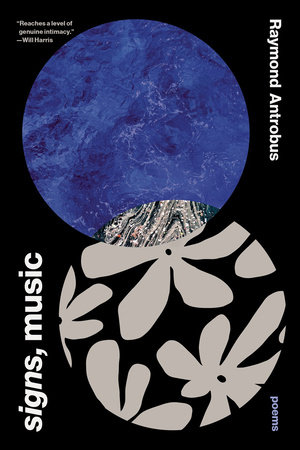
“Raymond Antrobus’s Signs, Music is unlike any poetry about becoming a father I’ve read. A report from two different countries—the land before birth and afterwards—the strength of this book comes from what it lets stand: half-thoughts, snatched conversations, hard memories. Caffeinated anticipation gives way to exhaustion and wonder, and a darker strain of introspection. The transition from fatherlessness to fatherhood isn’t smoothed over, but the son’s birth allows for a reconfiguration of relationships—with Antrobus’s mother, with the city he grew up in. ‘They’ve always been here,’ he writes. ‘I’m just / moving slowly enough to see them.’ Here is a book of slow seeing which reaches a level of genuine intimacy.” —Will Harris, author of Rendang and Brother Poem
“Signs, Music wades devotedly through weathers of joy, grief, wonderment and terror—all of which arise as fleetingly on the page as they do in the throes of new parenthood. Vulnerable and hopeful, though never expectant of certainty or utopia, Signs, Music is a prayer for a world that might yet look tenderly upon young black life.” —Victoria Adukwei Bulley, author of Quiet
“In this honest, witty and humane book, Antrobus brilliantly pins down the before and after of parenthood—and the uncrossable gap between the two. These poems manage to look both backwards and forwards: at who we were, who we are and who we hope to be.”—Joe Dunthorne, author of O Positive
“Stunning in its concise clarity, Signs, Music testifies to more than the process of becoming a parent for the first time. It bravely parents author and reader alike through the undeniable parallels between childhood and personhood, father-making and nation-making, while documenting the often hidden and inextricable relationship between violence and tenderness and the brutal necessity of both in the transition from human to caregiver. ‘I keep asking people about children. / How do you keep them alive?’ In his attention to sound, space, and language, Antrobus remains innocent and present, never naive, gently pointing to what we might drop from our language if we want to be remade. This is an incredible follow-up to his previous hat trick of collections”. —Marwa Helal, author of Ante body







 QUICK VIEW