Today, June 10th 2015, would have been Saul Bellow’s 100th birthday. In celebration of his of his life, we reached out to Beena Kamlani, Bellow’s editor, to reflect on the writer’s life and influence.
Bellow @ 100: Some Reminiscences and Thoughts
To read Bellow is to be struck. As by a meteor, a thunderbolt, or something from some indefinable source. You are suddenly in possession of knowledge that comes from elsewhere—as if gifted. Stunned and blessed—how often does this happen to us in our lives? I speak from experience. I read him when I was eight. The book was Herzog. We preferred to read because TV in Bombay, India, was grainy and unpredictable. From the Hardy Boys to Enid Blyton, from Jane Austen to H. Rider Haggard—there was nothing that was considered unacceptable, and nothing that turned us off. But the world opened up for me when I came to Herzog. For it spoke about things no one had ever spoken about before. Its openness bowled me over.
Saul Bellow’s editor, Beena Kamlani
I was eight. It was a hard book to read as a child. The intellectual discourses in the letters Moses Herzog wrote were confusing and frustrating, for one didn’t know any of the references. But its truth was unassailable. Perhaps a child can grasp such things more easily than an adult for here was Moses remembering his childhood, the youngest in a family of four children, an immigrant family struggling to make it in immigrant Chicago, describing the helplessness of a child who sat in full knowledge of the struggles and challenges that faced them. These challenges colored his experience of childhood. Persistent failure rubbed shoulders with success; dashed dreams and thwarted ambitions made near impossible lives already brought low by sickness, the deaths of close family members, and sheer survival. Simple existence had to be constantly redefined, rearticulated, reimagined.
In our family, too, there were deaths, divorces, and the effects of failure. Illness and sudden loss were common. Mourning bore witness but the questions multiplied. No one said a word in the mistaken belief that children ought to be protected from the truth. But there, in the kitchen of Moses Herzog’s home on Napoleon Street, in immigrant closeness and proximity, there are no secrets and the children come to know everything because it’s happening in front of them. It is the source of his intimate knowledge about a child’s world, filled with uncertainty, frustration, knowledge that is useless in the present but becomes part of our psychic calibration later, and the constant threat of abandonment. “We were like cave dwellers,” Moses says. We, too, become cave dwellers with him as we hear his pain about losing a beloved wife to a best friend, about the terrible longing for his daughter, and listen to him rage in loneliness against the world. There is the unforgettable scene in that kitchen when Father Herzog comes home robbed and beaten after a bootlegging expedition. “’Sarah!’ he said. ‘Children!’ He showed his cut face. He spread his arms so we could see his tatters, and the white of his body under them. Then he turned his pockets inside out—empty. As he did this, he began to cry, and the children standing about him all cried. It was more than I could bear that anyone should lay violent hands on him—a father, a sacred being, a king. Yes, he was a king to us. My heart was suffocated by this horror. I thought I would die of it. Whom did I ever love as I loved them?” Beckett, writing about Proust, said, “Yesterday is not a milestone that has been passed, but a daystone on the beaten track of the years, and irremediably part of us, within us, heavy and dangerous.” In Herzog, Bellow shows us how to record our pasts, how to transcribe them, how to live with them, even when they threaten to wreck us.
Photo credit: Beena Kamlani
Bellow concerned himself with what affected people, in the way they lived their lives, and in the way they dealt with the struggles of the heart. He had a real feeling for it, which is why his work leaves such a mark. He taps corresponding notes in another’s life. He is able to articulate what we know but cannot decipher for ourselves. “Every writer’s assumption is that he is as other human beings are, and they are more or less as he is. There’s a principle of psychic unity. [Writing] was not meant to be an occult operation; it was not meant to be an esoteric secret.”
Memory becomes the key to unlocking those crossover truths from writer to reader. You not only become a cave dweller in that kitchen but you also recognize the truth of what’s happening when the older Moses takes you into the kitchen of his home where these struggles took place. You trust the sensibility and the mind of the older Moses, remembering, seeing his family again, and as a reader you find equivalent emotional hotspots in your own life, hotspots that take you right into the heart of Saul’s work.
In the world I grew up in, girls are handed knowledge in breadcrumbs. It is a privilege, a gift. Boys can expect it by the sackful, for it is necessary to live life, to bring forth families and to support them. What Bellow does is to hand us all this gift.
When I was working with him, every night, weary with the challenges and exhilarations of the work, we would wind down for the day and hand the manuscript to his wife, Janis, for safekeeping. He had gone, as usual, close to the fire, and it had taken a lot out of him. We worked on hard copy, and it was the only extant copy of the manuscript. The vault she placed it in was none other than the freezer, for this is the last place to be attacked by fire. That act of reverence and preservation was necessary—for the present, yes, but also for posterity. For those words, cooling in their frozen vault, would become jewels for readers in the future, illuminating and warming them as we ourselves had been.
Years later, I told him I’d read him when I was eight. “It was Herzog,” I said. He looked at me incredulously. “You don’t say!” he said. Then he put his fingers on the table where we were working and playfully drummed them against the wooden surface. “And here we are!” he said.
-Beena Kamlani
Browse through all of Bellow’s work here.
In The Knockoff, by Lucy Sykes and Jo Piazza, Imogen Tate is a highly accomplished fashion editor at the top of her game, in spite of the fact that she is a bit tech-challenged (she’s barely mastered e-mail). Eve Morton is her ambitious assistant at Glossy magazine. When Imogen returns from a leave of absence, Eve has taken over and is determined to turn the beautiful pages of Glossy into an app.
Imogen has to reinvent herself in ways she never imagined as she struggles to re-gain control of the magazine. Office politics have never been quite so stylish.
Lucy Sykes is the former fashion director of Marie Claire and Rent the Runway. Jo Piazza is the Managing Editor of Yahoo Travel. It’s a co-author match made in heaven: The Knockoff is filled with insider dish on the worlds of fashion and tech.
Here are a few of their favorite things to do, see, and read–offline as well as online.
LUCY AND JO’S FAVORITE THINGS
Jo’s Favorites
1. Favorite sites and apps
I travel so much that most of my favorite sites and apps are things I can use on the go. I use Buddhify to meditate on the road.
I am an NPR addict so I have the WNYC app, but then I individually have the This American Life and The Moth apps, which I listen to constantly while I travel.
My favorite hotel booking app is Hotel Tonight for last minute booking (and I am almost always last minute). I use City Maps to get around in a new place and I am obsessed with the Go Pro app.
2. Favorite offline things to do with friends
Yoga, cooking dinner, skiing.
Also…seeing how long we can go without looking at our phones.
3. Favorite books about women in the workplace
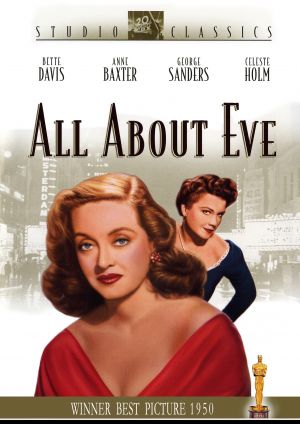
The play All About Eve inspired so much of The Knockoff that we have to mention it here (in addition to the movie).
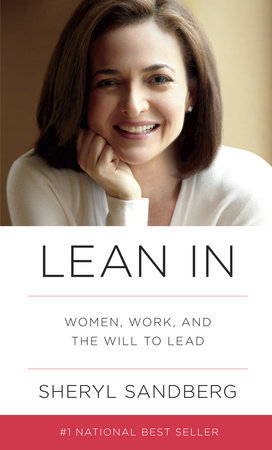
I am obsessed with Girl Boss right now. I think Sophia Amoruso is my spirit animal.
I also love Kelly Cutrone’s If You Have to Cry Go Outside
4. Favorite movies about women in the workplace
I remain obsessed with the movie Working Girl (Oh the shoulder pads!)
9 to 5 (obviously)
Baby Boom (First time I girl-crushed on Diane Keaton!)
Legally Blonde
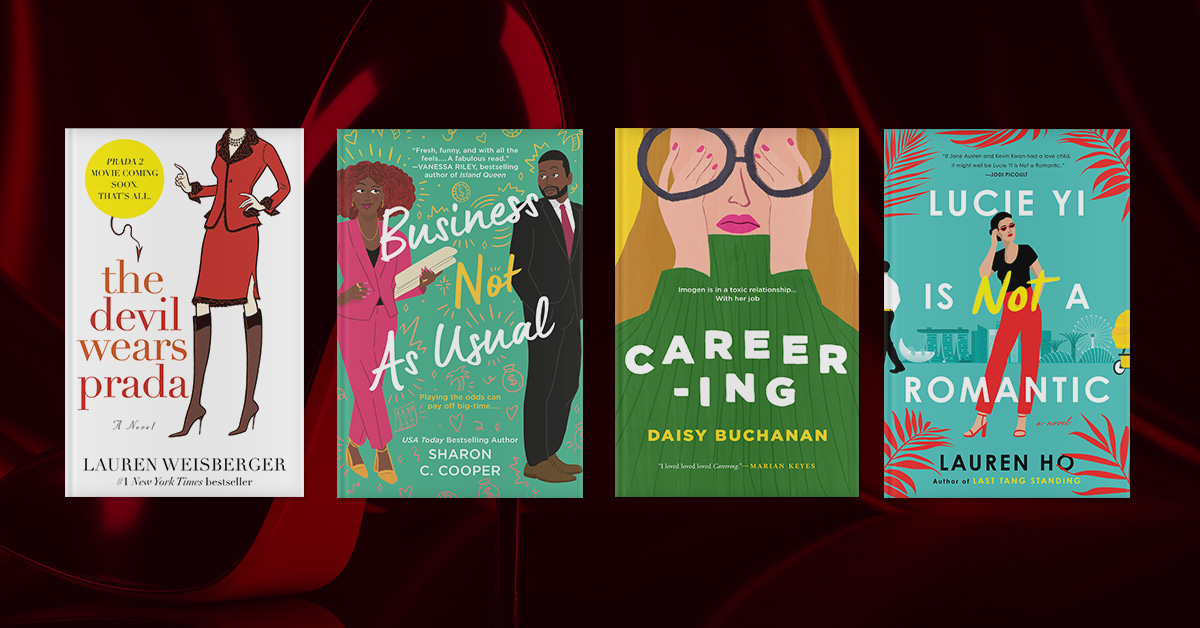
The Devil Wears Prada
Lucy’s Favorites
1. Favorite sites and apps
My Flybarre App is friendly, quick, and simple. It makes working out seem easy!
My Instagram is right up there–being a visual person and having the attention span of a gnat, it gives me a jolt of excitement 4 or 5 times a day. Does that sound naughty?
Netflix is so amazing. I get into bed and put my headphones on and I am off on a fascinating bizarre creepy story while my boys watch boring football–perfect!
2. Favorite offline things to do with friends
I adore Flybarre an amazing super hectic sexy boot camp/ballet class–all the rage in NYC. I have taken all my friends and my husband!
I adore cooking for a dinner party, totally from scratch, once a week. I call it farm stand to table, as I buy everything from Farmer Harry down the road. I also love to buy vintage cocktail glasses and old silver. Lots of white flowers and candles are my tricks to making a pretty table.
Hanging with my family–all the cousins, aunties and uncles and grandparents. Watching my elder son become a passionate sportsman and a good guy. Seeing my young son playing the part of Lysander was a first, and making fairy cakes with him –and eating all the mixture first.
3. Favorite books about women in the workplace
All About Eve (Well, the play is as good as a book–it’s so sharp, timeless and true!
Hop in the Backlist Time Machine! This feature is where Penguin Random House staff members recommend their favorite backlist titles – instead of the next best thing, these are the best old things. Sometimes we peer into the past on our own, to give a little extra attention to a book that still holds uptoday.
We asked one of our employees, Linda Cowen: SVP, Associate General Counsel in the Legal department, to share a favorite backlist book. She’s even memorized the first few lines of the book – see what she wrote below.
Justine, by Lawrence Durrell:
“The sea is high again today, with a thrilling flush of wind. In the midst of winter you can feel the invention of Spring. A sky of hot nude pearl until midday, crickets in sheltered places, and now the wind unpacking the great planes, ransacking the great planes.”
Why this book/lines?
I love fiction that doesn’t have a straight narrative/chronological plot. For instance, I love books of linked short stories where you don’t realize how the characters are connected until several stories in. Justine is the first book in Durrell’s Alexandria Quartet, which consists of four linked novels. They all tell a version of the same events from the points of view of four different characters, and in a slightly different style. You can’t get the whole picture unless you read all four, but also each stands on its own. And for Durrell, the city itself was the most important character. It’s quite magical, especially because pre-WWII Alexandria simply doesn’t exist in the same way anymore.
Of the four books Justine is the most lyrical, which makes sense because Justine herself is the most inscrutable character. These books also bring me back to when I first read them, in my early 20s, traveling for six weeks in Greece, a completely improvised trip. Even in the mid-1980s you could still go somewhere not too far away but be very remote, almost like time travel. I like to revisit them every few years, like visiting old friends, and also my own past. With that first line I’m immediately transported. My favorite edition is the Penguin Ink edition, with cover art by Robert Ryan. It’s just gorgeous and so evocative of the time. Just looking at it makes me want to start reading. I have a copy in my office.
– Linda F. Cowen
SVP, Associate General Counsel
Inspired by Justine? If you’re starting to dream of Egypt, Fodor’s has a great guide to Alexandria.





 When I was working with him, every night, weary with the challenges and exhilarations of the work, we would wind down for the day and hand the manuscript to his wife, Janis, for safekeeping. He had gone, as usual, close to the fire, and it had taken a lot out of him. We worked on hard copy, and it was the only extant copy of the manuscript. The vault she placed it in was none other than the freezer, for this is the last place to be attacked by fire. That act of reverence and preservation was necessary—for the present, yes, but also for posterity. For those words, cooling in their frozen vault, would become jewels for readers in the future, illuminating and warming them as we ourselves had been.
Years later, I told him I’d read him when I was eight. “It was Herzog,” I said. He looked at me incredulously. “You don’t say!” he said. Then he put his fingers on the table where we were working and playfully drummed them against the wooden surface. “And here we are!” he said.
-Beena Kamlani
Browse through all of Bellow’s work here.
When I was working with him, every night, weary with the challenges and exhilarations of the work, we would wind down for the day and hand the manuscript to his wife, Janis, for safekeeping. He had gone, as usual, close to the fire, and it had taken a lot out of him. We worked on hard copy, and it was the only extant copy of the manuscript. The vault she placed it in was none other than the freezer, for this is the last place to be attacked by fire. That act of reverence and preservation was necessary—for the present, yes, but also for posterity. For those words, cooling in their frozen vault, would become jewels for readers in the future, illuminating and warming them as we ourselves had been.
Years later, I told him I’d read him when I was eight. “It was Herzog,” I said. He looked at me incredulously. “You don’t say!” he said. Then he put his fingers on the table where we were working and playfully drummed them against the wooden surface. “And here we are!” he said.
-Beena Kamlani
Browse through all of Bellow’s work here.