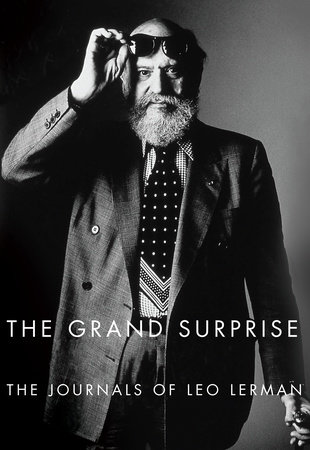
“Engrossing . . . In his review of Period Piece [a memoir by Charles Darwin’s granddaughter], Lerman endorsed ‘wit’ and ‘humor’ in books of recollections, and there is no shortage of either here. . . . The Grand Surprise exemplifies the qualities that Lerman himself sought out in the autobiographies and life recollections that he–an astonishingly successful autodidact with no more than a high school education–so avidly read: wit, respect for time past, profound feeling, a lack of cheap sentimentality, and above all an abiding sense, when others might have become jaded, of deep ‘wonder’ at the haut monde (as he liked to put it) of Art and Society to which he had struggled so hard to gain access. . . . To my mind, what makes The Grand Surprise most worth reading for anyone interested in the substance, rather than the coruscating surface, of the times and culture it describes is the scintillant quality of Lerman’s critical acumen. To read this book is, as it were, to witness a meteor shower of casually tossed-off insights into dance, theater, film, music, art, and literature of his day, and of the past. . . . I savored every page of his remarkable private writings . . . . “
–Daniel Mendelsohn, The New York Review of Books
“The Grand Surprise [is] a magnificent arrangement of [Leo Lerman’s] unpublished memoirs and correspondence. . . . Stephen Pascal, Lerman’s assistant for more than 12 years . . . deciphered and edited his former mentor’s journal’s with [Lerman’s longtime partner Gray] Foy’ s help and privy knowledge, and hunted down hundreds of Lerman’s letters. In The Grand Surprise, Pascal resurrects and imposes order on a dazzling life in the scene-stealing language of the man who lived it. . . . Lerman [once complained] ‘I am fat with words.’ Pascal has reshaped Lerman’s reminiscences into a heroic physique, and given his subject the posthumous consolation that a hope he confided to himself late in life, in a notebook he did not know would be found, was true: ‘I did do something extra: I lived. I will live.’ . . . . Lerman’s parties attracted everyone from magazine editors and writers to Maria Callas, Anaïs Nin, Margot Fonteyn, Frederick Ashton, Cecil Beaton, Diana and Lionel Trilling, Aaron Copland, Gloria Steinem and Leonard Bernstein. . . . Lerman knew absolutely everyone, and what’s more, absolutely everyone knew him. . . . In his notebooks, he could convey an entire life in a sentence, in a clause, or even in one word. . . . Anaïs Nin wrote of him in a diary entry that he ‘talks like Oscar Wilde, but has a warmth in his glittering dark eyes,’ and that his conversation evoked a ‘magician’s tour de force.’ . . . ‘And all you remember is the fantasy, the tale, the laughter.’ In these pages, Lerman’s words put the fantasy on paper. . . . Lerman mused late in life, ‘the final desolation comes with the realization that life is like fiction.’ His certainly was. But even as The Grand Surprise invites the reader backstage to revisit the illustrious dramatis personae of his memory, it also reveals the private heart of a public man. . . . In 1948, in an acid vignette he published in Vogue, [Truman] Capote gave a thinly veiled portrait of Lerman, disguising him as a popular party-giver named Hilary. . . . ‘Hilary so wants everyone to be glamorous, to be a storybook creature; somehow he persuades himself that the grayest folk are coated with legend-making glitter.’ But reading this book, you are tempted to conclude that it was Capote’s gray that was an illusion; the glitter was real. You just had to be Leo Lerman to see it.”
–Liesl Schillinger, The New York Times Book Review, cover
“You couldn’t have written for a living in New York during the last third of the twentieth century without having heard of–and probably from–Leo Lerman. The bearded and ebullient features editor of Vogue was forever on the freelancer phone, putting out a fire or starting one . . . And when he wasn’t on the phone, he was discovering something marvelous or meeting someone sexy at the ballet, the theater, the opera, or the ‘Fashion and Surrealism’ exhibit at the Fashion Institute of Technology . . . Lerman–born poor in Spanish Harlem; raised ambitious in Jackson Heights, Queens; done with classrooms after high school, a graduate of fashion magazines, émigré salon culture, and a 1930s New York underground of drag clubs and homosexual speakeasies; Jewish, gimpy, autodidactic, and ‘queer’ (his word); a quick study and glad hand, with his Turkish cap, purple sheets, and ‘royalist fantasies’–this Leo embodied upward mobility, class transgression, and theatrical reincarnation . . . And for more than half a century, from his first Vogue assignment in 1941 to his deathbed in 1994, he kept brilliant notes on what Beauty and Legend looked like before vulgarians stormed glam gates. Naturally, when some of your best friends are Maria Callas, Marlene Dietrich, and Truman Capote, the gossip is salacious. Naturally, if you invite Imogen Coca, Lionel Trilling, and Anaïs Nin to the same party in 1946, or Robert Motherwell, Leontyne Price, and Si Newhouse in 1964, or Martha Graham, Woody Allen, and Lillian Hellman in 1976, some chairs will be broken, and some hearts too.”
–John Leonard, Harper’s
“Lerman’s diaries, interspersed with his correspondence and an unfinished memoir, form a rich, occasionally rueful mosaic of a man who collected friendships the way those around him collected wealth or accolades, and who, most of the time, seemed to find his life the better for it. . . . Lerman was at the center of fashionable New York society for almost fifty years, thanks to work at such magazines as Vogue and Mademoiselle. The son of a housepainter in East Harlem, Lerman was drawn to ‘the surface glitter’ of the élite, and he helped launch the careers of countless singers, writers, actresses, and artists. He was known for frugal but grand soirées– Marlene Dietrich emptied the ashtrays at one; William Faulkner stood in line with Maria Callas for Chinese food at another–but he never entirely lost his sense of being an outsider, or his feeling that magazine work was a distraction from ‘a life of letters.’”
–The New Yorker
“The Grand Surprise, with an intoxicating mix of gossip, anecdotes and character sketches, will be for many a grand surprise. Lerman writes with just the right touch of brio and bite as he evokes a vanished time.”
–Robert Osborne, The Wall Street Journal
“[Lerman] knew everyone who mattered among the culturati of the mid-20th century, and his personal observations of them, and of the nature of art itself, form a chronicle that Proust might have envied. It truly is a grand surprise.”
–Amanda Vaill, Town and Country
“A literate, gossipy read about the rich, famous and talented.”
–Forward
“Lerman’s once secret journals are dish to die for.”
–Advocate
“Compelling . . . full of wit and insight. . . . Many of us fantasize about having dinner parties with favorite icons as our guests, but this was reality, not fantasy, for Leo Lerman, a gay writer and editor at Condé Nast from 1941 until his death in 1994. He became renowned for the parties he hosted for the luminaries of his day. . . . While hobnobbing with the cultural elite, Lerman wrote detailed journal accounts of his life, and those writings have been compiled by Stephen Pascal, [Lerman’s] assistant for 12 years, into The Grand Surprise. . . . [The] book paints a clear picture of the writer’s life and cultural observations. Born in 1914, New York, Lerman grew up in a lower middle-class Jewish family. High school was his only formal education, but he devoured books, avidly reading everything from Virginia Woolf’s novels to Marcel Proust’s Remembrance of Things Past. Lerman ‘dreamed of becoming his generation’s Proust,’ Pascal writes in the introduction. He wrote journals for ‘documentation,’ Pascal says, to use later as source material for a Proustian novel about his time. While Lerman never achieved this monumental task, reading his journals, written between 1941 and 1993, reveals a fascinating impression of not only his life but also the cultural landscape of the latter half of the 20th century . . . Lerman leaves behind an entertaining legacy, and a valuable remembrance of things past.”
–Kathi Wolfe, The New York Blade
“Lerman [once] told [Paul] Bowles that his stories were like Chinese boxes, each opening into another–and that at the end there was nothing. Bowles remembered that sharp sting [for 30] years. That was the power of Lerman’s reach as a critic and tastemaker, a power he had exerted through magazines like Vogue and Vanity Fair. Now his diary, The Grand Surprise, shows us not only the Lerman of glittering parties, openings, first nights, and famous friends, but a private man with an inner core far deeper than his surface life would ever have suggested. . . . ‘Leo’s book was a revelation to me,’ I said on a visit to Gray Foy, Lerman’s lifelong companion. ‘It was a revelation to me too,’ he said.”
–Frederic Tuten, New York magazine
“There is great dish here and also great heart. . . . Leo Lerman knew everyone from Cary Grant to Diana Vreeland to David Hockney to Steve Martin. Among his closest friends were Truman Capote, Marlene Dietrich, Maria Callas, and Diana Trilling. He has great stories to tell about them all. He is always, even in these private journals (and letters), more courteous than catty, a curious and humorous observer. . . . He wrote about his world of art, theater, celebrities, glamour, for several Condé Nast publications from the late 1940s to the early 1990s in short bursts of lively prose. . . . [Yet his] greatest accomplishments were as an inspired party giver, grateful guest, loyal friend, and sympathetic confidant. . . . He remained attached to his powerful New York Jewish family, faithful to his life-long partner, and true to his own personal vision.”
–Barbara Fisher, The Boston Globe
“Leo Lerman was the last of the Condé Nast mandarins–an industrious aesthete with a lapidary eye for the latest nugget of high culture that could be polished up for the slick pages of Vogue. For more than a half-century, he knew everybody in the incestuous world of the arts and the rich in Manhattan and beyond, entertained most of them, and gossiped about all of them. . . . Confected by Mr. Pascal from [hundreds of Lerman’s] notebooks, along with snippets from letters that [he] wrote to Marlene Dietrich and others he loved the most, The Grand Surprise is an evocation of a lost world of the arts that rivals the Goncourt brothers’ portrait of 19th-century Paris. Through Lerman’s pages parade Truman Capote and Tennessee Williams, Hemingway and Faulkner, Maria Callas and Greta Garbo, Norman Mailer and Dietrich, a drunken Marion Davies, a gaga Evelyn Waugh and a flabby-armed Nancy Reagan. . . . Delicious giblets bob in the soup of names. . . . At once charming and insufferable, Lerman was a rhapsodic collector of pals, lovers, knickknacks, talent, wit and memories. He never hid his lower-middle-class Jewish roots or his homosexuality, but he could be bitchy. . . . [Lerman] was a brilliant and authentic self-invention–son of a house painter, born on East 107th St. in Manhattan and raised in Jackson Heights, Queens . . . [He] lived the life he dreamed of, and wound up leaving us a superb secret history of the culture of our times.”
–Edward Kosner, The Wall Street Journal
“A compulsively readable storehouse of outrageous anecdote and sexual revelation, of shrewd comment and keen-eyed description . . . Leo Lerman spent his adult life working for glossy fashion magazines such as Vogue, Mademoiselle and Harper’s Bazaar. Late in his career, he was briefly the editor of Vanity Fair during its difficult rebirth. . . . [He] essentially devoted his adult life to the New York social whirl. . . . His Rolodex was the envy of lesser mortals. Marlene Dietrich, Maria Callas, Lincoln Kirstein, Truman Capote, Diana Vreeland and dozens of other eminences would call him up to chat. . . . A dazzling life, it would seem . . . And yet the pages of The Grand Surprise reveal a man assailed by the conviction that he has frittered away years on over-rich lunches at the Russian Tea Room and sold his talent for a mess of pottage. . . . Though he clearly worked hard at his articles, profiles and book reviews, Lerman’s secret ambition was to be a novelist, possibly even a great one like his beloved Proust. . . . Nothing ever came of [his] efforts. . . . But over the years Lerman did squirrel away notes, diaries and letters, not to mention party invitations, and these Stephen Pascal has ably edited in The Grand Surprise. . . . Lerman is adept at capturing a passing figure with an apt smile or comparison. . . . Sometimes, you can hardly believe the shameless name-dropping or the catty remarks. . . . The Grand Surprise is full of delicious anecdotes about shallow, venal, power-mad, sex-crazed and often unlikable people.”
–Michael Dirda, Washington Post Book World
“[The Grand Surprise] is sequined with [Leo Lerman’s] dazzling friends, but Leo himself is the best company, startlingly self-aware, ecstatic in the presence of beauty, abidingly tender about the love of his life, the artist Gray Foy, and gallant in the face of pain. Anyone at all familiar with what the Buddhists call the vicissitudes of living–gain and loss, fame and disrepute, praise and blame, pleasure and sorrow–will hear in his sensible talking to himself the voice of the wise uncle he was to so many.”
–Amy Gross, Vanity Fair