





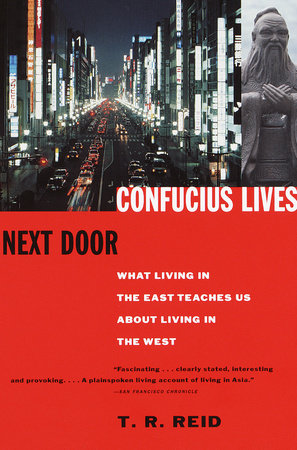

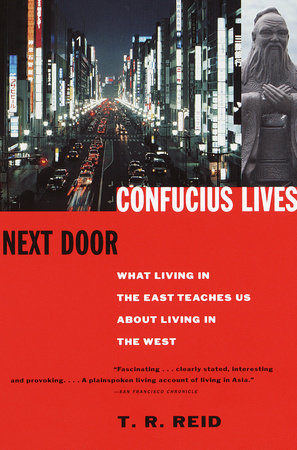
Those who’ve heard T. R. Reid’s weekly commentary on National Public Radio or read his far-flung reporting in National Geographic or The Washington Post know him to be trenchant, funny, and cutting-edge, but also erudite and deeply grounded in whatever subject he’s discussing. In Confucius Lives Next Door he brings all these attributes to the fore as he examines why Japan, China, Taiwan, and other East Asian countries enjoy the low crime rates, stable families, excellent education, and civil harmony that remain so elusive in the West. Reid, who has spent twenty-five years studying Asia and was for five years The Washington Post’s Tokyo bureau chief, uses his family’s experience overseas–including mishaps and misapprehensions–to look at Asia’s "social miracle" and its origin in the ethical values outlined by the Chinese sage Confucius 2,500 years ago.
When Reid, his wife, and their three children moved from America to Japan, the family quickly became accustomed to the surface differences between the two countries. In Japan, streets don’t have names, pizza comes with seaweed sprinkled on top, and businesswomen in designer suits and Ferragamo shoes go home to small concrete houses whose washing machines are outdoors because there’s no room inside. But over time Reid came to appreciate the deep cultural differences, helped largely by his courtly white-haired neighbor Mr. Matsuda, who personified ancient Confucian values that are still dominant in Japan. Respect, responsibility, hard work–these and other principles are evident in Reid’s witty, perfectly captured portraits, from that of the school his young daughters attend, in which the students maintain order and scrub the floors, to his depiction of the corporate ceremony that welcomes new employees and reinforces group unity. And Reid also examines the drawbacks of living in such a society, such as the ostracism of those who don’t fit in and the acceptance of routine political bribery.
Much Western ink has been spilled trying to figure out the East, but few journalists approach the subject with T. R. Reid’s familiarity and insight. Not until we understand the differences between Eastern and Western perceptions of what constitutes success and personal happiness will we be able to engage successfully, politically and economically, with those whose moral center is governed by Confucian doctrine. Fascinating and immensely readable, Confucius Lives Next Door prods us to think about what lessons we might profitably take from the "Asian Way"–and what parts of it we want to avoid.
When Reid, his wife, and their three children moved from America to Japan, the family quickly became accustomed to the surface differences between the two countries. In Japan, streets don’t have names, pizza comes with seaweed sprinkled on top, and businesswomen in designer suits and Ferragamo shoes go home to small concrete houses whose washing machines are outdoors because there’s no room inside. But over time Reid came to appreciate the deep cultural differences, helped largely by his courtly white-haired neighbor Mr. Matsuda, who personified ancient Confucian values that are still dominant in Japan. Respect, responsibility, hard work–these and other principles are evident in Reid’s witty, perfectly captured portraits, from that of the school his young daughters attend, in which the students maintain order and scrub the floors, to his depiction of the corporate ceremony that welcomes new employees and reinforces group unity. And Reid also examines the drawbacks of living in such a society, such as the ostracism of those who don’t fit in and the acceptance of routine political bribery.
Much Western ink has been spilled trying to figure out the East, but few journalists approach the subject with T. R. Reid’s familiarity and insight. Not until we understand the differences between Eastern and Western perceptions of what constitutes success and personal happiness will we be able to engage successfully, politically and economically, with those whose moral center is governed by Confucian doctrine. Fascinating and immensely readable, Confucius Lives Next Door prods us to think about what lessons we might profitably take from the "Asian Way"–and what parts of it we want to avoid.
Author
T.R. Reid
T.R. Reid is the author of five books in English and two in Japanese. Through his reporting for The Washington Post, his syndicated weekly column, and his light-hearted commentary from around the world for National Public Radio, he has become one of America’s best-known foreign correspondents. Reid lives in London.
Learn More about T.R. ReidYou May Also Like
 QUICK VIEW
Hard Landing
Paperback
$23.00
QUICK VIEW

Every Drop for Sale
Ebook
$14.99
QUICK VIEW
Churchill and Orwell
Paperback
$18.00
QUICK VIEW

The Oil and the Glory
Ebook
$13.99
QUICK VIEW
You Belong in a Zoo!
Ebook
$5.99
QUICK VIEW
Uses of Disorder
Ebook
$14.99
QUICK VIEW

Bully Boy
Ebook
$14.99
QUICK VIEW
Superpower
Ebook
$13.99
QUICK VIEW

Stand Before Your God
Paperback
$17.00
QUICK VIEW
FDR’s Folly
Paperback
$20.00


×