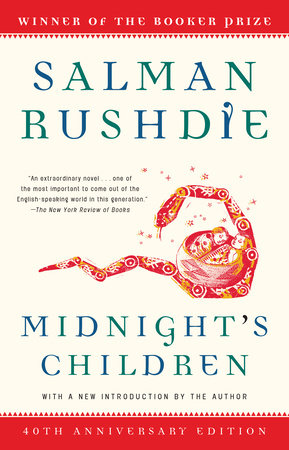
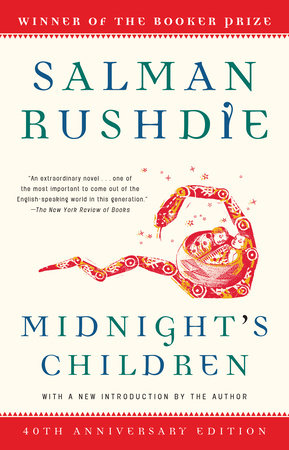
“BEST OF THE BOOKER” AWARD WINNER • This towering classic of international literature is at once a riveting family saga and an astonishing evocation of a vast land and its people.
“One of the most important books to come out of the English-speaking world in this generation.” —The New York Review of Books
Saleem Sinai, the hero of Midnight’s Children, is one of the thousand and one children born in India at the stroke of midnight on August 15, 1947, the dawn of its independence from British rule—the moment, in the words of its first prime minister, Jawaharlal Nehru, when India had her “‘tryst with destiny.'” The twists and turns of this destiny form the springboard from which Salman Rushdie launches into his celebrated fantasia of our modernity.
At once a fairy tale, a furious political satire, and a meditation on the ways in which time and change both shape and are shaped by the life of a single individual, Midnight’s Children announced the triumphant return of epic storytelling to our highly evolved literary tradition. With its central themes of displacement and indeterminacy, and its highly original use of a polyglot vocabulary absorbed form three distinct but overlapping cultures, this book anticipated and to a certain extent defined the multifarious, dislocated, ever-expanding world in which, increasingly, we all live.
Midnight’s Children won the Booker Prize in 1981 and then in 2008 it was named “‘The Best of the Booker,'” the best book to have won the prize in the forty years of its existence.”
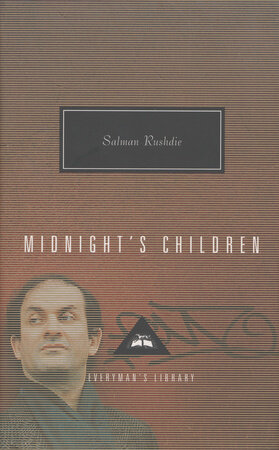
Everyman’s Library pursues the highest production standards, printing on acid-free cream-colored paper, with full-cloth cases with two-color foil stamping, decorative endpapers, silk ribbon markers, European-style half-round spines, and a full-color illustrated jacket. Contemporary Classics include an introduction, a select bibliography, and a chronology of the author’s life and times.






 QUICK VIEW