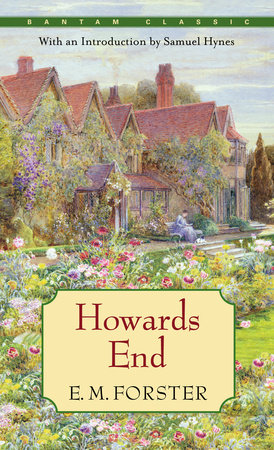
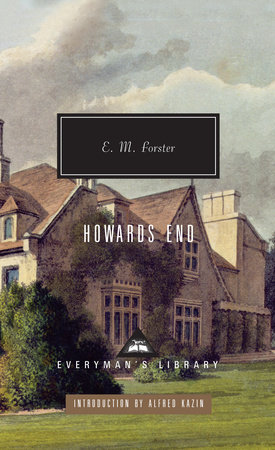
First published in 1910, Howards End is the novel that earned E. M. Forster recognition as a major writer. Soon to be a limited series on Starz.
At its heart lie two families—the wealthy and business-minded Wilcoxes and the cultured and idealistic Schlegels. When the beautiful and independent Helen Schlegel begins an impetuous affair with the ardent Paul Wilcox, a series of events is sparked—some very funny, some very tragic—that results in a dispute over who will inherit Howards End, the Wilcoxes’ charming country home.
As much about the clash between individual wills as the clash between the sexes and the classes, Howards End is a novel whose central tenet, “Only connect,” remains a powerful prescription for modern life.
Introduction by Alfred Kazan
(Book Jacket Status: Not Jacketed)
Author
E.M. Forster
Edward Morgan Forster was born on January 1, 1879, in London and was raised from infancy by his mother and paternal aunts after his father’s death. Forster’s boyhood experiences at the Tonbridge School, Kent, were an unpleasant contrast to the happiness he found at home, and his suffering left him with an abiding dislike of the English public school system. At King’s College, Cambridge, however, he was able to pursue freely his varied interests in philosophy, literature, and Mediterranean civilization, and he soon determined to devote his life to writing. His first two novels, Where Angels Fear to Tread (1905) and The Longest Journey (1907), were both poorly received, and it was not until the publication of Howards End, in 1910, that Forster achieved his first major success as a novelist, with the work many considered his finest creation. Forster first visited India during 1912 and 1913, and after three years as a noncombatant in Alexandria, Egypt, during World War I and several years in England, he returned for an extended visit in 1921. From those experiences came his most celebrated novel, A Passage to India, his darkest and most probing work and perhaps the best novel about India written by a foreigner. As a man of letters, Forster was honored during and after World War II for his resistance to any and all forms of tyranny and totalitarianism, and King’s College awarded him a permanent fellowship in 1949. He spent his later years at Cambridge writing and teaching, and died in Coventry, England, on June 7, 1970. His novel, Maurice, written several decades earlier, was published posthumously in 1971.
Learn More about E.M. ForsterAuthor
E. M. Forster
E. M. Forster (1879–1970) was born Edward Morgan Forster in London. He attended Tonbridge School as a day boy and went on to King’s College, Cambridge, in 1897. With King’s he had a lifelong connection and was elected to an Honorary Fellowship in 1946. Forster wrote six novels, four of which appeared before World War I: Where Angels Fear to Tread (1905), The Longest Journey (1907), A Room with a View (1908), and Howard’s End (1910). An interval of fourteen years elapsed before he published A Passage to India. It won both the Prix Femina Vie Heureuse and the James Tait Black Memorial Prize. Finished in 1914, his novel on homosexual themes, Maurice, was published in posthumously in 1971. He also published two volumes of short stories; two collections of essays; a critical work, Aspects of the Novel; The Hill of Devi, a fascinating record of two visits Forster made to the Indian state of Dewas Senior; two biographies; two books about Alexandria (where he worked for the Red Cross during World War I); and, with Eric Crozier, the libretto for Benjamin Britten’s opera Billy Budd. The Times called him “one of the most esteemed English novelists of his time.”
Learn More about E. M. Forster