READERS GUIDE
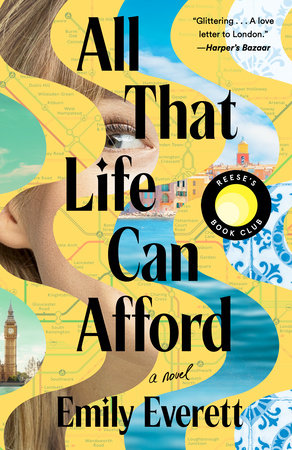
In Conversation with Emily Everett
What inspired you to write All That Life Can Afford?
This book was inspired by my own experiences living in London in my early twenties, teaching SAT prep in fancy boarding schools and tutoring for wealthy families. At first I just wanted to write about London as a way to get back to that time: I loved my years there, that exciting, exploratory time when you’re figuring out the world and where you belong in it, and how you’re going to make a life (and a living!). But I knew it would also be a great way to examine class and wealth and privilege, since class is so much more defined in Britain compared to the U.S. London is home to some of the richest people in the world, and they have access to a side of the city that I certainly didn’t, as a broke grad student. I only caught glimpses of it, through the well-off students I tutored for. This book was a chance to explore that other London (and Saint-Tropez, and Lisbon!) I’d always been curious about, and to see how seductive and corrupting it might be. And, of course, it was 2021 when I first thought of the book, and post-pandemic travel hadn’t really opened up yet—so this was the closest I could get to seeing Europe!
Did you have a favorite character to write? If so, who were they, and why were they your favorite?
I really loved writing Faye, honestly. Even though she’s a bit of a villain, she starts out as a classic frenemy, and that is such a fun thing to write! It was tricky to get her character correct, and we tweaked her a lot in editing, but I wanted to keep her complex and conflicted: I think she really does like Anna, but also maybe envies her a little, or wants credit for Anna’s success. Writing Faye’s backhanded compliments and snide remarks was a really delightful challenge for me. Most of all, I loved writing how she moved through the world—like she’s untouchable, like the world will just mold itself to her whims. That kind of supreme confidence is so fun to inhabit.
My other favorite was Pippa. Her character is sort of a blend of two tutoring students I really enjoyed teaching, both from very wealthy, eccentric families. Pippa has that same untouchable confidence that Faye does, but without the nasty edge. Whenever I laughed out loud writing this book, it was always because of Pippa. She has a witty, sarcastic humor, but it’s never unkind. I love the bond that she and Anna built together.
Once Anna starts working for the Wilders, she meets a wide array of people who come from wealth and privilege. Was any of this world inspired by your own experiences in London?
When I was SAT tutoring in London, I was constantly surprised by the wealth I encountered. I’ll never forget when one of my students took out an iPad to use as a calculator in a math lesson. iPads were brand new back then and cost about as much as my rent for a month. And I did find myself traveling abroad to fancy homes, on occasion, for tutoring jobs, though I never got to stay as long as Anna does! But for that week or two, I got to pretend I lived like those families do, and it was glorious. Not because I coveted their wealth, but because I was worry-free while I was with them, at least financially. I did worry about delivering good SAT scores!
A funny thing about tutoring is that you’re really inside the family unit; you’re in their house, you hear arguments, you see what’s for dinner. I felt like I could write those kinds of families, show that they have real lives and real feelings, even if they do live well. It would be so uninteresting if the Wilders were just a caricature of a rich family. I also didn’t want to caricature the new friends that Anna makes through the Wilders. I had friends in London who came from wealthier families, and our days weren’t so different—we all went for drinks at the pub, spent sunny days in the park, went to the movies. I always felt that the main difference between us wasn’t how we lived but what we worried about. Which is to say that I assumed they had less to worry about. They could more easily pay their bills, weather periods of underemployment, pay for emergency expenses or a flight home. I felt they had a freedom I didn’t, and it was mostly a freedom from worry.
What was your favorite scene to write, and why?
I have a lot of favorites, but I really love the scene when Anna gets lost in Lisbon, and then found. She’s so tough throughout the story, really putting on a brave face and pushing through, never wanting anyone to see her struggling. When she’s lost, her defenses drop, and we see how vulnerable she really is—and it leads her to have an intimate conversation that might not have happened otherwise. Writing that scene, when her guard is down, was really liberating. And romantic! And if you’ve ever been to Lisbon, you know that it would be pretty easy to get lost there!
Another favorite scene was a very late addition—when Callum’s borrowed car overheats in Saint-Tropez, and Anna saves the day. It’s really the first moment we get to see Callum’s vulnerability; he’s normally calm and cool, but we see him really let his guard down in this scene because he’s so worried. And Anna chooses to disobey Faye in order to stay and help him. That’s a moment that felt important to me to include. Even though Anna is starting to be seduced by this glamorous life, she’s still herself, still someone who will go to bat for her friends when they need her.
What type of research did you do to write All That Life Can Afford?
I mostly had to dig through my memories of life in London! I also talked with my friends who were tutors and teachers like me at that time, and we swapped stories of the wild experiences we’d had in fancy homes, hotels, and schools. A friend who lives in Highgate gave me some good tips about the local culture, like The Ham & High, the weekly paper just for the posh neighborhoods of Hampstead and Highgate.
One of the trickier things to research was technology; I wanted to make sure I was accurately reflecting what we could do on our phones back then, in 2009 or 2010. For example, you could probably pull up a map on your iPhone, but it would take forever, and it was just in your browser. And you certainly couldn’t do that while visiting a foreign country, unless you got a new phone or SIM card there. It was so much easier to get lost back then!
I visited London when I was finishing the first draft, and that gave me a chance to confirm many of the descriptions and details I’d pulled from memory. One special thing I did was go for cocktails and oysters at the Savoy Hotel’s American Bar, since I’d actually never had oysters before, and they show up a lot in the book (almost as much as the Savoy!). That night, the waiter brought us twice as many oysters as we’d ordered, but couldn’t take them back. We ate them all, and then I put that scene in the book! (And I haven’t eaten oysters since.)
What inspired you to set part of the story in Saint-Tropez? Have you ever visited?
I’ve been to Saint-Tropez twice, and it really is unforgettable! One of my flatmates in London had a family home there, high on top of a hill over the bay, and the Wilders’ villa is based on that home. It was the dreamiest place I’ve ever been—not because it was glamorous or over the top, but because it was very laidback there, everyone drinking pale rosé and relaxing by the pool, maybe driving out to a vineyard or down to get dinner at the port. We watched fireworks over the bay on Bastille Day, so it was easy for me to imagine Anna watching the New Year’s Eve fireworks!
Having lost her mother at a young age, Anna is very much dealing with her grief throughout this novel. What inspired you to write her this way?
When my mother died, I was thirty-one. I had a whole life and a job and a set of responsibilities. I didn’t feel like I could stop everything and process my grief, because it would destabilize me too much—emotionally but also logistically, too. I wanted Anna to be young enough to admit to herself what a huge loss her mother’s death is, young enough that her life would be split in two, before and after. I let her make space for her grief as an everyday part of herself, even if she does choose to keep it a secret for the most part. I knew she would be trying to heal that hurt with anything that felt good, even if it meant making some questionable decisions. I was also really interested to see how the layers of losing her mother to what is, essentially, a failing of the pay-to-play American healthcare system would feel to Anna, once she’s in London—not only because diabetes care is free there, but also because she’s suddenly friends with people who spend more on dinner than her mother did on insulin. I knew that would add some layers of complexity to her relationships with those people: a desire to live like them and also an undercurrent of resentment or distaste.
What is your favorite location that Anna visits?
This is so hard to choose—almost everywhere she visits in London is a favorite place of mine, from the ICCO pizza place to the British Library Reading Rooms where I wrote my own dissertation! Most of the book, and all of its locations, were inspired by my nostalgia for that time in my life, when I was living abroad and experiencing these new places for the first time. I think I had the most fun writing Anna’s time in Lisbon, because that’s a city I fell in love with more recently, and I wrote a few chapters of the book while I was there. The Michelin-starred restaurant she goes to for her birthday is a real restaurant I went to with a friend. They brought us tiny dishes, just a bite or two, again and again for hours. As soon as I got home, I wrote down every dish and detail, because I knew it would be perfect in the book.
Did you always know how the story would end?
Definitely not! This story actually had a few different endings in early drafts. The shape of the novel changed a lot, and that’s really what dictates the ending you need to feel satisfied. As it became clear that it was more a coming-of-age story than anything else, that clarified the right ending, and from then on it didn’t change at all. I also always knew who she would end up with, and where: I started picturing that scene where Callum surprises her at the British Library almost as soon as he entered the book as a character! The earliest draft of the novel didn’t have much of the Jane Austen thread, and introducing that gave shape to the love triangle, as a vaguely Darcy-and-Wickham rivalry. I really wanted to have a reveal moment when Anna realizes that Callum has been advocating on her behalf, behind the scenes, while she’s been thinking all this time that he dislikes her. Moments like that are so charged!
What’s next for you?
I’m working on another novel; this one is a little less autobiographical, but definitely draws on aspects of my life growing up on a small family farm. It’s about a recently widowed woman who tries to save her family’s struggling farm by upcycling it into a trendy farm wedding venue. Beautiful, over-the-top weddings are, of course, the last thing she wants to be around, and in the process she discovers some dark family secrets behind the romantic farm history she’s always been told. It’s been really fun writing the wedding scenes, and dipping into a sort of mystery storyline that weaves in and out. I’m so excited to share it with readers in a few years!
Discussion Questions
1. Have you ever dreamed of living somewhere else, as Anna dreamed of London? If so, where do you see yourself?
2. What was your favorite scene, and why?
3. Once Anna arrives in Saint-Tropez, she feels pressure to leave her past behind to fit in with her new surroundings. Have you ever tried to rewrite your past in this way? How did it make you feel?
4. Who was your favorite character, and why?
5. If you were in Anna’s shoes, would you have been more drawn to Callum or Theo? Why do you think that is?
6. Have you ever been caught in a lie? How did you respond?
7. As Anna gets to know the Wilders, Faye is quick to bond with her. How did you feel about their relationship?
8. Have you experienced loss, as Anna has? If so, how do you think it affected your life choices in the aftermath?
9. Throughout the novel, we see Anna embark on a journey of self-discovery. What is the most important lesson she learns along the way, in your opinion?
10. What did you think of the ending?