
Oh Poor Horror, Misunderstood: Josh Malerman on Horror’s New Generation

This essay was written by Josh Malerman and originally appeared on Unbound Worlds. Josh Malerman defines the new generation of horror writers as only he can in this inventive essay. Unbury Carol is out now, and Inspection is coming in April 2019.

Oh, poor horror, misunderstood.

Mother says you’re made up of witches and woods, brutal bloodletting, slashers in hoods. But I know better, having eaten my share, saved some for later, stashed under stairs.

Mixed ‘em and matched ‘em and made new pairs.

Mother doesn’t like you. She says you are trite! I try to convince her night after night. I beseeched her, “Dear Mother, open thy mind. Horror is no longer a word you will find so neatly packaged with stuffing and twine.”

“Leave me, dark child, with a full foamy stein. And take your common monsters, speckled with teeth Used so often they put me to sleep. Take your old bones lying out in the rain While I read something compelling and sane.”

Oh, poor horror, misunderstood.

I continued with Mother, as well as I could. My argument expanded to include books she deemed good. “Some say Jane Eyre is as much of a fright as Tanith Lee’s Dreams of Dark and Light. And some cite Melville as a man of such tales, for what could be scarier than a giant white whale? But never mind the classics, fuddy mother of mine, horror no longer grows on the vine Here, let me show you one of mine.”

Here I showed Mother Inspection of mine.

She huffed and she hawed until halfway she knew it, she lifted the book and she almost threw it, then brought it back down to the yarn on her knees, and read the second half at her ease.

“But this isn’t horror, rotten child of mine, for it has no vampires or inverted nines.”

“But Mother, you see! The word is elastic, and all us new writers are made of new plastic! We’ll write of such things, but not cause they’re gaudy, we’re interested in both the mind and the body. We thrill but we think, we’re intellectually naughty. We’re interested in both the mind and the body.”

Dear Mother then frowned and dismissed me again. But she hadn’t yet thrown the book in her hand.

“What does your kind know of the ways of the soul? Coming of age? Quality control? Leave me, braindead child, and take with you your trolls.”

Oh poor horror, misunderstood.

I took leave as she ordered but for only so long, and returned with a stack of new songs. A tower of books, a stack of new songs.

“Horror has changed, Dear Mother it’s true, it’s not the same now as it was for you. The genre is present as the ice in your drink, it’s come up through the pipes and the sink.”

Here Mother looked to the kitchen, to the sink, and I felt I’d made progress, had got her to think.

“The genre has fled from the castles of yore and is no longer steeped in bones and gore–though we love such elements, we love them, it’s true! But did you know the color blue could be as much monster as the thing in the brew? Did you know we see monsters in even baby blue?”

“The way you talk, it’s as if you see scares everywhere.”

“That’s it! That’s right! Even over there!”

I pointed to a corner where nothing was there.

Mother shook her head and pointed, too, a long wrinkled finger and said, “You, oh you. Do you think me so vulgar to believe such a thing? That your genre might be found on a butterfly’s wing?”

“But what better place–do not make a face–for your likeness may match the pattern of lace in the curtains of this room in which we debate, or the pattern indeed of the butterfly’s mate.”

“Oh!” Mother said, shaking her head. “Leave me, gross child, and take your undead. You speak as though you’d marry Dreary and Dread.”

Oh poor horror, misunderstood.

“I’ll leave you, Dear Mother, I’ll go up to my bed. But not without repeating the things that I’ve said. For horror has risen from the graves of yore and can be found now in places never heard of before, or perhaps even the corners of this very room! A brand new monster in this very room!”

She looked to the corner and I felt I’d scored, but I’d need to describe what stood where the walls met the floor.

“Do you see it, Dear Mother? The crown of its head? Why, it’s not even a ghost, it’s not even dead. Nor is it invisible, as you’ve read of before. What stands in this room is More.”

More as a monster?” Mother laughed at me so. “But what sort of horror does More have in store?”

I crossed the room then.

“The livers are living but they still want More. The lovers are loving but they still want More. Mothers are presented with examples but they still want More. Do you see, Dear Mother, we’ve made a monster of More?”

Mother seemed to consider, but did not look resigned.

“I told you,” I said, “the body and the mind.”

She set down my book, took the yarn from her lap, rose to a standing, and clapped a lone clap.

“Bedtime for me, ugly child of mine.” And she made for the staircase of antique pine.

Her opinion, I thought, as hard as the wood.

Oh poor horror, misunderstood.

But as she took the first step, and the step did shriek, she paused without turning to speak: “The way you see it, stairs could be horror. And a person who takes them, an explorer.”

She did turn then, and gave me a wink, nodded her head as if to rethink, then climbed the stairs and called over her shoulder, “Interesting child, you simmer and smolder–do all you new writers think this way? Horror in all things, every day?”

She stopped outside her bedroom up there, perhaps pondering a brand new scare.

“Yes, Dear Mother,” Dear Mother, I swore.

And she whispered, “Not bad,” before closing the door.


Photo by W A T A R I on Unsplash

Penguin Random House Joins Leading Renewable Energy Alliance

We are excited to announce that Penguin Random House has become the first book publisher to sign onto the Renewable Energy Buyers’ Principles, part of the Renewable Energy Buyers Alliance (REBA), which informs utilities and other suppliers what industry-leading, multinational companies are looking for when buying renewable energy from the grid. The program, which is supported by the World Wildlife Foundation (WWF), launched in July of 2014 with just 12 signatories. Penguin Random House is now the 78th company to sign. Through our paper certification process, LED lighting program, and energy offset programs, among other programs, Penguin Random House continues to improve and implement “green” practices across our operations. Since 2014, we have already reduced our carbon emissions by 10%, and we remain committed to reducing carbon emissions by 10% by 2020 and 20% by 2025 through improvements to our company’s infrastructure and energy-saving capacity.

How to Deal with Plotter’s Block (Which Is Worse Than Writer’s Block)

This article was written by Francesca Hornak and originally appeared on Signature Reads.

This year, with the deadline for my second novel in sight, plotter’s block descended. Plotter’s block is different from writer’s block. Writer’s block, as I see it, is when you have a story but the words aren’t flowing or behaving. Plotter’s block is when you’re itching to write, perhaps you’re already writing — except you have no story. Nothing to reel your readers in. All you have is a jumble of settings, characters, conflicts, scenes. Nothing, in short, that is actually going to hold that blurb. The tricky thing is that actively searching for ideas can feel contrived, and paralyzing. So there’s definitely a case for putting everything on hold, while your subconscious chews things over. But if you’re as impatient as I am, you’ll want to help your subconscious out in the meantime. These, then, are the three places I look for stories (without telling myself I’m looking).

Read the local news Unlike the global or national news, local papers are mines of small-scale human-interest stories. And these stories, the family feuds, the individual tragedies, the community uprisings and the everyday heroes, are exactly the material a novelist needs. It worked for me, anyway. The plot I’ve ended up with for my second novel is based on a story in my local rag about ‘Patient X’ — a mysterious man who had been lying unconscious and unidentified in hospital, for thirty days. The paper’s focus was on the man: Who was he, and how could someone go un-missed ‘in one of the most connected cities in the world’? My focus is going to be on the patient’s neighbors, who find him, call him an ambulance, and are then brought together by the puzzle he presents. Conversations with strangers Everyone has something for your novel, if you let them talk. Case in point: after I’d found Patient X, I met someone at a wedding who told me about a strange man in her very bourgeois street in West London. His house, which he has apparently lived in since birth, looks derelict with boarded up windows. He barely speaks to anyone (although you can faintly hear him playing the violin through those window boards). But every morning he goes to the local tube station, collects a load of free papers, and delivers one to every house on the street. Immediately I thought of Patient X, and what great details these would be for the local ‘loner’ — possibly even details the plot could twist or hinge on. Then there was the man I sat beside on a plane who told me how his mother, sick of making packed lunches every morning, hit on batch-freezing industrial quantities of sandwiches every few months instead. He and his siblings would then get these frozen sandwiches — usually only half defrosted — in their lunchboxes. Admittedly it didn’t spark a whole novel, but something in its muted, suburban madness really appealed to me. And unlike a friend or relative, a stranger is unlikely to find out you plundered their life. If they do, you’ve obviously written a bestseller. Existing stories If you’re really stuck, it’s worth considering any myths, parables, or fairy tales that caught your imagination as a child. I’ve always loved the story of The Prodigal Son — I like the way its themes of sibling rivalry and unconditional parental love are so enduring, and the fact that everyone behaves badly or rashly at some point. I used it to structure my first novel Seven Days of Us, because I knew I wanted to write a family story about one rebellious sister and one who was very attached to her parents. The key to making this method feel fresh and inspiring, I think, is to reverse one aspect of the existing story. In my case, the ‘errant’ sibling was off doing good deeds, rather than squandering her inheritance, while the stay-at-home sibling was very frivolous. I don’t see any shame in this tactic — apparently there are only about seven stories in the world anyway, so it’s no wonder we all get plotter’s block from time to time. Good luck. Plotter’s Block / Photo by Kelly Sikkema on Unsplash

Mur Lafferty Chats about the Not-So-Complicated-Motivations of Han Solo, Her Favorite Recent Star Wars Characters, and Podcasting

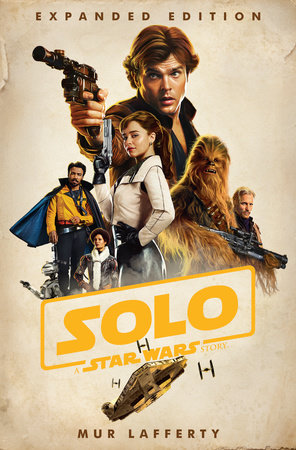
This interview was done at New York Comic Con 2018 and has been lightly edited and condensed for clarity. We sat down with Mur Lafferty for a quick chat about Solo: A Star Wars Story, what it was like writing a film novelization, and the not-so-complex motivations of Han Solo.     Keith Rice: Okay, so Solo: A Star Wars Story, was that your first novelization of a film? Mur Lafferty:  Yes, yes it was. KR: What was the process like? ML:  Well I was flown out to San Francisco to Lucasfilm, I had basically the day with the script and then I went home and started writing.  I came up with a couple of additional scene ideas, and those had to be cleared through Lucasfilm. There was a delay on the deadline of the book which was great for me because I got to see the movie and was able to then tweak whatever I had gotten maybe a little wrong, which helped, because there were a couple of things I’d read in the script that I couldn’t quite picture. It was pretty amazing. KR: Can you talk a little bit about some of the new content you explored? ML:  (SPOILER ALERT – Skip this section if you haven’t seen “Solo”) The movie starts out with Han Solo running away from a deal gone bad.  So, I decided I wanted to write that deal.  Backup, say, fifteen minutes, and that’s when the story starts.  We see Han Solo trying to cheat the people he’s selling the coaxium to so he can steal some of it for himself.  Of course that goes very poorly and then he steals the speeder. I also expanded the scene of him at the academy, working with the Navy.  And probably my favorite scene that I added was L3 merging with the Millennium Falcon from her point of view.  Finally, I threw in this crazy idea to put an epilogue in there about what happened to all the coaxium they stole, where Enfys Nest took it, and Lucasfilm actually approved it, which shocked me to my core! I’m like, okay.  I asked for all of this, all the toys in the world, and they delivered. KR: So, you added canon, basically. That’s amazing. ML:  Yeah, so I got to write the epilogue with Saw Gerrera and Jyn and Enfys Nest. KR: What I does it feel like taking on an iconic characters like Hans Solo? ML:  It was intimidating, but he’s –  I mean, let’s be honest, he’s not a complicated character as an adult, and so he’s not a complicated character as a young man.  He’s, you know… “I’m gonna try to ride my bike down this hill, okay the brakes failed, so lets make the best of it, and turn when we need to turn and okay, we’re going faster now, I just want to try not to crash.”  I mean, that’s pretty much how he approached everything in his life.  And so, just making that a little more naive and a little bit more willing—and removing some of the bitterness of his adult life—that’s how I wrote it. KR: How do you find a balance between your podcasting and your writing? ML:  I usually do not podcast as much as I intend to. So, writing is the priority.  And luckily because the shows are about writing, my listeners understand.  Because when I tell them I actually have a book due and podcasts aren’t going to be coming as often, they understand because they’re writers, or they want to be.  Honestly, podcasting doesn’t take that much time.  It’s all the other things, procrastination, or the things that demand you time from home, or deciding that ten minor emails are more important that your daily writing or something. That’s what I struggle with.  It’s not a time thing, it’s a priorities thing. If I can dedicate an hour or two hours a week to podcasting I’d be fine. It’s just finding those two hours among the maelstrom of procrastination and stuff that is my constant struggle. KR: If you could take on another Star Wars character, who would you want to write? ML:  Completely different from Solo?  Gosh, so many. KR: Who’s your top three? ML:  I really want to write some young Finn stories.  I want to know, I mean, something had to happen in his youth that gave that spark of, “I got to get out of here,” kind of thing.  Gosh, I don’t know.  Everyone I think of has already been done by very good authors, and, you know, Leia’s one of my favorite characters of all time but there’s been a lot of stuff told about her. KR: Yeah. ML:  I guess I’m just going towards the newer ones.  I have to say, Enfys Nest, I love her. I think that there are so many stories you can tell about her.  And I think are a lot of stories you could tell about Qi’ra, after she went to take on the Crimson Dawn.  I think a lot of people – I’m going on a tangent here – I think a lot of people were very confused by Qi’ra’s actions. I heard somebody say she was betraying Han.  And I didn’t see that at all. She never ever, ever, said she would go with him.  She never promised anything.  He just assumed and went off on his own little fantasy world. But I would love to follow her and see a little bit more of her reasoning behind things. I guess my top three would be Enfys Nest, Qi’ra and Finn. KR:  What’s your current favorite podcast? ML:  I’m not listening to podcasts right now. I feel awful, I feel awful. KR:  No, don’t. ML:  There’s so many amazing podcasts I hear about now, but I usually use my audio time to listen to books. KR:  How about this.  If you had to pick a podcast to introduce someone to podcasts, what would you recommend?  ML:  Let’s see.  A friend of mine, Rob Walsh, who now works at Libsyn, Liberated Syndication, one of the first podcast hosts, he did a podcasts called podCast 411, where he’d talk about all the news in podcasting.  And that was pretty cool to watch.  For children’s podcasting one of the first people who did that was Grant Baciocco, was Radio Adventures of Dr. Floyd.  He took, just, a very small scripted radio show-type format and made it for kids.  It was very funny and really clever.  Gosh, and you know for fiction, Scott Sigler I believe is still doing a lot of fiction and a lot of keeping up with everything.  He’s putting out a lot of content as well as his books. Check out Mur Lafferty’s Solo Keith Rice is a West Virginia native and a freelance writer residing in Philadelphia with his lovely, if oft exasperated wife and three cats. Keith fosters an enthusiastic appreciation for beer and scotch, collects comics, and most importantly is an avid reader and movie lover. Oh, he’s a pretty big fan of sci-fi and fantasy as well. Drop him a line @Keith_Rice1.

5 Pieces of Writing Advice No One Tells You

This article was written by Abbi Waxman and originally appeared on Signature Reads.

In my opinion, most writing advice focuses on totally the wrong thing: The wordy bit. Thinking about what you’re going to write and how to say it — sure, yeah, that’s important. Characters, motivations, yes, yes, yes. But there are other challenges bedeviling today’s writer, and several of them are misleadingly trivial and oft overlooked. I’ll tackle those instead, because “misleadingly trivial” is an excellent band name. Here are five pieces of writing advice no one tells you.

1. Wear Layers You’d be surprised how much body temperature affects your work. Think of yourself as a racehorse; too cold and you’ll pull a muscle, too hot and you’ll get all lathery and need a really short guy to take you outside and walk you around in circles. Consider your environment, dress accordingly, then add two layers. Coffee shops are often overly air conditioned, presumably to stop writers from moving in permanently. It hasn’t stopped me, but then, I’m a highly trained professional. 2. Dress Loose I don’t know about you, but when I’m working I either type like a dervish, caressed by the muse and happily pounding away, or curled up in the chair like a pinched worm, wondering whether it’s too late to train as a veterinary nurse. For this reason — and also the general reason that life is too short for non-elasticated waistbands — wear comfortable clothing with plenty of room. You may need to assume one of the classic writer’s positions: The Hunch, The Self-Hug, The Horrified Stare, or The Forehead-Desk Pose, and non-stretch fabrics will restrict your creative flow. 3. Bring Snacks I personally like small snacks I can pop in my mouth while making vital author-type choices (is he frowning? glaring? frowning? glaring?). I favor nuts, because they’re high in some better thing whilst being low in some other, worse thing, and I particularly favor pistachios, because I can shell a load of them at once while making tougher choices (is the character dead? is he alive? dead? alive? both??) and then eat the resultant pile of little green nuggets during the lesser decisions (see original parentheses). Popcorn is okay, although sometimes I lose concentration because I’m fishing those little translucent kernel covers out of my aging teeth. I’ve flirted with M&Ms and other small chocolate items, but it turns out I have this weird allergy wherein if I eat pounds and pounds of chocolate my body gains weight. I think it’s just me; you’re probably fine. 4. Your Butt is your Achilles heel. Writing isn’t a particularly dangerous job, let’s be honest. Over-caffeination is an ever-present threat, but when was the last time a writer got harpooned or ripped asunder by a giant threshing machine … while writing? Not recently. However, the literary career does take a physical toll. Non-ergonomic seating can lead to painful Gluteus Numbeous, or Neckus Stiffus, not to mention more poetically named afflictions such as Creaky Scapula, Notetaker’s Neck or, worst of all, Mangle Wrists.  This is not a modern problem: Charles Dickens had a shocking case of Peripheral Plume Disease and Henry David Thoreau took all those walks around Walden Pond in order to stop his ankles from seizing up.* Take frequent rests, lie down as much as possible, and keep a bag of frozen peas at the ready. That’s my advice. 5. The Final and Most Important Piece of Writing Advice: When in Doubt, Nap. Writing is hard. Often you can’t think of what to say, or who should say it, or what the other guy should say back to the first guy, and you end up with your hands in your pockets watching YouTube videos about dog rescues rather than getting anything done. You know what’s a better use of your time? Sleeping. Lie down, cover yourself with your softest blanket in your favorite color, and gently lower those eyelids to a count of three. When you wake up you’ll either have a solution to your problem, or just be closer to bedtime, and that’s a win in anyone’s book. In a nutshell, that’s the best advice I can give: Wear layers, dress comfortably, maintain appropriate snack levels, watch your posture, and nap whenever possible. Keep all that in mind and the actual writing-down-the-words part will be no problem at all. *Neither of these things is true, but wouldn’t it be great if they were? Writer typing article © Rawpixel.com/Shutterstock

Delilah Dawson talks Kill the Farm Boy, writing with Kevin Hearne, and fairytale tropes

This interview was done at New York Comic Con 2018. We caught up with Delilah Dawson for a quick chat about Kill the Farm Boy, fantasy tropes, Spam Musubi, and drinking with Kevin Hearne.       Keith Rice: you have Kill the Farm Boy out now, and No Country for Old Gnomes is coming out next year? Delilah Dawson:  Yeah – – KR:  So, what can you tell us about The Tales of Pell. DD:  Tales of Pell are like if The Princess Bride got in a car crash with Discworld.  It’s all about flipping fantasy tropes in a loving way, playing with the tropes of Dungeons and Dragons and what happens when a group of heroes gets together.  Kevin Hearne and I came up with the idea at an airport barbecue restaurant in Houston.  He wanted to do an anthology and I was there for it, and then we realized that took a lot of math and author herding.  We’re like, what if we just wrote the book together? Then you each only have to write half a book, which is a really good deal for us.  It’s all about playing with fantasy tropes. There’s a dark lord but his only magic is that he can make bread in various kinds of crusty goodness.  There is a fighter in a chainmail bikini because her real armor is on hold for layaway, which is why she needs the money. There is a bard who is also kind of a bunny rabbit, and the hero turns out to be a goat, because guess what happened to the farm boy? KR:  What was it like writing something like Phasma, and then moving on to this kind of farcical fantasy? DD:  It was refreshing. Phasma, we call it the “Mad Max” of Star Wars.  It’s kind of unrelenting, violent, soul-crushing, it is a sharp book.  And then you move into the Tales of Pell, which is all light-hearted, fun, jokey, a couple of fart jokes. So, it was very freeing, and in troubled times it was really nice to come home and get an email and it’s this hilarious chapter from Kevin Hearne who is really funny.  And it’s all about being lighthearted and loving, and the good guys win.  It was really nice. You know, you come back from a big fight and it’s like that refreshing sip of ale. KR:  After writing Phasma are there any other Star Wars characters you’d like a crack at?  DD:  The great thing about the current Del Rey Star Wars editing team is that they seem really great at matching authors to the characters, the stories that a given author would really be great at telling.  So, I feel like anything they ask me to do, it would be because they thought I would be the best person to write that particular story. I would be totally down for it.  Phasma is great.  Violent women are kind of my modus operandi.  And, you know, same with Bezine Netal in The Perfect Weapon.  The original pitch for that was female James Bond in space.  I was totally there for it. So, yeah, I would love anything that was offered me. You know, I really want to know what happens to Cardinal and to Phasma.  Although I know what happened to Phasma, but we don’t know about “Episode 9.” Cardinal and Bezine Netal are kind of my babies and I want to make sur that their okay.  And if they’re not ok, I want to make sure that they go out with guns a-blazing. KR:  How was the experience co-writing with Kevin Hearne? DD:  It’s like going to the bar with your best friend and laughing your butt off.  Those stories, we did the outlining and story-breaking when we were at a Con together.  We would just go bar-hopping.  No Country for Old Gnomes, that was on Frenchman Street in New Orleans, we’d go into one bar, get a drink, listen to the music, look at the art on the walls and different things would make its way into the book.  And then for The Princess Beard, we were in Seattle and I had never had Spam Musubi, and I was like, “Kevin, we have to go get Spam Musubi.”  We ended up with these two foot-tall hurricanes.  And we’re like, “Oh, and it’s a book that’s got some piracy in it!” So, it was very fitting.  So, just a little bit of, “Oh, buddy, you know what would be fun, ooh, yeah that’s a really good idea, let’s do that.” [Laughs]  We giggle a lot. KR:  What was the inspiration for Kill the Farm Boy DD:  Kevin [Hearne] came up with it, it was his idea for an anthology and I said we should make it into just a book we write together.  I think the actual inspiration was just the trope of, kind of, every fantasy novel ever – a poor white boy from nowhere special suddenly discovers he’s the chosen one with secret powers and is the scion of a generation. We were, like, “Oh, my God, stop.”  Like, we love “Star Wars”, but Luke was pretty whiny at the beginning. Let’s accept it and he could’ve died at any moment. So, we were like, well what if we start off with a farm boy anointed as the chosen one and then he kicks it?  Who picks up and carries the torch of that quest?  How do the people come together to do the right thing?  It was all about lovingly playing with the Dungeons and Dragons sort of dungeon party trope, to tell a more current story that is feminist, that is LGBTQ inclusive, that is diverse, it’s not all just a bunch of white awesome people.  We just really wanted to tell a more kind of fairytale fantasy. KR:  You write Lady Castle and Sparrowhawk for Boom.  DD:  Yeah, pretty much anything that’s a portmanteau or two words thrown together, I will write. KR:  What’s your process like writing comics versus writing fiction?  DD:  100% different.  When I write a book, I mean, granted, properties like Star Wars are very different – you work with committee of people, there are outlines involved – but writing a book for me at home is just, I do what I want, and then I turn it in, and an editor helps make it better. With comics, the idea in the pitch has to be something that would lend itself to a very visual story, and you have to describe the world-building.  You also have to think about length and pacing in a different way. A comic is usually 22 pages, and the ones I’ve written have been four or five-issue arcs, so each issue has to have its own small story that has an ending and then they all have to contribute to the overall arc.  It takes a little bit more advanced planning.  There’s also this wonderful surprise of, you write your pages, you edit them, you get them right, and then one day art just falls in your lap and your like, “Oh my God, this is the thing that I dreamed up except better.”  Because the artists are the heroes of comics.  They do all the heavy lifting.  All mad props to them.  They take our ideas and our words and just make them gorgeous.  You don’t really get that with novels.  You get to see one cover that you might or might not like, but in comics you’re usually involved in the art, and it shows up and it’s like seeing your dreams made real. KR:  Okay, so, if you could pick three books to recommend for fans of Kill the Farm Boy what would they be? DD:  Books for fans of Kill the Farm Boy?  Wow, hmmm, it’s more like, “if you like this book, then you would like Kill the Farm Boy.” KR:  Let’s go with that. DD:  So, Good Omens, Discworld, The Princes Bride. If you liked my Lady Castle stuff, if you like Monty Python. All that sort of stuff would lead you into Kill the Farm Boy.  But, I haven’t really read anything as kind of silly and playful as it in a long time. Check out Delilah Dawson’s Kill the Farm Boy Keith Rice is a West Virginia native and a freelance writer residing in Philadelphia with his lovely, if oft exasperated wife and three cats. Keith fosters an enthusiastic appreciation for beer and scotch, collects comics, and most importantly is an avid reader and movie lover. Oh, he’s a pretty big fan of sci-fi and fantasy as well. Drop him a line @Keith_Rice1.

20 PRH Books Longlisted for 2019 Carnegie Medals for Excellence

The 2019 Andrew Carnegie Medals for Excellence in Fiction and Nonfiction Longlist has been announced and includes 20 books published by Penguin Random House imprints.   Established by the American Library Association in 2012, the Carnegie Medals for Excellence serve as an ALA guide to help adults select quality reading material. Our longlisted nonfiction titles: Our longlisted fiction titles: View the complete longlist here. The 2019 Carnegie Medals for Excellence six-title shortlist—three each for the fiction and nonfiction medals—will be announced on October 24. The two medal winners will be revealed at the Reference and User Services Association’s Book and Media Awards (BMAs) event at American Library Association (ALA) Midwinter Meeting in Seattle on January 27, 2019.

Staff Picks: Haley

Who better to give book recommendations than the bookish experts? Penguin Random House employees are sharing their favorite reads every month. Browse below! Haley, Consumer Marketing Haley is a marketer with the heart of a nerd, writing and running the social media accounts for Unbound Worlds, Penguin Random House’s sci-fi and fantasy site. When not at work, she’s off traipsing through imaginary worlds and trying to find room for her ever-growing book collection.