Tag Archives: literary fiction

Riverhead Vice President & Editorial Director Rebecca Saletan on Exit West by Mohsin Hamid

Riverhead Vice President & Editorial Director Rebecca Saletan, Mohsin’s longtime editor, shares her insights on Mohsin Hamid’s new novel: “I have had the enormous privilege of publishing Mohsin Hamid for the entire span of his extraordinary writing life, some twenty years now. He has the rare and precious gift, never more evident than in this new book, of being able not only to see into the future but to imagine, in the shape of real human lives, plausible and humane alternatives to the dark places where our worst impulses could lead us.”  
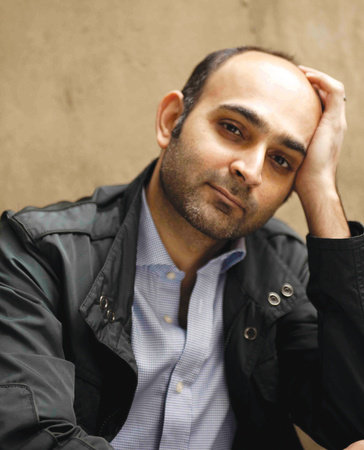
Mohsin Hamid, Photo by Jillian Edelstein

Mohsin Hamid. Photo by Jillian Edelstein
From the internationally bestselling author of The Reluctant Fundamentalist, Exit West goes on sale from Riverhead Books on March 7 and is an astonishingly timely love story that brilliantly imagines the forces that transform ordinary people into refugees — and the impossible choices that follow — as they’re driven from their homes to the uncertain embrace of new lands.  Profoundly intimate and powerfully inventive, this book tells an unforgettable story of love, loyalty, and courage that is both completely of our time and for all time. Exit West has been lauded with tremendous advance praise.  Here is a sampling: “Mohsin Hamid’s dynamic yet lapidary books have all explored the convulsive changes overtaking the world
His compelling new novel, Exit West, is no exception
Writing in spare, crystalline prose, Hamid conveys the experience of living in a city under siege with sharp, stabbing immediacy
.Hamid does a harrowing job of conveying what it is like to leave behind family members, and what it means to leave home, which, however dangerous or oppressive it’s become, still represents everything that is familiar and known.” –Michiko Kakutani, The New York Times “[A] thought experiment that pivots on the crucial figure of this century: the migrant
 [A] wry, intelligent novel
 brilliantly managed
 Hamid’s cautious, even fastidious prose makes the sudden flashes of social breakdown all the more affecting,” the author continues. “Evading the lure of both the utopian and the dystopian, Exit West makes some rough early sketches of the world that must come if we (or is it ‘you’?) are to avoid walling out the rest of the human race in the 21st century.” –The Financial Times “Writers should be wise, and Hamid is wiser than many
 No novel is really about the cliche called ‘the human condition,’ but good novels expose and interpret the particular condition of the humans in their charge, and this is what Hamid has achieved here.” –The Washington Post “Hamid’s prose powerfully evokes the violence and anxiety of lives lived ‘under the drone-crossed sky.’ But his whimsical framing of the situation offers a hopeful metaphor for the future as the ‘natives’ come to accept their new neighbors.” –TIME Magazine Learn more about the book here:

Writing Tips from Jillian Cantor, author of The Hours Count

We know readers tend to be writers too, so we feature writing tips from our authors. Who better to offer advice, insight, and inspiration than the authors you admire? They’ll answer several questions about their work, share their go-to techniques and more. Now, get writing! 

How would you recommend creating and getting to know your characters? The absolute first thing I do is decide my main characters’ names. I feel like I need to know someone’s name before I can start to know him or her. My favorite place to figure out first names is the Social Security popular baby names website, where you can view name popularity by birth year (back to 1879) to see what common and (uncommon) names were in the year your character was born. After I decide names, I’ll start to make notes of other things, like birthdays/age or relationships to other characters, quirks, where a character lives, or things he/she likes or dislikes. But I start drafting pretty soon into this process. I mostly learn and get to really know my characters as I’m writing the first draft, thinking about what they do and how they react and speak when I put them in different situations. So I think the best way I get to know my characters is to write them. By the time I get to the end of the first draft, they’re often different than what I started with (and I know them much better). But then I go back and revise. After developing an idea, what is the first action you take when beginning to write? The first line of novel is really important. It sets the tone for the entire book. I want it to show what the book is ultimately about, but also to be interesting and hook the reader. When I first start thinking about and developing an idea I always start thinking about first lines. I jot down ideas, often for weeks or months. But, I don’t wait for the perfect first line before I start drafting a book. I begin with the first one that comes to me and then I keep writing from there to get my first draft going. So just the act of getting words and ideas down on the page is the most important action I take in order to actually start writing. I set a goal for myself – usually 3-5 pages a day – and I make myself sit down and write something, make some progress in the draft, even if it’s ultimately terrible and will all be changed in revision. Most of the time the first line that appears in the final draft of the book is not at all what I started with. I keep thinking on that first line, even as I keep writing the first draft. Usually I don’t understand enough about the story myself until I finish or get most of the way through a first draft. So I start writing at the beginning, but 9 times out of 10 that beginning changes by the time I make it to the end! Is there something you do to get into a writing mood? Somewhere you go or something you do to get thinking? I always write at home, and I need quiet to write. I negotiate my writing schedule around my kids’ schedules so I usually write while my kids are at school during weekdays, or very early in the mornings on the weekends or during the summer when my kids are home – really, whenever I can find uninterrupted quiet each day. I have an office in my house where I can shut the door, and I do write there, but when no one else is home I also write at my kitchen table. I like to drink coffee while I write, and that always helps to get me thinking. Or when I get stuck, I’ll exercise. Taking a long walk, run, or hike, often helps me work through a plot a point I was stuck on or figure out a problem in my story. What’s the best piece of advice you have received? The best advice, and I got this from a writing professor in grad school, is simply, “butt in chair.” As in, just sit down and force yourself to write something, no matter what it is or how terrible you think it is. The hardest part is making yourself sit down to do it. So I don’t let myself make excuses – I put my butt in the chair every morning and write something. What are three or four books that influenced your writing, or had a profound effect on you? I read Bird By Bird by Anne Lamott in the first fiction writing class I took, and I still have a copy on the shelf in my office. I love what she writes about first drafts and I feel like it’s still important to give myself permission to write something terrible the first time around as long as I write something. I’m a big believer in the importance of revision! Black and Blue by Anna Quindlen is one of my favorite novels, and the first I read by her. I come back to it, and her novels, again and again, because I feel like I learn so much about sympathetic character development from her. The Handmaid’s Tale by Margaret Atwood, which I first read in college, always makes me think about writing characters in a world different from our own today (which is applicable for writing historical fiction as well) and the fact that characters still need to first be inherently human and relatable, no matter how different their world is from the one we know.

Learn more about the book below!

Writing Tips from Donald Ray Pollock, author of The Heavenly Table

We know readers tend to be writers too, so we feature writing tips from our authors. Who better to offer advice, insight, and inspiration than the authors you admire? They’ll answer several questions about their work, share their go-to techniques and more. Now, get writing!  Is there something you do to get into a writing mood? Somewhere you go or something you do? Yes, I go to my “office” in the backyard, a former garden shed that I fixed up when we bought the house we’re living in now (unfortunately, I have a difficult time blocking out the world, so writing in a “public” place is impossible for me). There is no phone or internet, just a table and chair and some reference books along with a laptop and a typewriter. The first thing I do to get started is pour a cup of coffee from a thermos and light a cigarette. Believe me, I’ve tried, but I can’t do it any other way. What’s the best piece of advice you ever received? Learn to sit in the chair for a designated period of time, regardless of whether anything is “happening” or not. I think this is the main thing that defeats many aspiring writers, and it’s easy for me to see why.   There have been many, many days when I’d rather be doing anything else (it’s the only time when washing windows seems like a fantastic idea). But I almost always force myself to stay put because nothing will ever happen unless I’m sitting there to help make it happen.   It might be a little easier for me because I’m the type of person who does better at writing and everything else if I’m living on a schedule, but it’s still hard sometimes.  What writing techniques have you found most important? When I decided to learn how to write short stories, I didn’t know anything and I struggled for quite a while without making much progress. Then I read an interview with a writer who said she learned to write by copying out other people’s stuff. For some reason, that made sense to me, and I began typing out short stories by Hemingway, Cheever, Yates, Johnson, O’Connor, on and on. I did approximately one story a week for maybe 18 months and it got me so much “closer” to seeing how they did things like writing dialogue, making transitions, etc. It could be that it worked for me because I’m not a very good reader, but it definitely helped me start figuring some things out. On occasion, when I’m having a bad day, I will still type out a paragraph or two from somebody else. What are three or four books that influenced your writing, or had a profound effect on you? Blood Meridian by Cormac McCarthy is the best novel I’ve ever read. Unfortunately, reading it also makes me realize how worthless my own work is. Denis Johnson’s Jesus’ Son. I copied every story out of that book when I was starting out, and it helped push me toward the idea of developing, for lack of a better term, my own “voice.”   Also, Earl Thompson’s A Garden of Sand, which I came across when I was maybe sixteen and have never forgotten. I’ve mentioned it before in interviews as being the first book I ever read that contained characters similar to some of the people I grew up around.   Of course, you have to understand, my reading was somewhat limited in those days and I probably hadn’t even heard of people like Faulkner and O’Connor yet. Learn more about the book below:

Writing Tips from Deena Goldstone, author of Surprise Me

We know readers tend to be writers too, so we feature writing tips from our authors. Who better to offer advice, insight, and inspiration than the authors you admire? They’ll answer several questions about their work, share their go-to techniques and more. Now, get writing!  What writing techniques have you found most important or memorable? The most important thing I tell beginning writers (and myself whenever I’m struggling which is often) is to put one’s bottom on the chair every day and dedicate whatever hours you can to work. The daily commitment is more important than the amount of time you spend at it. For me, writing is a process that needs to be attended to, fed, and kept alive every day no matter how difficult or non-productive the time may seem. The struggle to write is part of the process, and often as you take a walk or a shower or fold laundry or drive to a meeting or any of the other mundane tasks we all do during a day, your creative brain will gift you with some insight or bit of dialog or the very answer to the problem you couldn’t solve that morning. But only if you keep the process alive by working every day. How would you recommend creating and getting to your know your characters? Write notes to yourself about your characters before you begin your work. Sit in front of the empty screen and write down whatever comes to mind – facts like how old they are, what the look like, but also random thoughts like whether they have nightmares or like physical exercise or what their favorite food is or whether they’re a dog person. Whatever comes to mind, whether it is germane to the story you’re telling or not. You have to know your characters (even the secondary ones) as well as you know the members of your own family. That knowledge will inform what they say and how they behave. It will make your characters particular and interesting and ultimately, if you know them well enough, THEY will tell you what they want to say and do. What’s the best piece of advice you have received? Surprise yourself when you’re writing. Describe your writing style in 5 words or less. Emotional and character driven. What are three of four books that influenced your writing, or a had profound effect on you? Well before I even contemplated becoming a writer, I read Doris Lessing’s novel, The Golden Notebook, and was astonished to realize that one could write a whole book about the intimate, mundane lives of women. I think it was the first time I realized that this territory was important enough to explore. Amy Bloom taught me how to write about grief – the theme which unites the stories in my collection, Tell Me One Thing. In her story, Sleepwalking, from her collection, Where The God of Love Hangs Out, she writes about how the family members left behind deal with the death of their husband and father without ever mentioning grief or having people break down into emotional messes. It’s all in the behavior of the characters and is amazingly moving and restrained and powerful. I was astonished when I read Elizabeth Strout’s novel, Olive Kitteridge, that it was possible to write a truly prickly, often unlikeable character and still create understanding and sympathy and connection to her. Strout helped me be bolder in writing my characters and certainly gave me permission to create Daniel, in Surprise Me, with all his idiosyncrasies and edges and flaws. Learn more about the book below: