





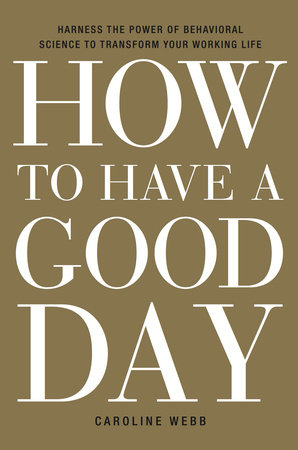
Writing Tips from Caroline Webb, author of How to Have a Good Day
We know readers tend to be writers too, so we feature writing tips from our authors. Who better to offer advice, insight, and inspiration than the authors you admire? They’ll answer several questions about their work, share their go-to techniques and more. Now, get writing!
After developing an idea, what is the first action you take when beginning to write?
My writing generally weaves together three strands of content. There’s some nugget of scientific research that I think is interesting and useful – maybe a study that I’ve just read about, or something which I’ve been wanting to write about for a while. Then, I also want to be clear on the practical advice that’s implied by that scientific insight. But there’s also the story or example that illustrates the topic. And my route into a new article or chapter can be any of those three; I start with whichever piece feels easiest and most exciting to get down on paper. When it’s the anecdote, I usually focus first on scraps of vivid language that an interviewee or client has used to describe a difficult situation. For the science and the advice, I will usually write in bullet points first – what my consulting colleagues used to call a “dot-dash” – to check the flow of the argument and ideas before I start investing in the bounce and feel of the language.
Is there something you do to get into a writing mood? Somewhere you go or something you do to get thinking?
Absolutely. One thing that really helps me is to put on large noise-cancelling headphones. They dampen ambient noise and reduce distraction, allowing me to think more clearly. But they’ve also become something I associate with really getting into deep thinking mode. As a result, simply putting them on sends a clear signal to me that I’m about to focus on my work – making it easier to dive in. (I write about the science behind this in chapter 3 of my book, for those who are interested!) And I’ve had three writing soundtracks in recent years. There was a period where the only thing I listened to was Haydn string quartets. For a long while, I’ve worked with a playlist of rather sparse and instrumental “deep house” music. (I think the two genres have a lot in common, but that’s for a different type of interview.) But sometimes nothing but silence will do.
Did you always want to write? How did you start your career as an author?
I always loved writing as a kid – especially science fiction, which I imagine was a surprise for my English teachers in the 1970s – and I was editor of my college yearbook and newsletter. I drifted away from writing as I built a career in economics. But after a few years, I had a job which was as much about writing as thinking: authoring the Bank of England’s Inflation Report. This was a publication analyzing and describing the state of the economy, so the writing was dry – yet I still loved it. And I learned many things that have served me well as a non-fiction writer. For example, the publication was so influential that bad syntax in a key sentence might end up moving financial markets in the wrong direction – so I learned the value of precision and clarity, and I learned what made a sentence easy or hard to read. (We even had to put our writing through a computer program to test the reading age required to understand it.)
After reconnecting with my love of writing, I took every opportunity to write in real sentences rather than relying on PowerPoint slides. And once I’d written a couple of articles for the McKinsey Quarterly, I realized that it was time to bring writing back into the center of my life. That’s when I started work on the book, writing a four-page outline of something I wouldn’t finish for another four years.
What’s the best writing advice that you have received?
Lynda Gratton (Professor of Management Practice at London Business School, and author of 8 successful books) told me early in the process of writing my book that I would eventually need to make it my full-time job – at least for a few months. She was right; there really does come a point where you simply have to stop doing absolutely everything else, and say “right now, I am a writer, and my job is to write.” And her advice helped me recognize when it was time to disappear into the writing bunker.
Meanwhile, Matt Lieberman (neuroscience professor at UCLA and author of Social) told me to look after myself physically while writing, reminding me to see exercise as an investment in my mental and emotional sharpness.
What are three or four books that influenced your writing, or had a profound affect on you?
At least four books encouraged me toward writing How to Have a Good Day.
Predictably Irrational, by Dan Ariely. To see such a book capture people’s imagination made me excited that behavioral economics was coming of age. Moreover, I saw that it was possible to make academically rigorous material fun and engaging.
The Happiness Hypothesis by Jonathan Haidt. I loved the cross-disciplinary approach of this wise book, drawing from psychology and neuroscience and even ancient philosophy. Also, my husband wooed me with it – it was the first present he ever bought me.
Your Brain at Work, by David Rock. This put neuroscience in the context of the workplace, and it was the first book that I’d seen do that.
Thinking Fast and Slow, by Daniel Kahneman. It was inspiring to see that such deep scientific concepts could excite a broad general audience. It helped too that I had heard him say that he’d found it tough to write the book. Since he’s a brilliant Nobel Prize laureate, that made me feel that it was okay for me to experience the occasional rough patch! And of course, it was all worth it. (I’m sure he feels that too.)
Learn about how to Have a Good Day here.

 These past five weeks at Random House have been really educational and productive. I am interning in the Advertising/Promotions department, as well as the Art/Design department for the Random House Publishing Group imprint. Even on my first day I could tell that this was going to be a valuable experience that I would enjoy. Being an intern can be intimidating, but this is not the case at Random House. Everyone who works here is extremely humble, and friendly, and is eager to teach beginners the works of the business. It is an environment where teamwork is fostered, and the success of books is priority.
In the Art department I am being supervised by Paolo Pepe, the SVP & Creative Director. I have been reading manuscripts and learning how to design book covers using Adobe Creative Suite and hand illustration. This process has been really challenging because everyone involved in the process has a very specific image of how they think the cover should look. One book that I am working on has been in the cover development process for almost a year. It has been really interesting learning about the process from such talented designers, as well seeing the selection process from the publisher’s point of view. For the art department, I’ve also been creating mechanicals using Adobe Creative Suite, and creating templates for e-books.
In the Advertising and Promotions Department, I am being supervised by the Sr Director of Creative Services, Annette Melvin. For the department I have been using Adobe Creative Suite to create advertising materials for upcoming books, such as social media banners, and print ads. I’ve also been writing copy for upcoming book’s advertising campaigns.
These past five weeks at Random House have been really educational and productive. I am interning in the Advertising/Promotions department, as well as the Art/Design department for the Random House Publishing Group imprint. Even on my first day I could tell that this was going to be a valuable experience that I would enjoy. Being an intern can be intimidating, but this is not the case at Random House. Everyone who works here is extremely humble, and friendly, and is eager to teach beginners the works of the business. It is an environment where teamwork is fostered, and the success of books is priority.
In the Art department I am being supervised by Paolo Pepe, the SVP & Creative Director. I have been reading manuscripts and learning how to design book covers using Adobe Creative Suite and hand illustration. This process has been really challenging because everyone involved in the process has a very specific image of how they think the cover should look. One book that I am working on has been in the cover development process for almost a year. It has been really interesting learning about the process from such talented designers, as well seeing the selection process from the publisher’s point of view. For the art department, I’ve also been creating mechanicals using Adobe Creative Suite, and creating templates for e-books.
In the Advertising and Promotions Department, I am being supervised by the Sr Director of Creative Services, Annette Melvin. For the department I have been using Adobe Creative Suite to create advertising materials for upcoming books, such as social media banners, and print ads. I’ve also been writing copy for upcoming book’s advertising campaigns.

 As a publicity intern, I am involved in reaching out to media outlets and generating interest in our books. This generally consists of brainstorming and researching outlets to which we can pitch our books; writing a press release that gives a brief summary of the book and explains why it is interesting, useful, or important; and mailing out a copy of the book along with a press release to each outlet, hoping that they will find it interesting enough to review. This can be especially fun at DK, where we publish such a wide array of titles. In one day, I can put together a press release and mailing for a book on cheese, another for a book about the Pope, and a third for a children’s sticker book.
While I spend most of my time on the steps of this process, there are new tasks that pop up every day, whether they be helping to schedule an author tour or assisting with our holiday gift guide. Publicity is a new field for me, but I’ve learned so much in the past five weeks, and I’m glad to say that I’m really enjoying every day. I’m so grateful to have this opportunity with DK, and I’m eager to learn more as I continue working this summer.
As a publicity intern, I am involved in reaching out to media outlets and generating interest in our books. This generally consists of brainstorming and researching outlets to which we can pitch our books; writing a press release that gives a brief summary of the book and explains why it is interesting, useful, or important; and mailing out a copy of the book along with a press release to each outlet, hoping that they will find it interesting enough to review. This can be especially fun at DK, where we publish such a wide array of titles. In one day, I can put together a press release and mailing for a book on cheese, another for a book about the Pope, and a third for a children’s sticker book.
While I spend most of my time on the steps of this process, there are new tasks that pop up every day, whether they be helping to schedule an author tour or assisting with our holiday gift guide. Publicity is a new field for me, but I’ve learned so much in the past five weeks, and I’m glad to say that I’m really enjoying every day. I’m so grateful to have this opportunity with DK, and I’m eager to learn more as I continue working this summer.
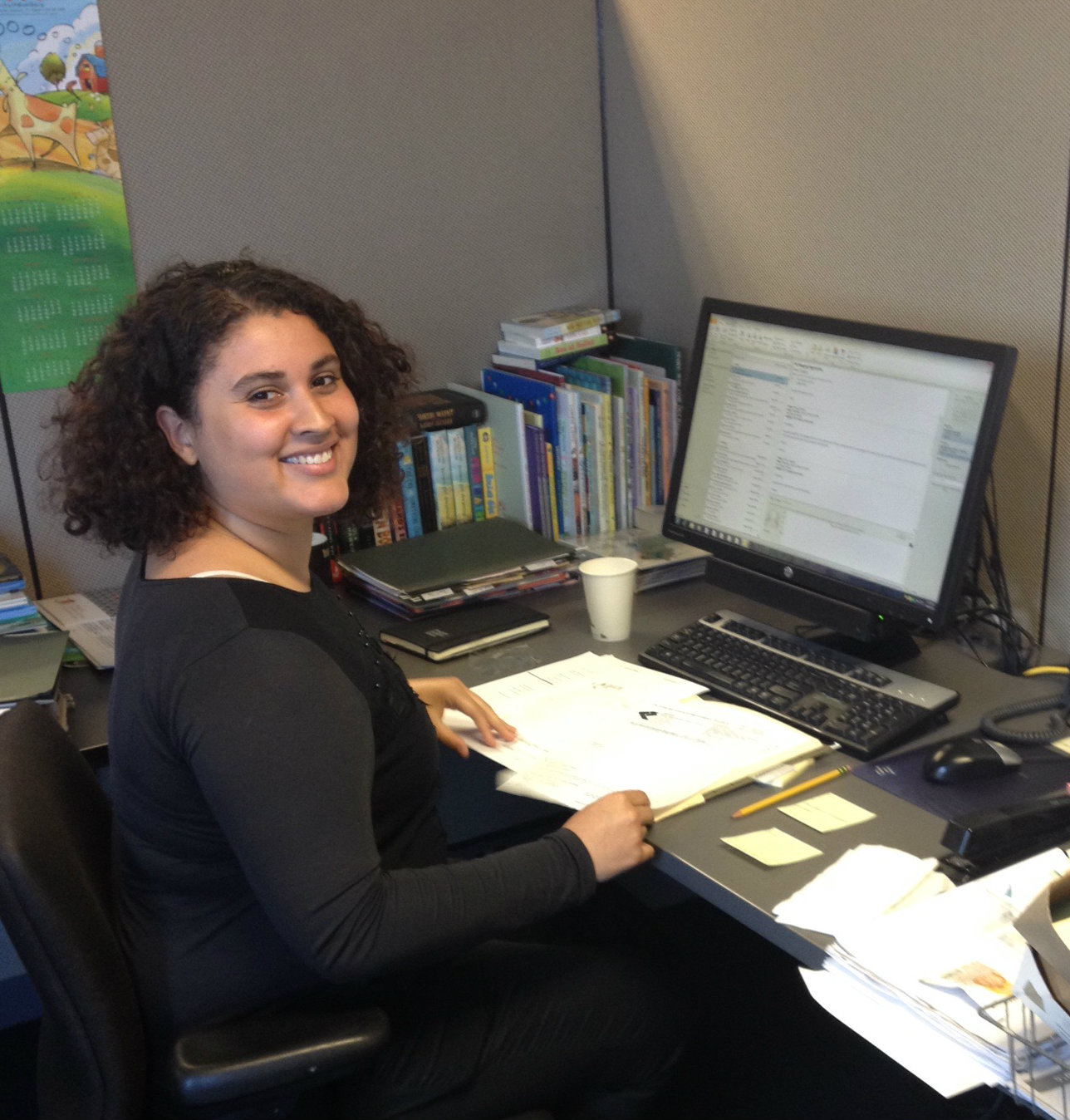 And then there’s digital, one of my favorite parts of production. This really surprised me because I’ve always hated reading books from a tablet. Regardless, I found that I enjoyed the immediacy of seeing the end product. It takes about a month to see a turnaround for an e-book, while it takes 6-9 months for a printed title! My tasks with digital production include writing memos to Aptara (the company who puts together the e-books) giving specific and detailed instructions on what we want the final product to look like. Once the files are made and returned to me, I check it to make sure it is exactly what we wanted. Afterwards, I circulate it to various departments where they give the “OK” or tell us what needs to be worked on. Easy!
I’ve learned so much about the process of publishing already, so for the next and last 5 weeks of my internship I can only imagine how much more I will gain from the people who make this department work so smoothly.
And then there’s digital, one of my favorite parts of production. This really surprised me because I’ve always hated reading books from a tablet. Regardless, I found that I enjoyed the immediacy of seeing the end product. It takes about a month to see a turnaround for an e-book, while it takes 6-9 months for a printed title! My tasks with digital production include writing memos to Aptara (the company who puts together the e-books) giving specific and detailed instructions on what we want the final product to look like. Once the files are made and returned to me, I check it to make sure it is exactly what we wanted. Afterwards, I circulate it to various departments where they give the “OK” or tell us what needs to be worked on. Easy!
I’ve learned so much about the process of publishing already, so for the next and last 5 weeks of my internship I can only imagine how much more I will gain from the people who make this department work so smoothly.


