Tag Archives: reading

Writing Tips from Megan Crane, author of Make You Burn

We know readers tend to be writers too, so we feature writing tips from our authors. Who better to offer advice, insight, and inspiration than the authors you admire? They’ll answer several questions about their work, share their go-to techniques and more. Now, get writing!Ā  Is there something you do to get into a writing mood? Somewhere you go or something you do to get thinking? I’m a big believer in the ā€œwriting retreat.ā€ Sometimes writing retreats involve locking myself in a hotel room for a few days to really throw some words on the page—other times these retreats involve gathering with my writer friends in a variety of inspiring, usually beautiful places, where the word count might not be high but the camaraderie and daydreaming leads to a whole lot more writing down the road. This is how The Deacons of Bourbon Street series came into being. Last spring, Maisey Yates, Rachael Johns, and I roomed together at the RT Convention held in New Orleans. We spent a lot more time wandering that fascinating, mysterious city than we did at the conference. When an editor (perhaps jokingly!) suggested we should write a multi-author series together since we got along so well, we jumped at the idea. New Orleans and gritty bikers seemed to go hand in hand for us, and once we settled on that premise, it seemed inevitable that we should pull in Jackie Ashenden, renowned for her dark and sexy stories, to round us out. And all because we visited New Orleans! After developing an idea, what is the first action you take when beginning to write? We sent a lot of emails back and forth, since we live all over the place—Maisey and I on the west coast of the US, Rachael on the west coast of Australia, and Jackie in New Zealand. But we also spent some time on Skype. We talked a lot about biker books, about characters, about the kinds of things we liked and the sorts of stories we wanted to tell. We fashioned an overarching plot and then we decided who our characters would be within that plot. We came up with a synopsis for all four books and once that had the enthusiastic support of our agents, we settled down and wrote a chapter each to introduce our characters and stories. That was the most fun—to see all the conversations and ideas we’d thrown around come together into these four fantastic stories. All set in our decadent version of New Orleans’s famous French Quarter. How did you handle plot and character continuity across four books? We talked a lot. Communication is key when it comes to working on multi-author projects. We discussed timing and plot points and the characters’ relationships with each other endlessly. We also sent each other/the whole group the scenes where their characters appeared in our books. The goal was always to make the characters feel seamless across all the books, and to show how they all functioned as this group of sworn brothers, reunited after years in exile. I think we pulled it off, but of course, that’s for readers to decide! Is there something you do to get into a writing mood? Somewhere you go or something you do to get thinking? I was lucky enough to write my book a few months after everyone else did. This was particularly helpful because it meant that I’d already read how the series ended and could write directly toward it—always a huge advantage! So one of the things I did to get in the writing mood was to read those other books and immerse myself in the world. Another thing I did was to curate ā€œinspiration boardsā€ on Pinterest. Looking at moody reference pictures (many featuring Charlie Hunnam, of course, as everyone’s favorite biker inspiration Jax Teller) was another way to get myself in the right mindset. I also relied pretty heavily on a mix I made of songs that brought me into the right headspace. One in particular (Arctic Monkeys, ā€œDo I Wanna Know?ā€) was and is such a perfect encapsulation of my hero in this book that all I have to do is listen to that awesome opening and I’m right back there in the Priory with Ajax… Do you ever base characters off people you know? Why or why not? I have some family members who are more familiar with biker clubs than I am, but I didn’t base any characters on them. Though I did appreciate it when they didn’t laugh at me when I told them what kind of book I was writing! The truth is that reality doesn’t make great fiction. Characters are always better when they’re entirely themselves instead of pale imitations of real people. ā€œLarger-than-lifeā€ makes a good story and fascinating characters. ā€œJust like lifeā€ is something we can all do all by ourselves, without a good book. I prefer books. Learn more about Make you Burn here.

Reading & Eating: The Broad Fork, by Hugh Acheson and Under Magnolia, by Frances Mayes

Wine and food pairings are all well and good, but there’s no better pairing than two complementary books. Reading + Eating posts feature two titles that will inspire you to cook, read, eat, and enjoy. The gorgeous cookbook images, and handpicked recipes and quotes make for some delicious reading.Ā  This month, we’ve paired Frances Mayes’Ā gorgeous memoir about growing up in the South with The Broad Fork, a lush cookbook from beloved chef, Hugh Acheson. collage

In Under Magnolia, beloved author Frances Mayes returns with a lyrical and evocative memoir of her childhood in the South. Under Magnolia is a searingly honest, humorous, and moving ode to family and place, and a thoughtful meditation on the ways they define us, or cause us to define ourselves.

ā€œAs gothic as anything Faulkner could have dreamed up, populated by characters straight out of a Flannery O’Connor story…a thorny memoir that strips away the polite Southern masks, sweet magnolias be damned.Ā Unforgettable.ā€ – Atlanta Journal Constitution

ā€œWith perfect-pitch language, Mayes unblinkingly describes her growing-up years… One can almost taste the mushiness ofĀ ā€˜a pot of once-green beans falling apart in salt pork’; one can almost smell the cloying scent of honeysuckle, gardenias and overripe peaches that infuse the always-too-humid air.ā€ā€“ USAToday.com

Read more about Under Magnolia here.

The author of The Broad Fork, Hugh Acheson, is a James Beard Award-winning chef and partner of the restaurants Five & Ten, The National, and Empire South in Georgia. In this beautiful new cookbook, he focuses on seasonal produce, balance, and flavor. See below for two wonderful recipes from the book.

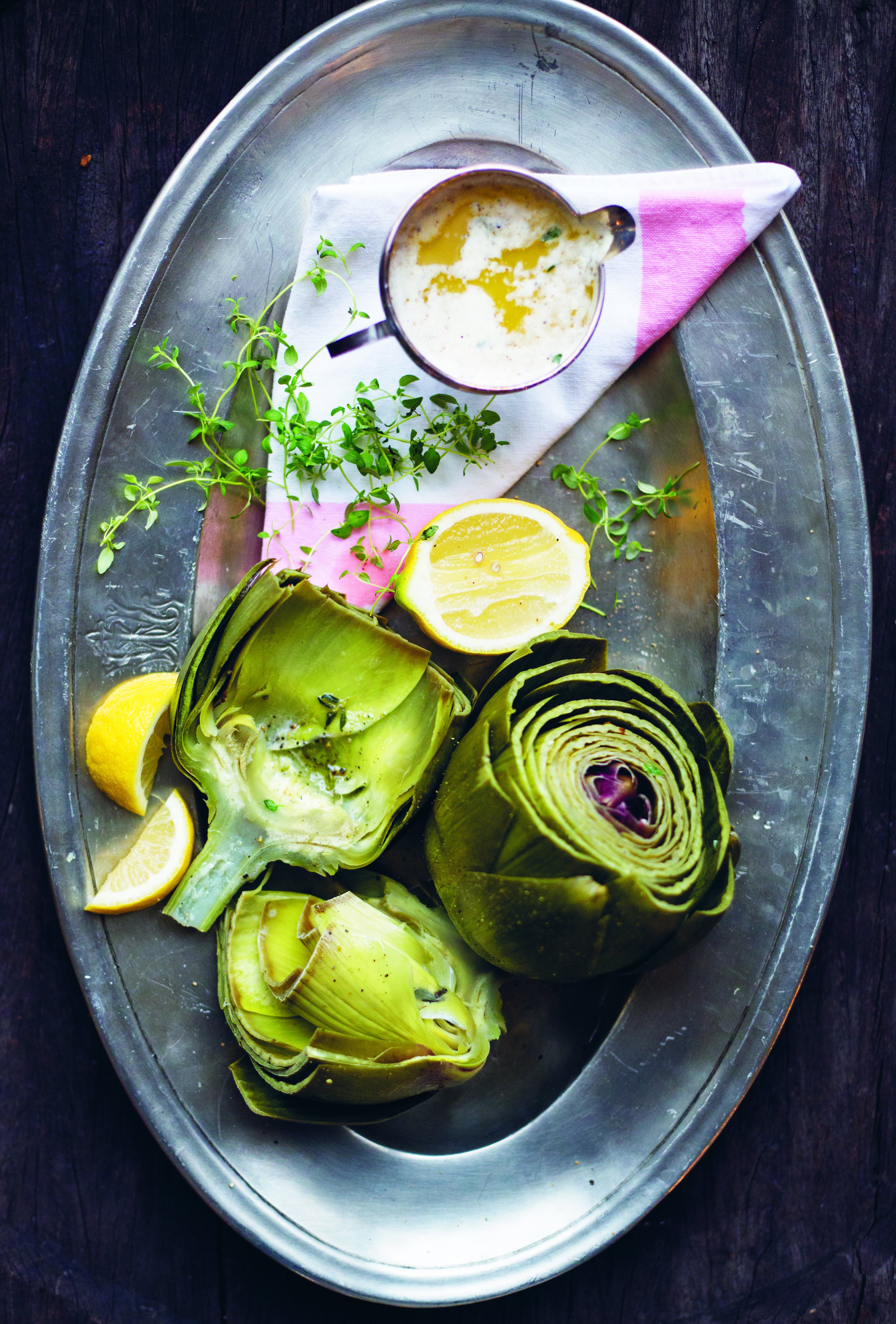
455_Ache_9780385345026_art_r1 POACHED SHRIMP OVER RADISHES WITH SALSA VERDE Serves 4, as an appetizer Poached shrimp take about three minutes. Salsa verde can be made ahead. Radishes take a minute to cut up, if that. The broth assembles in a minute and is cooked for fifteen before the shrimp go in. I guess what I am saying is that I realize you’re busy but this is so easy, so fast, and so impressive that you need to go and make it. When buying shrimp, hopefully you find them fresh. But if not, shrimp are one of the few things that freeze well, so find fishmongers whom you trust and buy from them. They’ll know which ones are going to put a smile on your face. 1 pound shrimp (16 to 20 count) 1 teaspoon olive oil ¼ cup dry vermouth 3 cups chicken stock ¼ pound (½ stick) unsalted butter 1 sprig fresh thyme 1 leek, white and light green parts well washed and cut into 1-inch lengths Kosher salt 12 radishes, quartered ½ cup minced celery with leaves ¼ cup Salsa Verde 1. Peel the shrimp, leaving the tails on and reserving the shells. (Even better if you have the heads, but if you’re buying head-on, buy about 1½ pounds.) Set aside. 2. In a 4-quart saucepan, heat the olive oil over medium-high heat. When the oil shimmers, add the shrimp shells (and heads if you have them) and cook for 3 minutes, until bright pink and aromatic. Add the vermouth and deglaze the pan. Add the chicken stock, butter, thyme sprig, leek, and kosher salt to taste. Bring to a boil and then simmer over low heat for 15 minutes. Strain the mixture and return the liquid to the pan over medium heat. Discard the strained solids. 3. Season the shrimp with kosher salt, and immerse them in the poaching liquid. Cover and cook for 3 minutes or until the shrimp are just cooked through. 4. Arrange the radishes and the celery in individual bowls for serving. Divide the shrimp among the bowls, and then ladle some of the poaching liquid over them. Finish each bowl with salsa verde, and serve. 272_Ache_9780385345026_art_r1 STEAMED ARTICHOKES WITH DRAWN THYME BUTTER Serves 4, as a side I was a wee little guy when Pops was doing a sabbatical in Palo Alto, at venerable Stanford University, but I remember eating egg rolls and artichokes with drawn butter. Now that may not have been in the same meal, but that’s how my memory puts them: together. The egg rolls were (amazingly enough) homemade by my mum and the artichokes came from a couple hours south of us. Big, green, thistly orbs. And I fell for them—hook, line, and sinker. Now my kids love the hunt to get to the heart of the artichoke, scraping each leaf with their teeth and getting all they can from their beauty. 7 tablespoons unsalted butter 1 cup sliced yellow onion 1 tablespoon fresh thyme leaves ¼ cup fresh flat-leaf parsley leaves 2 large globe artichokes, top 2 inches sliced off 1 cup dry white wine Kosher salt 1 lemon, cut into wedges 1. Place a stockpot over low heat and melt 1 tablespoon of the butter in it. Once the butter starts to foam, add the onion, half of the thyme, and the parsley, and begin to sweat the onion. While you prepare the artichokes, the onions will happily hang out over low heat. 2. Tear off the first few outer leaves from the bottom of each artichoke, as well as any attached to the stem. Using a vegetable peeler, shave the stems until you reach the white inner part. Add the artichokes to the pot, stem side up. Then add the white wine and enough water to cover the artichokes. Bring to a boil over high heat, add enough salt to make the liquid pleasantly salty, and then lower to a simmer. To keep them submerged, place a plate that’s just small enough to fit inside the pot over the artichokes. Cover the pot with a lid and cook the artichokes for about 20 minutes, or until you can slide a knife into the stem with no resistance. 3. Remove the plate and then the artichokes from the liquid, and place the artichokes on a cutting board to cool. When they are cool enough to handle, use a chef’s knife to carefully slice each artichoke in half, starting at the tip of the stem. This will expose the heart of the artichoke. Just above the heart you will see a fuzzy part, which is called the ā€œchoke.ā€ Using a small spoon, remove the choke. You will be left with the heart and the fleshy leaves. 4. Melt the remaining 6 tablespoons butter in a small saucepot and add the remaining thyme leaves. Once the butter is fully melted, set it aside. 5. Place the artichokes on a large platter and season with salt, to taste. Garnish with the lemon wedges. Serve with the reserved melted butter for dippin’. Read more about The Broad Fork here.
From the Editor’s Desk: Becky Cole, Editor of Stir

Editors get very passionate about books they work on – the Editor’s Desk series is his orĀ her place to write in-depth about what makes a certain title special. Get the real inside-scoop on how books are shaped by the people who know them best. When the proposal for Stir came in, it was subtitled ā€œHow My Brain Exploded and I Got Cooking.ā€ What I found in those pages just about made my own brain explode. Here was a memoir by a first-time writer who had survived a traumatic brain injury, a Harvard Ph.D candidate who lost sight in one eye, her sense of smell, and a chunk of her skull so large that she had to wear a hockey helmet to protect her brain, impressive enough, but what made the proposal a standout was not her injury, but the way she wrote about how food and the simple everyday acts of cooking, baking, stirring, sautĆ©ing, and sharing it, helped her to heal. As she writes in the book, getting well meant finding her everyday, and she found hers in the kitchen. This stunning book didn’t fit neatly into any category in the bookstore, but everyone at Penguin Random House who read it loved it, and we knew we had to publish Stir. Every author takes an approach to writing that makes sense to them. Some outline, others write set pieces to be stitched together later. Some write almost in a fugue state, getting the book down on paper from beginning to end, barely stopping to put in commas. Jessica was not that kind of writer. She was careful, precise. Every word worked at the sentence level. The challenge with Stir was broader—we didn’t want the book to be pigeon-holed as a recovery memoir, but we also knew that her illness was the natural beginning of her story. During editorial talks, we spent much of our time discussing how to weave various strands together. First, of course, there was the aneurysm. Then, there was the food—the facts of cooking it and eating it and recovering because of it. Beyond those two main threads, there was a love story between Jessica and her unflappable husband, Eli, including their attempts to start a family (spoiler: they do! as anyone who follows her wonderful blog, sweetamandine.com knows from the pictures of her two adorable daughters she posts there); an ode to the constellation of women in her life—her mother, stepmother, grandmothers, her Aunt Fran, and close friends—whose influence she feels strongly in the kitchen; and, finally, the story of how she came to a new understanding of the link between food and identity. As we’d talk, Jessica would occasionally ask me, ā€œHow do you think I should…?ā€ We’d mull it over and then she would go off and come up with a perfect solution. When I said as much, more often than not, she’d respond that she had simply looked at a memoir she admired to see how that writer succeeded in doing whatever it was Jessica herself was trying to do. She was applying the skills she’d honed as an academic to the process of writing a memoir. She read and dissected every memoir she could get her hands on —Wild, The Liar’s Club, Eat, Pray, Love, and My Stroke of Insight, and dozens of others– to pick them apart and learn how they performed different feats of narrative and storytelling. She marked her copy of Wild with a ā€œPivot!ā€ in the margins next to the places Cheryl Strayed switched from one subject to another without losing the reader, and then figured out a way to make the technique her own in Stir. It was as if she was reading to defend her dissertation and her dissertation was how to tell the story of her life. Again and again, I could see her incorporating the lessons she’d gleaned from the writers she loved into her own book. One day, she sent me a document I’m not sure I was meant to see. It was an eleven page spreadsheet with columns delineating plot, characters, conflict, what we learn (general), what we learn (food), and ā€œto do.ā€ It showed an awareness of how the book was working—or not—from a structural perspective, which helped to keep everything in balance. Another time, she sent me a file that had all of the material dealing with Eli in one document so she could make sure the story hung together, which it did. This all sounds terribly clinical, but the book that came out of it is anything but, despite a good part of it taking place in and out of hospitals after brain surgery. What I love about Jessica’s writing, especially her writing about food, is how unfussy it is—the opposite of academic writing with its particular conventions, and different, too, from a certain type of food writing, the kind with sumptuous descriptions of dishes that sound like menu items at a restaurant where almost no one can afford to eat. Jessica, however, writes every bit as much for the person who swoons over grass-fed butter as she does for someone who savors a Ritz cracker melting on her tongue. She writes exquisitely but without pomp about how the way we prepare food and who we eat it with connects us to our past, our future, and our true selves. The moments where she connects to food shine brightly on the page. She writes about the smell of cucumber when her olfactory nerves kick in again, the mushrooms chopped for a favorite pasta dish when she first returns to the kitchen, and an almond cake resting on a counter that acts as a Proust’s madeleine of sorts as it lets her know, as she writes, that food had something to teach her, and that it felt good to listen. I am glad that she did. Read more about Stir here.

Writing Tips: Robin Kirman, author of Bradstreet Gate

We know readers tend to be writers too, so we feature writing tips from our authors. Who better to offer advice, insight, and inspiration than the authors you admire? They’ll answer several questions about their work, share their go-to techniques and more. Now, get writing!Ā  What’s the best piece of advice you have received? At a talk at Columbia, Philip Roth said something that has stayed with me since; I’m not sure it counts as advice as much as a description of his writing process. He said that he lets himself write freely for some time and then rereads the material, pen in hand, and circles whatever feels alive. This idea, of live material, is what I take to be essential to good literary writing. I’ve come to believe most anything wrong with a first draft can be fixed later—plot can be focused and adjusted, endings changed, themes emphasized, characters and sentences refined, and so on—but what cannot be accomplished later is breathing life into something flat or false. Did you always want to write? How did you start your career as an author? I came to fiction writing later than most writers I know: not until my mid-twenties. Before then the writing I’d done was almost entirely academic; for a while I’d seriously considered a career in philosophy. When I think about my first attempts at fiction, they seem to me very much influenced by philosophy: back then I started every story or novel with a concept, and developed it pretty linearly. Readers of Bradstreet Gate might be surprised to hear this; that book proceeds so differently, following characters in often unpredictable directions. That improvisational feeling took me a lot of work and time to achieve. Is there something you do to get into a writing mood? Somewhere you go or something you do to get thinking? The best way to get into a writing mood really is to just start writing—if not writing in the most ambitious sense (new scenes, preciously crafted sentences) then just sketching, thinking through ideas on paper. I often do start writing on paper, developing thoughts in notebooks, until I have some material to work with and sufficient momentum to get back to a scene. What writing techniques have you found most important or memorable? I do a terrific amount of exploratory writing; that is, writing that probably won’t make it into the final book but that allows me to play with my characters and their situations until the material shapes and reshapes itself into a form I like. Often, I continue to do this even later in the process: once I’ve worked up one scene or one idea, I’ll make myself do another version or two—an altered course of events, a new reaction from my character—just to see if something more interesting happens. That way I have a means to evaluate my choices, and it’s a good way to avoid crutches and clichĆ©s. Do you ever base characters off people you know? Why or why not? I’d say my characters contain some elements of people I know, but often several people in combination, and I still try to leave most of my characters’ biographies and sensibilities to invention. For me, sticking too closely to real people would be confining, and possibly prevent me from the important work of having to think through the experience of my characters myself. Maybe it’s that I understand those around me less well than I like to imagine, but copying actual people hasn’t proven as useful in my writing as it seems to be for others—or worth risking the consequence of terrifying family and friends. Learn more about Bradstreet Gate here.

Writing Tips from Dianne Emley, author of Killing Secrets

We know readers tend to be writers too, so we feature writing tips from our authors. Who better to offer advice, insight, and inspiration than the authors you admire? They’ll answer several questions about their work, share their go-to techniques and more. Now, get writing!Ā  Is there something you do to get into a writing mood? Somewhere you go or something you do to get thinking? In the early morning, I consume coffee, turn on my computer, plant my butt in my desk chair in my home office, and let my cats get settled into their usual spots. I quickly check email and look at the headlines on a news site to see if the world has blown up outside my bubble. If I don’t need to duck for cover, I start working. I stay off social media until noon (that’s my plan, anyway). Each of my books has its own digital journal: it’s for stream of consciousness stuff, whatever’s on my mind. I open the journal for my current book and type like mad for a few minutes. It helps me discharge anything that’s weighing on me so I can move on. Then I open my manuscript and revise the last few pages I wrote the prior day, which leads into the new day’s work. For those days when the work just isn’t happening, I make deals with myself. Write for 45 minutes and get up and do something else for 15. Write until lunchtime and then do something else. Oddly, times of personal crisis are excellent writing periods for me because what better escape is there than to immerse yourself in a good book? How would you recommend creating and getting to know your characters? I start by naming them. By going through that process, I think through their history, circumstances, and personalities. When was she born? What’s her ethnicity? What’s her birth order in the family? Was she raised in a traditional two-parent family or something else? Would her parents have selected a popular name of the era or something unique? Does she come from a modest background or is she well heeled? Does she later change her name or go by a nickname? Is her name evocative of who she is? The protagonist of my current series of suspense novels is Nan Vining. She’s rooted in tradition and family, so I named after her grandmother, Nanette. But she’s tough, so her nickname, ā€œNan,ā€ is clipped and direct. I liked the surname Vining because it’s uncommon and has a lot of consonants, which for me makes a tougher sounding name than one with many vowels. Also, it evokes a vine, which is appropriate for Nan who’s tenacious and steady. Her name is a great fit for her, but I’ve changed names when a character has evolved and the name no longer works. Thank goodness for ā€œFind and Replace.ā€ Did you always want to write? How did you start your career as an author? I fell in love with writing and reading before I really learned how to do either one. When I was about four years old, I could write my name, with the Ns backward, and three words: yes, no, zoo. My mom was a reader and I was fascinated with her books. I’d look through the pages and pick out the few words I could read. When I got to the white area after a chapter break, I thought that space was there for me to finish the story. I’d take a crayon and have at it, writing, ā€œyes, no, zoo,ā€ and signing my name with backward Ns. It didn’t make my mom too happy to find me scribbling in her books. After I truly learned how to read and write, I wrote compulsively—letters, diaries, stories—but didn’t attempt to publish anything. I didn’t feel I was good enough. Many years later, I took a creative writing class at UCLA, where I started my first novel. After three years, while working fulltime at a day job, I finished that book and got it published. I’ve been writing and publishing fiction ever since. What’s the best piece of advice you have received? Finish that first draft, even if it’s a big, flawed mess. And then the next best piece of advice I’ve received comes into play: Writing is about rewriting. What are the perks and challenges of writing a come-back character? Five years passed between my last Detective Nan Vining thriller and my latest one, Killing Secrets. During that time, I wrote a standalone, The Night Visitor, and several short stories. The challenge in returning to the Nan Vining series came from reconnecting with the four earlier books and wondering whether I could still channel the writer who had created that vibrant world. I was afraid I’d somehow lost my feel for Nan, her daughter Emily, her work partner and lover Jim Kissick, and the other characters as well as the dark thread that runs through the series. My doubts disappeared when I started Killing Secrets and it felt entirely natural, as if I’d come home. It felt great to return to this familiar tableau, but also to break new ground. I’ve just signed a contract with Alibi to write the sixth and seventh in the Nan Vining series and I’m excited to see where the journey takes the characters and me. Read More about Killing Secrets here.

Writing Tips from Jax Miller, author of Freedom’s Child

We know readers tend to be writers too, so we feature writing tips from our authors. Who better to offer advice, insight, and inspiration than the authors you admire? They’ll answer several questions about their work, share their go-to techniques and more. Now, get writing!Ā  What writing techniques have you found most important or memorable? Reading out loud. As soon as I finish a chapter, I read it to my victim … ahem … husband. As a writer, I find when I read/write a chapter a few times over, my brain begins to to skim it. And reading out loud helps me to catch any mistakes I might have made. See? I used the word ā€œtoā€ twice in this question. It also helps with the rhythm. Writing should have rhythm. After developing an idea, what is the first action you take when beginning to write? The very first thing I do is write the ending. If I start right at the beginning, I tend to veer off course and before I know it, I’m writing a completely different story (I have too many ideas and a short attention span). Writing the last scene first helps me have something to aim for, so I can get from point A to point B without hitting too many traffic cones. Is there something you do to get into a writing mood? Somewhere you go or something you do to get thinking? I have ā€œa zone.ā€ When the headphones are on, I’m in the zone and should not be bothered, lest I throw the closest object on my desk across the room. I spend about half an hour to an hour (depending on the intensity of the narrative) with music blasting in my head, one that usually matches the scene. I always have to see it like a movie in my head before it reaches paper, so a soundtrack is pivotal. Then I do my damned best to think like that person, completely immerse myself (which can be hard, especially when writing a dark narrative). Then I need a proper half hour with music to ease myself out, I can’t be ripped away; it messes me up. That’s a lot of my creative process … some just call it madness. Oh, and caffeine. Lots and lots of caffeine. Did you always want to write? How did you start your career as an author? No, I didn’t. Writing came to me when I was at a period in my life of trying to save myself and clean up my life. It started for me while I was seeing a counselor. I’d go in, guns blazing, F this and F that and F this again. The therapist was a very conservative man who’d cringe every time I cursed or told a colorful story from my past. So he told me to write (I believe he said it hoping he wouldn’t have to hear me anymore). It was supposed to be a journal kind of thing, but I hated journaling. Writing about things I wanted to forget never helped me—it just ticked me off. So I wrote something fake (it’s still an existing chapter in my unpublished/first novel, The Assassin’s Keeper). He read it in silence and I waited, wondering if there were men outside with butterfly nets. When finished, he looked me right in my eyes and said, ā€œThat was the best ****ing thing I ever read.ā€ After that, I wrote more and more, writing a good chunk of my first novel in his office. I haven’t stopped since. What clichĆ©s or bad habits would you tell aspiring writers to avoid? Do you still experience them yourself? Ellipses … I put them everywhere. The truth is, I don’t even know how to properly use them. I just put them in when the page looks a little sad … What’s the best piece of advice you have received? I’m a girl who goes to the beat of her own drum. A lot of the advice from the greats just don’t work for me: I can’t write every day, I DO wait until I’m in the mood, I don’t read while writing … To quote Lillian Hellman: ā€œIf I had to give young writers advice, I would say don’t listen to writers talking about writing or themselves.ā€ Read more about Freedom’s Child here.

Writing Tips from Caroline Zancan, author of Local Girls

We know readers tend to be writers too, so we feature writing tips from our authors. Who better to offer advice, insight, and inspiration than the authors you admire? They’ll answer several questions about their work, share their go-to techniques and more. Now, get writing!Ā  What writing techniques have you found most important or memorable? The trick that probably has served me more than any other is to always stop and write down a promising idea or line when I think of it no matter what else I’m doing. If I’m on my way out the door or even falling asleep and something good pops into my head—some missing piece of information or crucial development in the story I’m working on, or perhaps an idea for a new story—I’ll stop and take the time to write it down even if it makes me late or means I’ll be tired in the morning. So many times in the past I’ve thought, Oh, I’ll remember that, or, Oh, I’ll sleep on it and write it down in the morning, but then when I return to it it’s gone. So now I always make a note of any idea, even if it’s just an indirect reference or a half-baked thought. So many projects that I’ve gone on to develop or see all the way through came from a scribble in a margin of a book or a text I sent myself at two in the morning. Is there something you do to get into a writing mood? Somewhere you go or something you do to get thinking? Reading great books always inspires me. There’s nothing like turning the last page of an incredibly satisfying story and just kind of letting the feeling it left you with soak in. Once I’m done processing that feeling, I’m almost always, like, I want to do that. I want to leave someone feeling that way. Even if the book is very different than my own work. What’s the best piece of advice you have received? At Bennington College, where I studied for my MFA, professors often encouraged us to focus not on publishing our work but on getting it as good as it could possibly be. To focus on what was on the page and not who was going to read it or in what format. At the time, I was frustrated by that. I thought, I didn’t come here to journal—I want to write for readers, but now I see the wisdom in that advice. Once something is published, it’s out there forever and your name will always be attached to it. I look back at stories I wrote in college, and even in my twenties, and I thank God no one is going to read them. There’s no rush to get published. And the reading public has no expiration date. Just write, and polish what you have written until it’s as good as it can be, and then worry about everything else. What clichĆ©s or bad habits would you tell aspiring writers to avoid? Do you still experience them yourself? I have a list of things I try to avoid, but clichĆ©s, verbs of utterance, and exclamation points are right up there. A few of each inevitably sneak into my work, especially in the first draft, but I do try to troll for them in the revisions that follow. I’ll give myself a few exclamation points for every hundred pages or so, but verbs of utterance I try to keep out altogether. As one professor at Bennington told me, ā€œā€˜F*** you!’ he shouted angrily,ā€ is redundant. It’s clear from what the speaker is saying that he’s angry. Let the words speak for themselves. If the line is really strong, ā€œhe saidā€ should suffice. Do you ever base characters off people you know? Why or why not? I definitely pull individual characteristics—sayings, speech patterns, mannerisms, quirks—from people I know, but it’s rare that any given person is the perfect complex combination of factors for the story I want to tell. And there just aren’t that many people I know as well as I know my characters. To write convincing characters, you need to know things about them that aren’t even on the page. You need to be keyed into how they would react to a given situation, what motivates them in that context, and the gap between what they say about it and how they actually feel—even if they’re not aware of the disparity. You need to get inside their heads in a way I don’t think we often do with people in our own lives. We approach people we know from our own perspectives, not theirs. Of course, by borrowing an isolated characteristic from someone you know and endowing your character with it, there’s the danger that the person you borrowed it from thinking the entire character is based on her. It’s, like, yes, you both wear yellow nail polish, but, no, I don’t think you secretly hate your mother! Read more about Local Girls here.

Let the Book Apothecary pick out your next read!

Further AfieldĀ features are from our greater Penguin Random House family. We pick interestingĀ articles to keep you updated on genre-specific news, interviews, and more.Ā  Feeling anxious? Discouraged? Lovesick? Let The Book Apothecary prescribe the perfect book for you. Inspired by Monsieur Perdu in the best sellingĀ The Little Paris Bookshop, the apothecary willĀ recommendĀ books good for what ails you. Screen Shot 2015-06-23 at 5.17.52 PM
ā€œWith all due respect, what you read is more important in the long term than the man you marry, ma chĆØre Madame.ā€ – Monsieur Perdu, The Little Paris Bookshop
parisThe Little Paris Bookshop is an enchantment. Set in a floating barge along the Seine, this love letter to books – and to the complicated, sometimes broken people who are healed by them – is the next best thing to booking a trip to France.”—Sarah Pekkanen, author of Catching Air Get your recommendations here!

Challenge Your Shelf: Book Club Summer Reading Challenge

Who said reading can’t be competitive? Every few months, we’ll be challenging you to read a list of selected books. Print out the challenge and cross the titles off as you go. Show off how much you’ve read by taking a picture and tweetingĀ @penguinrandomĀ or Instagramming (@penguinrandomhouse) with the hashtag #challengeyourshelf. 500