Dave Hill, author of DAVE HILL DOESN’T LIVE HERE ANYMORE, talks to Lindsay and Amy about writing, comedy, music, and family.
Learn about the book here:
MAESTRA author,
L.S. Hilton, came on the show to talk about the book that has it all: art, travel, money, sex, pop culture, food, feminism, and murder. She even has a stalker and is currently accepting applications for a proper troll.
Learn about the book here:
Ottessa Moshfegh, author of
Eileen, has won the
2016 PEN/Hemingway award for debut fiction!
Her novel is a dark and gripping story of a young woman in a dismal 1960s New England town. When a mysterious stranger enters Eileen’s world, her life begins spinning into chaos.
 The PEN/Hemingway Award is given for a novel or book of short stories by an American author who has not previously published a full-length book of fiction.
The award ceremony will take place April 10th, 2016 at the JFK library.
Listen to our interview with Moshfegh here.
Off the Grid, the sixteenth Joe Pickett novel by New York Times
bestselling author C.J. Box, is being published by G.P. Putnam’s Sons on March 8. Strong advance buzz has been building for this book, which revolves around how terror is found – and fought – in the wild expanses of Wyoming. Game warden Joe Pickett, his best friend Nate Romanowksi, and Joe’s daughter Sheridan are embroiled in multiple plot lines that unfurl with urgency, harrowing suspense and surprising twists.
The Joe Pickett character entered the literary world in 2001 and a reviewer for The New York Times
once wrote, “ … Box introduced us to his unlikely hero … a decent man who lives paycheck to paycheck and who is deeply fond of his wife and his three daughters. Pickett isn’t especially remarkable except for his honesty and for a quality that Howard Bloom attributes to Shakespeare – the ability to think everything through for himself.” Fellow Penguin Random House author Lee Child has called Box “one of today’s solid-gold, A-list, must-read writers.”
Read on for a Q&A with C.J. Box.
C.J. Box agreed to respond to the following questions for Igloo:
Sixteen novels in, what do you think accounts for the wealth of themes, storylines and characters that have kept your Joe Pickett series fresh and filled with surprises?
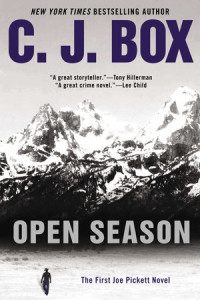
Although the first Joe Pickett novel (
Open Season) was written as a one-off at the time, the characters, themes, location, and style introduced in that book provided a great framework for the series to grow. I’ve never had to regret the foundation laid in that book. Also, because the books take place in real time the characters mature and change from book to book. For example, Joe Pickett’s daughter Sheridan is seven years old in
Open Season and now 22 in
Off the Grid. Because the characters get older and benefit (or not) from previous situations in the books I think that helps keep the series fresh. Plus, since each book includes a theme or controversy unique to the story (endangered species, alternative energy, the ethics of hunting, or in the case of
Off the Grid — domestic terrorism) they are all stand-alones in their own way.
A lot of your longtime fans will be happy that your character Nate Romanowski features prominently in Off the Grid. From a writer’s standpoint, what is involved in making Nate so interesting and unpredictable?
Unlike just about every other character in the series, Nate Romanowski is based on a friend of mine although I’ve exaggerated (Thank God) his personality. The buddy I grew up with was a big blonde middle linebacker who later went on to join the military and special forces. He took me falconry hunting and through him I was introduced to the very strange and fascinating world of falconers and the mindset that goes with it. And, of course, Nate carries one of the largest handguns in the world and he’s good with it.
For a reader coming to your Joe Pickett novels for the first time, which of your backlist titles, from Open Season onward, would you recommend they check out first and why?
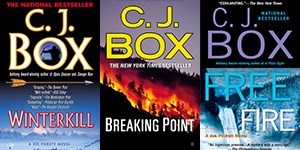
Tough question, since in their way each book stands alone. No reader would be hopelessly lost starting with any book in the series. Of course, those who’ve read them all say it’s important to start with OPEN SEASON so the reader can experience Joe’s family growing and changing, and I probably lean that direction. But there are certain books —
Winterkill,
Free Fire,
Breaking Point, and
Off the Grid – that I think could be good entry points into the series.
Find out more about C.J. Box’s books below.

Sabaa Tahir wrote the popular new Young Adult novel,
An Ember in the Ashes last year. On
Word and Film, she shared some of her inspiration and background as a writer.
“I grew up feeling voiceless and powerless as a kid. I turned to books – fantasy books, in particular – to give me comfort. As I grew up I realized I could find that sense of power and voice if I simply started writing.”
Read more about Sabaa
here and listen to her fantastic interview on
Beaks and Geeks!

We know readers tend to be writers too, so we feature writing tips from our authors. Who better to offer advice, insight, and inspiration than the authors you admire? They’ll answer several questions about their work, share their go-to techniques and more. Now, get writing!
After developing an idea, what is the first action you take when beginning to write?
Given the nature of historical fiction, the first thing I do is a lot of research. And that usually begins with reading old newspapers. Thanks to digitization, that’s much easier to do than it once was. Alas, also thanks to digitization, we’re creating far fewer new newspapers than before.
Did you always want to write? How did you start your career as an author?
I started to write a political novel (about the impeachment of a president) when I was thirteen or fourteen. By the time I got halfway through college, writing had become my serious ambition, but my own timidity drew me toward teaching and, for a while, the publication of constrained little pieces in academic journals. The best thing that happened to me early on, at the beginning of the 1980s, was becoming a semi-regular contributor to William F. Buckley, Jr.’s National Review. The 800-word book reviews I wrote for the magazine usually earned me about $150 or $200; more importantly, they forced my writing toward a greater concision and liveliness, a more personal, honest voice. All of that helped me to write A Book of One’s Own: People and Their Diaries (1984), an unexpected success (my picture in Time magazine!) that gave me the real beginnings of my career.
Describe your writing style in five words or less.
Fact-filled, parenthetical; judgmental; amused.
Do you ever base characters off people you know? Why or why not?
A historical novelist really has to use real-life figures in his work. A couple of times I’ve included, under their own names, people I’ve actually known: E. Howard Hunt in Watergate, and my late friend Christopher Hitchens in Finale. And yes, I’ve also refracted and disguised and renamed real people in some of my other novels. I mention Mary McCarthy below; she appears as the writer Elizabeth Wheatley in my novel Aurora 7. And Bandbox (2004), my comedy about the magazine business, is really a roman à clef that sprang from my time at Condé Nast. A writer’s whole life and acquaintance are always a part of his material. In fact, I would go so far as to say that no character in a novel has ever been made from whole cloth.
What are three or four books that influenced your writing, or had a profound effect on you?
At about ten or eleven I was a great devotee of Howard Pyle’s novel about knighthood, Men of Iron, although my real pleasure-reading in elementary school came from one publisher’s American-biography series. Every one of these books was, I seem to remember, 192 pages long, whether the subject was George Washington or Molly Pitcher.
During junior high school I got caught up in the great excitement over the publication of Truman Capote’s In Cold Blood. Buying hardback books was beyond my allowance, and I couldn’t wait for a public library copy, so I secured the book (was it for fifteen cents a day?) from the little “rental library” on the main street of my town. When my ninth-grade English teacher saw me with an early copy, she was jealous.
Mary McCarthy’s volume of essays, On the Contrary: Articles of Belief, 1946-1961, is the book that really made me want to become a writer. I read it in 1971, at college, and the book’s combination of literary criticism, political essays, memoir and travel writing suggested the whole range of genres I might try myself. I read all of McCarthy’s fiction, too. She became the subject of my undergraduate thesis, then later a friend and mentor. To this day I aspire to the clarity and force of her style, even though my own is nothing like hers.





