
Tag Archives: writing

Writing Tips from Elizabeth Berg, author of The Dream Lover

We know readers tend to be writers too, so twice a month, we’ll feature writing tips from our authors. Who better to offer advice, insight, and inspiration than the authors you admire? They’ll answer several questions about their work, share their go-to techniques and more. Now, get writing! 

Do you ever base characters on people you know?

All the time! And I think you’d be hard-pressed to find a writer who wouldn’t say the same thing. But. Even if you do base a character on a person you know, that person becomes changed in small or large ways to accommodate the story you are trying to tell. So in the end, a real person becomes a made-up person. That’s the way it works for me in fiction, anyway.

How would you recommend creating and getting to know your characters?

For some writers, characters just come to them, though they are usually vague at first, ill formed.  As the writer keeps on with the story,  the characters reveal more and more about themselves.

There are times, though, when a character comes out of nowhere, fully formed; I love when that happens. HOW it happens, I have no idea. It’s like finding a four- leaf clover.

Some writers are very meticulous about keeping notebooks, compiling details that will go into making up a character, and so by the time they start writing, the character is pretty much determined: how he looks and acts and says is less of a surprise.

If you want to write, you need to find out what methods work best for you. It’s always best for me when it’s FUN writing a character, even the obnoxious ones–in fact, the obnoxious ones might be the most fun to write.

How is writing historical fiction different from other fiction?

I think what’s most important in historical fiction is that it feels like the story is actually taking place in whatever time you set it. People need to talk a certain way, have certain ways of doing things, have certain expectations of each other, certain moral codes. Clothes need to be right. Food. The political and social climate. You take on a lot of responsibility when you write historical fiction. You have a contract with a reader that you will take them somewhere else in time; you don’t want them feeling like they’re seeing behind the curtain. It’s much harder than contemporary fiction!

Is there something to do to get in the writing mood?

Yes. Write.

I don’t mean to sound flip with this answer. It seems to be true that if you just get that first sentence down, another will want to follow. That said, I’m almost always in the mood to write; it’s what I love doing most. I think if writing is an awful chore for you, if you have to trick yourself into sitting down and putting down lines, you might be better off in another line of work. Even if you’re a good writer, if you don’t like doing it, what’s the point?

What is your writing style, in five words or less?

Intimate.

Read more about The Dream Lover here.

Writing Tips from Anna North, author of The Life and Death of Sophie Stark

We know readers tend to be writers too, so twice a month, we’ll feature writing tips from our authors. Who better to offer advice, insight, and inspiration than the authors you admire? They’ll answer several questions about their work, share their go-to techniques and more. Now, get writing!  After developing an idea, what is the first action you take when beginning to write? I try to get started pretty much right away — for some reason I can never make myself outline anything, or even do all that much thinking or research before I start writing. I think I just need to see the story on the page before I know what to do with it or whether it’s working. So as soon as I have the very beginning of an idea, I usually try to start writing the story or novel as I think it might go, starting from the beginning. I don’t know if this is actually a good system — I almost always end up rewriting much of the beginning, and for a novel I typically spend about a year writing and rewriting before I get to a story that actually works. But so far it’s the only system I’ve been able to follow.  Is there something you do to get into a writing mood? Somewhere you go or something you do to get thinking? These are pretty clichĂ©d, but I like to make tea and sit in a chair by the window. Sometimes I even light a scented candle. If it’s a first draft, I usually write long-hand in a journal. I find the computer pretty distracting, and I can’t seem to get in a groove if I’m looking at the screen. The journal allows me to sort of slip into an alternate mental space where I can think about the story I’m trying to tell. Did you always want to write? How did you start your career as an author? I always wanted to write. Before I actually knew how to write I’d make my mom or my aunt take dictation. I produced several “books” this way. You could say I started my career as an author when I published my first short story in The Atlantic in 2005. But I didn’t necessarily feel like I’d started a career then. I wasn’t sure I could ever publish anything else, and for a long time I didn’t. When my first novel came out in 2011 I felt a little more like I had a career, but I still wasn’t sure if I’d ever be able to publish anything again. I guess I’m not sure I’ll ever fully feel like I have a career as an author — I might always feel uncertain about the next step, the next thing. I do feel like a writer most of the time now, which is different from having a career, but which still feels good. Do you ever base characters off people you know? Why or why not? Sometimes when I’m thinking about what a character looks like, I’ll imagine people I know, but usually not people I know well. I don’t usually base characters’ personalities on people I know — my writing isn’t usually very autobiographical, so the stories I’m writing often call for people with particular characteristics that wouldn’t necessarily match those of people I know. If anything I tend to base characters on aspects of myself. If I’m trying to think about how someone might behave in a situation, I might think about how I might act if I were a little stronger, or weaker, or meaner. And so sometimes my characters end up being an expression of a particular side of me, sometimes intentionally and sometimes not. How is writing a novel different from the kind of writing you normally do? I’m also a journalist, and writing a novel feels very different from that kind of writing in that it’s more inward. When I write a news story I’m talking to people and reading things and stitching it all together into a piece that says something about the outside world. When I write a novel I’m sort of going deep inside my own brain and building a new world in there, and then trying to communicate some of it on the page. Someday I’d love to have my brain scanned while I’m writing fiction and then while I’m writing non-fiction — I wonder if the activity would look really different. Read more about Anna North’s book, The Life and Death of Sophie Stark here.

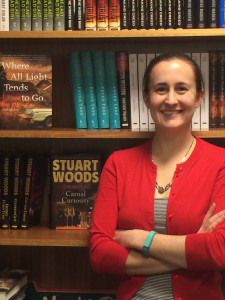
Three Questions for Putnam Editor Sara Minnich on David Joy’s debut novel Where All Light Tends to Go

Editors get very passionate about books they work on – the Editor’s Desk series is his or her place to write in-depth about what makes a certain title special. Get the real inside-scoop on how books are shaped by the people who know them best. Putnam Editor Sara Minnich answers “Three Questions for an Editor” about her work on David Joy’s Where All Light Tends to Go.  This highly praised debut novel is a savage and beautiful story of a young man seeking redemption. In the meth-dealing family at the center of the book, killing a man is considered a rite of passage, but when eighteen-year-old Jacob McNeely botches a murder, he is torn between appeasing his kingpin father and leaving the mountains with the girl he loves. The world that Jacob inhabits is bleak and unrelenting in its violence and disregard for human life, and having known nothing more, he wonders if he can muster the strength to rise above it. For a debut novelist, David Joy has a writing style that feels so natural and remarkably assured as he creates an off-the-grid world populated by authentic characters that are bound to cause readers to feel a wide range of emotions.  What were your thoughts and impressions as you read the initial manuscript for the first time? I was hooked within the first few pages of Where All Light Tends to Go. Both the writing style and the voice of the young protagonist were raw and gritty, utterly real.  After promising opening pages, I was crossing my fingers in hope that the rest of the book would hold up – and it absolutely did.  Shortly into the story things take a shocking and violent turn, and the pace only escalates from there.  Mostly I remember being unable to put it down.  The manuscript needed some work, but I knew from the first read that I loved it and that David was the real deal. How would you describe the scope of the editor/author process as Where All Light Tends to Go evolved into a finished book? The first draft that I read was in fairly solid shape in terms of the plot, pacing, and writing.  The element David and I spent the most time revising over the course of three drafts was the relationship between the hero, Jacob McNeely, and his love interest Maggie.  Maggie’s character needed to be fleshed out, and David did a lot of work to find her voice and to help the reader understand the magnetism between her and Jacob.  Their relationship was fundamentally transformed from the first draft to the final book, in a way that brought a lot of heart and hope to a story that is ultimately quite dark. This novel is not your traditional “book club” book, given the gritty nature of a lot of the stories that unfold in its pages, but it feels like a book that will spark a lot of discussions.  What kinds of readers do you think will be most attracted to Where All Light Tends to Go and why? The novel falls firmly in the category of country noir, so would be perfect for readers of Daniel Woodrell and Larry Brown.  Fans of shows like “Breaking Bad” or “Justified” would also find much to enjoy – a strong sense of place, characters that leap off the page, a grim and intense story, and a relentless pace. where-all-light-tends-to-go-by-david-joy Read more about Where All Light Tends to Go by David Joy here.

Three Questions for Random House VP & Executive Editor Kara Cesare on The One That Got Away

Kara Cesare, Vice President & Executive Editor, Random House Group, offers insights into her work with debut novelist Bethany Chase and the newly released The One That Got Away.  Full of both humor and heartbreak, this book tells the story of one woman’s discovery that, sometimes, life is what happens when you leave the blueprints behind. Having been the editor of a broad range of bestselling, award-winning authors, from Janet Evanovich to Lisa See, what was it about Bethany Chase and The One That Got Away that captured your interest and made you want to acquire and edit her novel? I fell into The One That Got Away immediately, and I didn’t stop reading until I turned the last page, which speaks to Bethany’s storytelling talent. I appreciated her gift for creating relatable, winning characters looking for love, but also searching for their place in the world. I missed the characters as soon as I finished the novel—that’s how vivid they were to me, and that’s when I knew I wanted to acquire such an impressive, emotional, and romantic debut. I was also very inspired by Bethany’s strong aesthetics in the novel—she’s an interior designer by trade and her descriptions of architecture and design are so mesmerizing. How would you describe the editor/author process of working with Bethany and what was involved in the evolution of this title from initial manuscript to finished book? Bethany is an incredible partner in publishing. We connected the first time we spoke about the novel, and she was open and receptive to the editorial notes I shared with her. She was very engaged in the editorial dialogue we had and was sincerely invested in making the novel as strong as it could possibly be. Who do you feel will be most attracted to The One That Got Away and what elements of the characters and the story will resonate most powerfully with readers? I think the premise—What would happen if you got a second chance at a love that almost was?—is really intriguing. Her opening is enticing: “Every woman has one. That name you Google at two o’clock in the morning. The intoxicating connection that somehow never solidified into anything real; that particular memory you still visit every now and then, for that guaranteed hit of pure, sugar-packed dopamine.” There’s an irresistible love story at the center of the novel, but there are also wonderful and poignant themes running through it about family, grief, resilience, and of creating a sense of home for yourself that I think will resonate. My hope is that the heart, wisdom, and humor that pervades this novel will appeal to readers looking for a great new voice in fiction, and that their discovery of this new talent will be one they can’t wait to share with their friends! Read more about The One That Got Away here.
everything you ever wanted by jillian lauren

Writing Tips from Jillian Lauren: My 3 Favorite Writing Tips You’re Going to Hate

We know readers tend to be writers too, so twice a month, we’ll feature writing tips from our authors. Who better to offer advice, insight, and inspiration than the authors you admire? They’ll answer several questions about their work, share their go-to techniques and more. Now, get writing!  Write a s***ty first draft. If I could give you only one piece of advice, it would be this. I didn’t make up—I heard it from Anne Lamott— thanks, Anne! Anne Lamott didn’t make it up either. Every writer since the beginning of time has written some god-awful, hideous nonsense at one time or another. I write straight through to the end of a book without once looking back. Not everyone does it this way— some people edit as they go. But for me, this is a great way to get out from under your own self-judgment. Sometimes I barely even punctuate my first drafts. I like to soft focus my eyes and write as if in a trance, going on tangents, allowing the most treacly sentimentality and absurd hyperbole. I breathe and write and try to open my mind to the click, the spark, the flow. I soldier on this way until The End. By that time I usually have some idea of what my book is about. It’s never what I thought when I started. Move around. Take a walk. Stretch. Breathe. Don’t live in your head so much that you forget your body. The body is one of our greatest recording devices– a goldmine of wisdom, memory and emotion. It digests and assimilates our thoughts and experiences, taking on a perspective that is often wiser than our intellect, and more accurate. There is no secret. I know you don’t want to hear “write badly” and “take a walk.” Usually what people ask for is my schedule (here it is: mornings, at least four hours a day, five days a week), a template for the perfect outline, a recommendation to the magic graduate school, a shortcut, an agent introduction, a way to make it not hurt so much. I often talk to people who are “stuck” with their memoirs, and watch their face fall when I ask them, “Have you thought about writing it straight through to the end and not looking back?” They usually have a million reasons why they can’t or shouldn’t do that. And maybe they shouldn’t. I don’t know what they need. But I do know three over-edited chapters won’t magically transform into a book one night while you’re sleeping. Writers are readers. We have grown up treasuring the books we devoured late at night, by the light of a stolen flashlight. We dreamed one day we’d be the name on the cover of just such a precious object. That may or may not happen, but either way it’s a worthy quest. It’s so easy to forget, while caught up in the morass of self-doubt and self-pity that can swamp our fragile writer souls, that this life of struggle is a dream come true. I love it fiercely. I hope I get to keep doing it until the day I die. Read more about Jillian Lauren’s book, Everything You Ever Wanted here.