
Tag Archives: literary fiction

Writing Tips from Mona Awad, author of 13 ways of Looking at a Fat Girl

We know readers tend to be writers too, so we feature writing tips from our authors. Who better to offer advice, insight, and inspiration than the authors you admire? They’ll answer several questions about their work, share their go-to techniques and more. Now, get writing! 

Did you always want to write? How did you start your career as an author? 

I started writing quite young. My mother worked in a deli in Montreal and when I was little, she would take me with her for the day. I would write monster stories and fairy tales for her (and me) on the backs of the paper placemats—mainly to entertain myself but also for the sheer pleasure and escape of building another world. I remember being flush with joy and excitement when I thought I had a novel on my hands at the age of 7 or so. Needless to say, that didn’t pan out.

 Is there something you do to get into a writing mood? Somewhere you go or something you do to get thinking?

 My main routine is to write in the morning in silence. I make coffee and then I turn everything off, including my phone and Internet connection, for as long as I can either stand or get away with. If I write in the morning like this, then I’m able to return to the story at various times later in the day and work on it regardless of where I am or the level of distraction. But I need those anchoring morning hours of silence and focus with the story in order to do that.

I also love Aimee Bender’s idea of the writing contract so I’ve done that with friends as well. You basically contractually promise to adhere to a certain number of writing rules that you determine (it could be a daily word count, or a number of hours per day) and then you check in daily via email with a ‘mentor’ (a friend) who confirms you’re moving forward. You do it with an overall writing goal in mind—like a novel—to be achieved by the contract’s end.  It’s quite loose, but what I love is that you make your own writing goal, your own rules for how you’ll reach it, and then you are required to follow through. I did it with a writer friend last summer, and we both completed drafts of our novels. And I’m doing one now with another writer friend for the revision. I like the collaborative aspect of it too—writing, while exhilarating, can also be quite a lonely, cave-dwelling business. It’s nice to come out of the cave every day and check in with a friend. 

After developing an idea, what is the first action you take when beginning to write?

I’m often inspired by a moment of tension that I’ve either observed, experienced or imagined—being in a fitting room with a dress that doesn’t fit, for example. I’ll take that point of tension and I’ll sit with it, trying to describe it with as much intimate, immediate and honest detail as possible. I’ll scrutinize it, draw it out, let myself imagine around it. By exploring a moment of tension like this, I find it acquires more layers and consequence, and a story will often emerge. Once I have the story, I can push that tension further still—in some cases, to its limits.

What are three or four books that influenced your writing, or had a profound affect on you?

My favorite stories have always been the ones that felt very intimate, like the writer really gave something vital in themselves to the telling of the story. For that reason perhaps, I love all of the novels of Jean Rhys—I love how urgent her writing is, how her characters experience outsiderness and alienation in ways that feel so immediate and visceral. Russell Hoban is another favorite. Not only is he a beautiful writer, but I love how he conceives that space between what we perceive to be reality and reality—a space that is inherently fraught with our anxieties, desires and dreams—as truly imaginative. In The Lion of Boaz-Jachin and Jachin-Boaz, a son’s anger at his father is an actual lion stalking the streets of London. Perhaps this is a throw back to my placemat writing days, but I’ve always been deeply inspired and excited by fairy tales and Alice in Wonderland narratives. I adore The Torn Skirt by Rebecca Godfrey, which is essentially a feverdreamy, high stakes Alice in Wonderland for adults. The first person voice is also incredible. And of course, The Winter’s Tale by Shakespeare, which is a strange, rich and wondrous fairy tale. The wonderful thing about reading or seeing Shakespeare is that no matter what hot mess of emotions you’re experiencing in your life—pettiness, hatred, fear, desire, joy, sadness, love, resentment—they become eerily performed by the play in question. Will’s got you covered. Within the stories, the characters, the language, there’s room for it all. Also, I love humor. Without writers like Dorothy Parker, Lydia Davis or Lorrie Moore, I would feel lost.

Learn more about Mona Awad’s new book below!

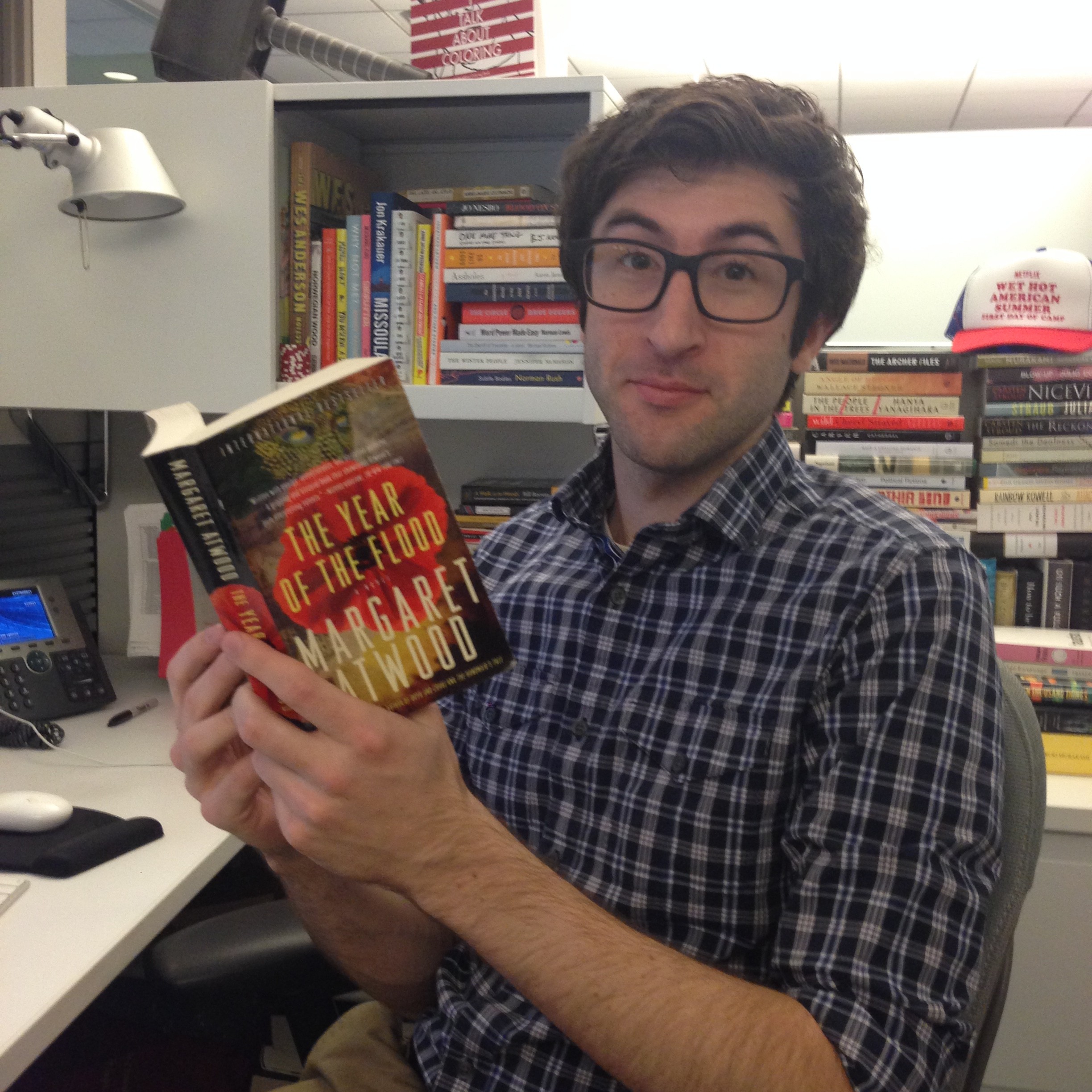
Bookspotting: Adam is reading The Year of the Flood by Margaret Atwood

Ever wonder what Penguin Random House employees are reading? We’re a bunch of professionally bookish people, so you can always count on us to have a book on hand
 or thirty piled on our desks. Our Bookspotting feature shows off the range of readers behind the scenes at Penguin Random House. adam maid Adam, Social Media and Digital Publishing for Vintage and Anchor books, is reading The Year of the Flood by Margaret Atwood. Find out more about the book here:  

Deb Garrison, Senior Editor at Pantheon, on The Stargazer’s Sister by Carrie Brown

The Stargazer’s Sister, Carrie Brown’s novel based on the life of Caroline (Lina) Herschel, the sister of the great 19th century astronomer William Herschel, and a noted astronomer herself, is my third project with Carrie and the first time we’ve worked on a historical novel together. In many respects this felt different, because of Carrie’s desire to be loyal to a life about which there is much on record—Lina Herschel has been the subject of biographies, alongside her brother—and to the actual stargazing they conducted. Carrie’s acknowledgments include a professor of physics and graduate students in the field, who helped her understand the mathematics of the brother-sister duo and the skies they observed with revolutionary results. Their success was due to, among other factors, William’s single-minded passion to build a telescope bigger than seemed possible—a wonderful episode in the novel where we see how truly remarkable it is when science is in the making: there are people who think of things that no one has thought of before and find ways to carry out their vision, despite the skepticism that surrounds them. I was awed by the world Carrie made vivid to me and at the same time, a good litmus test for the casual reader who may not have any particular interest in chasing comets but who cares deeply about women’s lives. Carrie’s job was to be historically accurate but to also help us understand the wonder of who Lina was—to invent a voice for her, and to create living episodes for this budding feminist. Lina was a career woman so much before her time that it seems ludicrous to use the term; she had a vocation, and made major sacrifices for it. She also sacrificed much to be by her brother’s side, to run his household in Bath, cooking and cleaning and keeping accounts for a thriving scientific enterprise that took place quite literally in the siblings’ backyard. As Carrie shows us, Lina had an unwavering if complex loyalty to William, who saved her from a life of misery at the hands of her aging and unhappy mother in Hanover, Germany. Because Lina was scarred and her growth stunted by typhus in her youth, she was not suitable to be married off; William recognized Lina’s superior intellectual gifts, paying for the ongoing care of his mother in order to free Lina from imprisonment as her caretaker and drudge-mate forever. What ensues is that she became his own caretaker and drudge-mate, yet also the necessary enabler of his genius—one mathematically gifted enough to work out the calculations needed to record what he sees in the skies during their obsessive and sometimes bone-chilling nightly observations. In The Stargazer’s Sister, Carrie moves the reader with a grace and insight similar to that of her previous Pantheon titles, The Rope Walk, about a ten-year-old girl losing innocence and discovering adult fallibility, and The Last First Day, about the wife of a beloved prep school headmaster. Whether historical or not, her novels expose the tenderness and uncertainty of female strength as it comes into being. Her interest in the female psyche and how it develops, is revealed to its bearer, and is bodied forth in true acts in the world, hovers between the lines throughout her work. Without caring especially for what shines in the sky (though Carrie does beautifully with the vastness of heaven, its treasures suddenly near to the eye for the first time in history), a reader can be fully riveted by Lina’s story – that of a girl with a curious and potent brain becoming a woman by following her entirely unique path. I am delighted to read the excellent reviews so far for this winning novel! Learn more about the book below!

Writing Tips from Kristopher Jansma, author of Why We Came to the City

We know readers tend to be writers too, so we feature writing tips from our authors. Who better to offer advice, insight, and inspiration than the authors you admire? They’ll answer several questions about their work, share their go-to techniques and more. Now, get writing!   How would you recommend creating and getting to know your characters? More often than not I start by trying to capture an inner voice or set of actions. As an exercise, I picture characters either sitting down or standing up, and spend a full page describing them. It gives me a chance to zoom in on small but significant details of their bodies and movements; before long I’m peering into their thoughts and feelings and imagining them moving around. You don’t want to introduce a character in a static way, like a model posed for a photograph. You want a reader to meet characters who appear busy going about their lives, which have gone on long before the story began and he or she arrived to observe them. Did you always want to write? How did you start your career as an author? I wrote even before I wanted to be a writer. In early grade school my class had to write in one of those black-and-white-marbled journals every day after recess, and I would often write down things about the make-believe games that my friends and I had played outside—time spent becoming superheroes, slaying dragons, that sort of thing. One day in the fourth grade we were assigned a long-term substitute teacher because our first one had gotten sick, and this new teacher didn’t like that we were using journal time to write about “made-up stuff.” I didn’t even know what she meant by that. It was all perfectly real to me. Somehow I got nominated to take our side of the fight to the principal, and she completely surprised me by agreeing that it was important to write down the kinds of stories I loved. She compromised, giving us new journals with red covers and allowing us to write in them after we had written in the marble notebooks for five minutes. So that was that. My first schism between nonfiction and fiction, and my first moment of fighting for my art. Even then it wasn’t until I think the seventh grade that it really dawned on me that writing could be a job, that all these books I loved to read had been written by real people—and that I could someday write my own. What’s the best piece of advice you have received?  About writing? A few years ago I went to Princeton for the afternoon to read through some old unpublished stories and letters belonging to J. D. Salinger, the famous recluse. One of the letters, to his editor, was sent from either basic Army training or the Western Front. And Salinger said, of his own early stories, “I’m beginning to feel that no writer has the right to tear his characters apart if he doesn’t know how, or feel that he knows how (poor sucker) to put them together again. I’m tired . . . my God, so tired . . . of leaving them all broken on the page with just ‘The End’ written underneath.” And reading that just set something off in me. I realized that was all I knew how to do with fiction, and I immediately resolved to learn how to put them back together again. It changed everything for me. Do you ever base characters off people you know? Why or why not? I think we all do that, whether consciously or unconsciously. Often a character may emerge as a thinly veiled version of someone I know, and then through the writing process that veil grows more and more substantial until the original person is nowhere to be found anymore. The funny thing about it is that I might borrow a few details about a character from the life of a friend, and often that friend is fine—and sometimes even flattered—if he or she ever notices. But I’ll also face situations when friends come up to me and say, “Oh, this character here is totally based on X, right?” and X will be a completely different friend, someone I had never thought about consciously. And yet I can see what they mean. . . . Learn more about Why We Came to the City below.

Ed Park, Executive Editor at Penguin Press, on The Portable Veblen by Elizabeth McKenzie

Ed Park, Executive Editor at Penguin Press, shares his insights into editing Elizabeth McKenzie’s new novel, The Portable Veblen, which went on sale Tuesday, January 19. Take it away, Ed! I joined Penguin Press in late 2014, and about two minutes later was sent Elizabeth McKenzie’s novel The Portable Veblen. The title made me smile, I remember, and every sentence that followed felt unbelievably fresh to me. It’s the story of a fraught engagement between seeming opposites: thirty-year-old Veblen, a down-to-earth office temp with a sideline in translating from the Norwegian, and Paul, an ambitious neurologist who’s being wooed by Big Pharma and the Department of Defense. Will they make it to the altar? Everything from the Palo Alto setting to the soulful squirrel that Veblen connects with (and Paul wouldn’t mind destroying) was at once strikingly original and true to life. EdParkVeblenJan2016 It’s been such a joy to watch the excitement build for this one-of-a-kind novel, with sales falling under its spell, and booksellers singing its praises. Along with being an IndieNext pick, Veblen has also received three starred pre-pub reviews and been selected by prominent indies for their signed first edition book clubs. Adam Kirsch’s early Veblen review in Slate took the thoughts right out of my head: “No matter how many novels you’ve read, it’s safe to say you’ve never read a novel like The Portable Veblen.” It’s true! Thinking about the list I’ve put together so far, I’m hoping something similar can be said for every title. For now, let’s begin with a young woman named after the economist Thorstein Veblen, and a very charismatic squirrel


Bookspotting: Kristin is reading The Girls by Emma Cline

Ever wonder what Penguin Random House employees are reading? We’re a bunch of professionally bookish people, so you can always count on us to have a book on hand
 or thirty piled on our desks. Our Bookspotting feature shows off the range of readers behind the scenes at Penguin Random House. Kristin, in consumer marketing, is reading an advance reading copy of The Girls by Emma Cline Find out more about the book here:
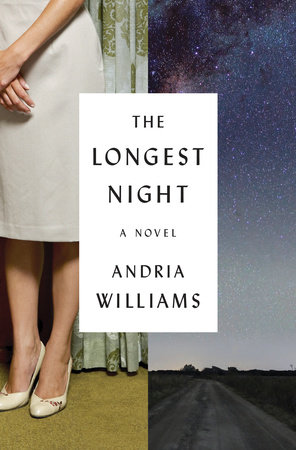
Andrea Walker, Executive Editor at Random House, on The Longest Night by Andria Williams

Editors get very passionate about books they work on – the Editor’s Desk series is his or her place to write in-depth about what makes a certain title special. Get the real inside-scoop on how books are shaped by the people who know them best.

Andria Williams’ debut novel The Longest Night is a book about many things—the Cold War, the American West, gender roles in the 1960s, the birth of nuclear power—but above all it is a portrait of a marriage and the forces that challenge it.  I was immediately drawn into the story by the opening scene of the novel—a man named Paul, racing through the night on a rural road, passing an ambulance and fire trucks that are rushing away from an accident that he is driving towards.  What is taking him there, compelling him to put himself in terrible danger?  Who is he trying to save?

Before we can get answers to this question the novel flashes back to a blindingly hot summer day, three years earlier.  A young family are driving cross-country from Virginia to Idaho Falls, where the husband, Paul, has been stationed for his next army tour.  They stop at a lake in northern Utah where local teenagers are diving from the rocks.  The wife, Nat, is desperate to cool off, and leaves her one and three year old daughters while she climbs to the top of the cliff and dives in, fully clothed.  When she emerges from the lake Paul is furious—embarrassed, ashamed, scared she could have hurt herself.  But as a reader, I was fascinated.  I wanted to know what Nat was looking for in that moment of freedom.  Did she just want to escape the demands of being a wife and mother for those brief seconds?  Did she want to show her husband that she was her own person, still?   Did she want to set an example of fearlessness for her daughters, or was she not thinking of them at all?

longest

When I describe Andria’s novel I often say that it reminds me of Revolutionary Road, if such a book were set in the American West.  That is to say—it is a story about frustrated ambition; domesticity; the stifling social norms of a small town, ruled by a cabal of wives who never fail to match the color of their centerpieces to the tablecloths.  Yet it is also a story about how love changes in a marriage—how it is shaped by distance and separation; the birth of children; by our challenges in reconciling our adult selves with our adolescent ones.  It is a story rooted in a uniquely specific time and place, that is utterly universal in its implications.  I hope you will enjoy reading it.

Read more about the book here.