Read below – Deanna Raybourn, author of the Veronica Speedwell Mysteries gives advice for plunging into Christie’s intimidatingly large catalog;
A few weeks ago a Twitter pal shyly confessed that she’d never read Agatha Christie before and was asking for advice on where to begin. And I admit, I had to sit down until the excitement passed. I never thought I would find a reader who hadn’t read Christie, and it was wildly thrilling to contemplate all the pleasures she had in store. I envied her deeply. There are few joys in life more simple and complete than discovering a new writer—a profoundly prolific new writer. (Christie’s career spanned the better part of five decades and few years went by without a new publication.) My Twitter friend could read for years and still have new Christie novels to discover, and because of this, I thought it might be a kindness to compile a sort of “Agatha 101” to steer her reading as she embarks. But that brought me to the thorny question of where to begin?
Of course, that’s a subject that has been known to end in bloodshed. There are the Poirot purists, the people who believe fervently that the natty little Belgian detective is Christie’s best and most accomplished sleuth. They are firmly and vehemently opposed by the adherents of Miss Marple, the well-beloved and dithery amateur detective from the tiny village of St. Mary Mead. Miss Marple spends her days in gardening and gossip and is just as concerned with the disappearance of a gill of picked shrimps as with unmasking murderers. You almost could not find two detectives with less in common. Poirot is urbane and sophisticated, a professional detective with a cosmopolitan lifestyle, committed to justice and able to command hefty fees for his services. Miss Marple is a fluttery spinster with maid troubles, too many shawls, and a mind like a sink, according to her nephew Raymond. Unlike Poirot’s rather more cerebral approach, she invariably solves crimes by invoking the village parallel on the grounds that human nature is much the same wherever one goes.
So how to choose between them? The answer is that you simply cannot. In order to appreciate Christie in her full glory, you have to read both and there is no middle ground. One might argue that Christie is at the height of her plotting powers with Poirot while Marple gives her complete scope for developing characters, but that would be splitting an abundance of hairs. Both detectives’ adventures are deeply satisfying.
For the inaugural book, I always suggest the delectably atmospheric Death on the Nile. This was the first proper “grown-up” mystery my grandmother ever gave me—I was ten at the time–and for that reason alone it holds a special place in my heart. I also remember picking it up to reread during my honeymoon cruise which is deliciously ironic when you realize that the entire plot centers around the murder of a bride on her newlywed cruise…But it stood up to that rereading and half a dozen since. The combination of exotic setting, unforgettable characters, and Poirot at the height of his powers is irresistible.
Since I propose starting with a Poirot adventure, it is only fair that Miss Marple gets equal time with Murder at the Vicarage. It is almost a crapshoot for me, choosing from amongst the Marple books, but I particularly like this one as it is set squarely in St. Mary Mead, and the spinster is best appreciated in her natural habitat. There are domestic disturbances and hidden scandals aplenty with lots of red herrings nicely sautéed and served up with a flourish.
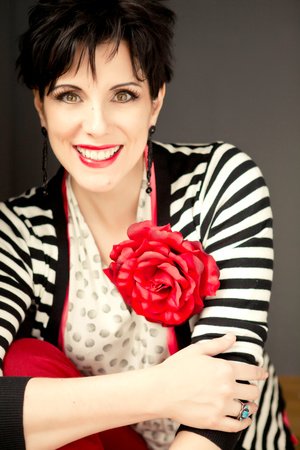
Deanna Raybourn
My next Poirot pick will be controversial because I would, admittedly with hesitation, plump for The Murder of Roger Ackroyd. The wailing you hear is everyone who just realized I have overlooked Murder on the Orient Express. But we had an exotic crime with a twisty solution inDeath on the Nile; in Ackroyd we have Poirot in what passes for exotic to him—a small English village. Seeing him in Miss Marple’s usual milieu is vastly entertaining. I propose it simply because the solution is one of the cleverest conjuring tricks Christie ever pulled off. It is a master class in plotting, and reading it was the first time I understood and appreciated precisely how brilliant Christie could be. (Of course, Orient Express has its own brilliance which is why it is a classic and you must read it too. So there, two for the price of one.)
What about a further adventure for Miss Marple? I would have to choose The Tuesday Club Murders, a collection of short stories, less for their innate Marpleness (she’s a minor character here, often narrating more than acting) than for the fact that these clever little stories show off Christie’s inimitable talent for creating perfectly-realized characters with just a few strokes of the pen. Craving something longer? Then by all means, A Murder is Announced is what you want. It is a “small” book with a murder in a private house with a limited number of suspects, but it is a splendid example of how Christie played fair with readers, but just barely.
And when you have finished with the canon—did you meet the charming Tommy and Tuppy? Ariadne Oliver? Parker Pyne? Harley Quinn?—and you are in the mood for some nonfiction, Christie has something to offer there as well. Come, Tell Me How You Live is a memoir of her time as the wife and occasional assistant of esteemed archaeologist Sir Max Mallowan. Christie accompanied him on numerous digs to Syria, recording life as she saw it in luscious detail. Her experiences there inspired her to write Murder in Mesopotamia and Appointment with Death, both Poirot mysteries.
Of course, pondering Poirot has made me wonder how I could have forgotten Evil Under the Sun! Well, best add that to the list along with The Moving Finger and The Body in the Library because you can never have too much of a good thing. And Agatha Christie novels are a very good thing indeed. So, my advice to my Twitter pal is to brew a pot of good strong Darjeeling or pour a stiff cocktail and settle in. She’s going to be there for awhile…
Check out Deanna Raybourn’s books below:
We know readers tend to be writers too, so we feature writing tips from our authors. Who better to offer advice, insight, and inspiration than the authors you admire? They’ll answer several questions about their work, share their go-to techniques and more. Now, get writing! What writing techniques have you found most important or memorable?
I write really fast, not worrying about making mistakes when I’m working on a first draft. I think novice writers make a mistake when they worry too much about where their novel is going, or get buried in too much outline. Surprise yourself, sentence by sentence; don’t worry about the next chapter. In reality, the first page of your novel is the most important of all. It’s where you define the pace and mood of your story.
What’s the best piece of advice you have received?
I was fortunate enough to study with the late Grace Paley. I remember showing her a story and she told me there was no conflict in it. I gave her this blank face, so she suddenly slapped her hands together, so that I could hear what conflict was. It was the simplest writing lesson I’ve ever had, but one that I’ve never forgotten.
What are three or four books that influenced your writing, or had a profound affect on you?
Isaac Babel’s Red Cavalry is fantastic. These are connected short stories based on the civil war in Russia and he has this enviable minimalistic style. He doesn’t waste a single word.
Where I’m Calling From by Raymond Carver. Carver is the American version of Babel to me. These were the stories that blew me away in graduate school, especially the way the morality of each piece ends up being thrown upon the reader. I love writers who don’t tie things up neatly for the reader.
Crime and Punishment by Dostoyevsky was one of those books I read as a kid that put me in a trance. Movies never had the same levitating effect on me as a novel like that.
Describe your writing style in five words or less.
An endless sense of dread.
Learn more about The Winter Girl below:
We know readers tend to be writers too, so we feature writing tips from our authors. Who better to offer advice, insight, and inspiration than the authors you admire? They’ll answer several questions about their work, share their go-to techniques and more. Now, get writing! How would you recommend creating and getting to know your characters?
As intimately as possible. For me, that’s by writing character sketches. Not just a paragraph or two, but deep intricate stories complete with grade-school triumphs and middle-school humiliations, grandparents immigrating and parents divorcing, detailed visions of houses and part-time jobs, dead pets and young-adult heartbreak, irrelevant vignettes coming out of the woodwork.
I don’t expect for this character-sketch material to make it into the book—90 percent of it doesn’t come close, and I end up deleting most of the 10 percent that I do shoehorn into early drafts. But this backstage exercise helps me define these imaginary people, so I know how their voices sound, what they look like and even how they dress, what they’re worried about and hopeful for, what they want. So when it’s time for these characters to walk onstage, they’re ready.
What’s the best piece of advice you have received?
When I was in my mid-twenties, I was a copy editor at Doubleday, and for a brief period it was my job to help shepherd Pat Conroy’s Beach Music into the world. I ended up spending a good amount of time with Pat, who’d temporarily relocated to New York City to finish working on the manuscript. One day we walked from a meeting at his editor’s house to his hotel, the unnecessarily long way through a cold damp Central Park, while Pat peppered me with questions about my unconventional childhood in New York City in the 1970s. I eventually asked why he was so curious. And he told me that this is the most important thing for writers to do: to listen—really listen—to other people’s stories.
After developing an idea, what is the first action you take when beginning to write?
I spend a huge amount of time writing about the book, instead of writing the actual text. This includes the above-mentioned character sketches, but also scenes that I don’t know will fit anywhere, and plot notes and alternate possibilities, and a detailed outline. Sometimes I have a half-dozen documents open, and none of them is the book. For my most recent, The Travelers, I even wrote a TV treatment and a pilot script, neither of which I attempted to sell.
I think it’s useful for me to try to tell a story in different formats, especially very short ones: the one-sentence elevator pitch and the one-page flap copy. A writer can spend a decade working obsessively on a novel, but in the commerce of publishing many of the most important decisions about any book will be made based on very short pitches—from literary agent to editor to sales rep to bookstore buyer to a potential reader standing in the bookstore, asking, “What’s it about?” Every single one of those interactions is an opportunity for the book’s life to be cut short or to survive, for someone to decline or to agree, “Okay, I’ll take a look.” But I won’t be there for any of those interactions—you never get a chance to defend your book!—so instead I want to try to make sure that the book is pitchable.
Did you always want to write? How did you start your career as an author?
I did, yes. But for a long time I equated being a working novelist with being third baseman for the Yankees: an unrealistic dream, an impractical self-indulgence. After college I was burdened with student loans to repay, no financial cushion, so I wasn’t in a position to bet everything on a creative-writing career—neither the writing-workshop academia life nor the freelance-writer version, trying to scrape by on short stories and house-painting gigs. I wanted to pursue a separate freestanding career, one that would definitely put me in the path of becoming a writer, but also one that would also be tenable and satisfying if I never ended up writing a published book.
So I worked in publishing. My career got off to an extremely slow start as a direct-marketing assistant at a professional-magazine publisher (our titles included the likes of Journal of Accounting and Middle Market Lending Letter, and I was tracking the efficacy of junk-mail campaigns), but one thing led to another, and I quickly moved into the book end of things, and seven jobs later I was an associate publisher. That turned out to be the last position I quit, nearly a decade ago. I was thirty-eight years old.
Learn more about Chris Pavone’s new book below!
Off the Grid, the sixteenth Joe Pickett novel by New York Times bestselling author C.J. Box, is being published by G.P. Putnam’s Sons on March 8. Strong advance buzz has been building for this book, which revolves around how terror is found – and fought – in the wild expanses of Wyoming. Game warden Joe Pickett, his best friend Nate Romanowksi, and Joe’s daughter Sheridan are embroiled in multiple plot lines that unfurl with urgency, harrowing suspense and surprising twists. The Joe Pickett character entered the literary world in 2001 and a reviewer for The New York Times once wrote, “ … Box introduced us to his unlikely hero … a decent man who lives paycheck to paycheck and who is deeply fond of his wife and his three daughters. Pickett isn’t especially remarkable except for his honesty and for a quality that Howard Bloom attributes to Shakespeare – the ability to think everything through for himself.” Fellow Penguin Random House author Lee Child has called Box “one of today’s solid-gold, A-list, must-read writers.”Read on for a Q&A with C.J. Box.
C.J. Box agreed to respond to the following questions for Igloo:
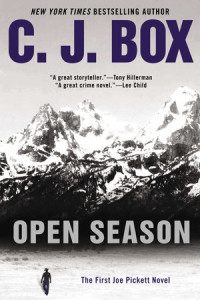
Sixteen novels in, what do you think accounts for the wealth of themes, storylines and characters that have kept your Joe Pickett series fresh and filled with surprises?Although the first Joe Pickett novel (Open Season) was written as a one-off at the time, the characters, themes, location, and style introduced in that book provided a great framework for the series to grow. I’ve never had to regret the foundation laid in that book. Also, because the books take place in real time the characters mature and change from book to book. For example, Joe Pickett’s daughter Sheridan is seven years old in Open Season and now 22 in Off the Grid. Because the characters get older and benefit (or not) from previous situations in the books I think that helps keep the series fresh. Plus, since each book includes a theme or controversy unique to the story (endangered species, alternative energy, the ethics of hunting, or in the case of Off the Grid — domestic terrorism) they are all stand-alones in their own way.
A lot of your longtime fans will be happy that your character Nate Romanowski features prominently in Off the Grid. From a writer’s standpoint, what is involved in making Nate so interesting and unpredictable?Unlike just about every other character in the series, Nate Romanowski is based on a friend of mine although I’ve exaggerated (Thank God) his personality. The buddy I grew up with was a big blonde middle linebacker who later went on to join the military and special forces. He took me falconry hunting and through him I was introduced to the very strange and fascinating world of falconers and the mindset that goes with it. And, of course, Nate carries one of the largest handguns in the world and he’s good with it.
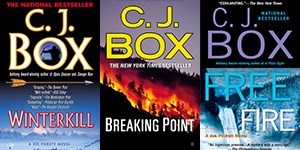
For a reader coming to your Joe Pickett novels for the first time, which of your backlist titles, from Open Season onward, would you recommend they check out first and why?Tough question, since in their way each book stands alone. No reader would be hopelessly lost starting with any book in the series. Of course, those who’ve read them all say it’s important to start with OPEN SEASON so the reader can experience Joe’s family growing and changing, and I probably lean that direction. But there are certain books —Winterkill, Free Fire, Breaking Point, andOff the Grid – that I think could be good entry points into the series.
Find out more about C.J. Box’s books below.
Ever wonder what Penguin Random House employees are reading? We’re a bunch of professionally bookish people, so you can always count on us to have a book on hand… or thirty piled on our desks. Our Bookspotting feature shows off the range of readers behind the scenes at Penguin Random House.
Kelli, in Crown production, is reading The Girl in the Spider’s Web by David Lagercrantz.
Find out more about the book here:
Ever wonder what Penguin Random House employees are reading? We’re a bunch of professionally bookish people, so you can always count on us to have a book on hand… or thirty piled on our desks. Our Bookspotting feature shows off the range of readers behind the scenes at Penguin Random House.
John, in online marketing, is reading The Hanging Girl by Jussi Adler Olsen.
Find out more about the book here:
Ever wonder what Penguin Random House employees are reading? We’re a bunch of professionally bookish people, so you can always count on us to have a book on hand… or thirty piled on our desks. Our Bookspotting feature shows off the range of readers behind the scenes at Penguin Random House.
Alex, in Crown production, is reading The Scarlatti Inheritance by Robert Ludlum.
Show us what you’re reading by using the #bookspotting hashtag!
Ever wonder what Penguin Random House employees are reading? We’re a bunch of professionally bookish people, so you can always count on us to have a book on hand… or thirty piled on our desks. Our Bookspotting feature shows off the range of readers behind the scenes at Penguin Random House.
Jalinya, Email Marketing, is reading The Girl on the Train by Paula Hawkins.
Show us what you’re reading by using the #bookspotting hashtag!







 Sara, in Knopf Doubleday marketing, is reading Shaker by Scott Frank.
Find out more about the book here:
Sara, in Knopf Doubleday marketing, is reading Shaker by Scott Frank.
Find out more about the book here:
 Tough question, since in their way each book stands alone. No reader would be hopelessly lost starting with any book in the series. Of course, those who’ve read them all say it’s important to start with OPEN SEASON so the reader can experience Joe’s family growing and changing, and I probably lean that direction. But there are certain books —
 Kelli, in Crown production, is reading The Girl in the Spider’s Web by David Lagercrantz.
Find out more about the book here:
Kelli, in Crown production, is reading The Girl in the Spider’s Web by David Lagercrantz.
Find out more about the book here:
 John, in online marketing, is reading The Hanging Girl by Jussi Adler Olsen.
Find out more about the book here:
John, in online marketing, is reading The Hanging Girl by Jussi Adler Olsen.
Find out more about the book here:
 Alex, in Crown production, is reading The Scarlatti Inheritance by Robert Ludlum.
Show us what you’re reading by using the #bookspotting hashtag!
Alex, in Crown production, is reading The Scarlatti Inheritance by Robert Ludlum.
Show us what you’re reading by using the #bookspotting hashtag!
 Jalinya, Email Marketing, is reading The Girl on the Train by Paula Hawkins.
Show us what you’re reading by using the #bookspotting hashtag!
Jalinya, Email Marketing, is reading The Girl on the Train by Paula Hawkins.
Show us what you’re reading by using the #bookspotting hashtag!


