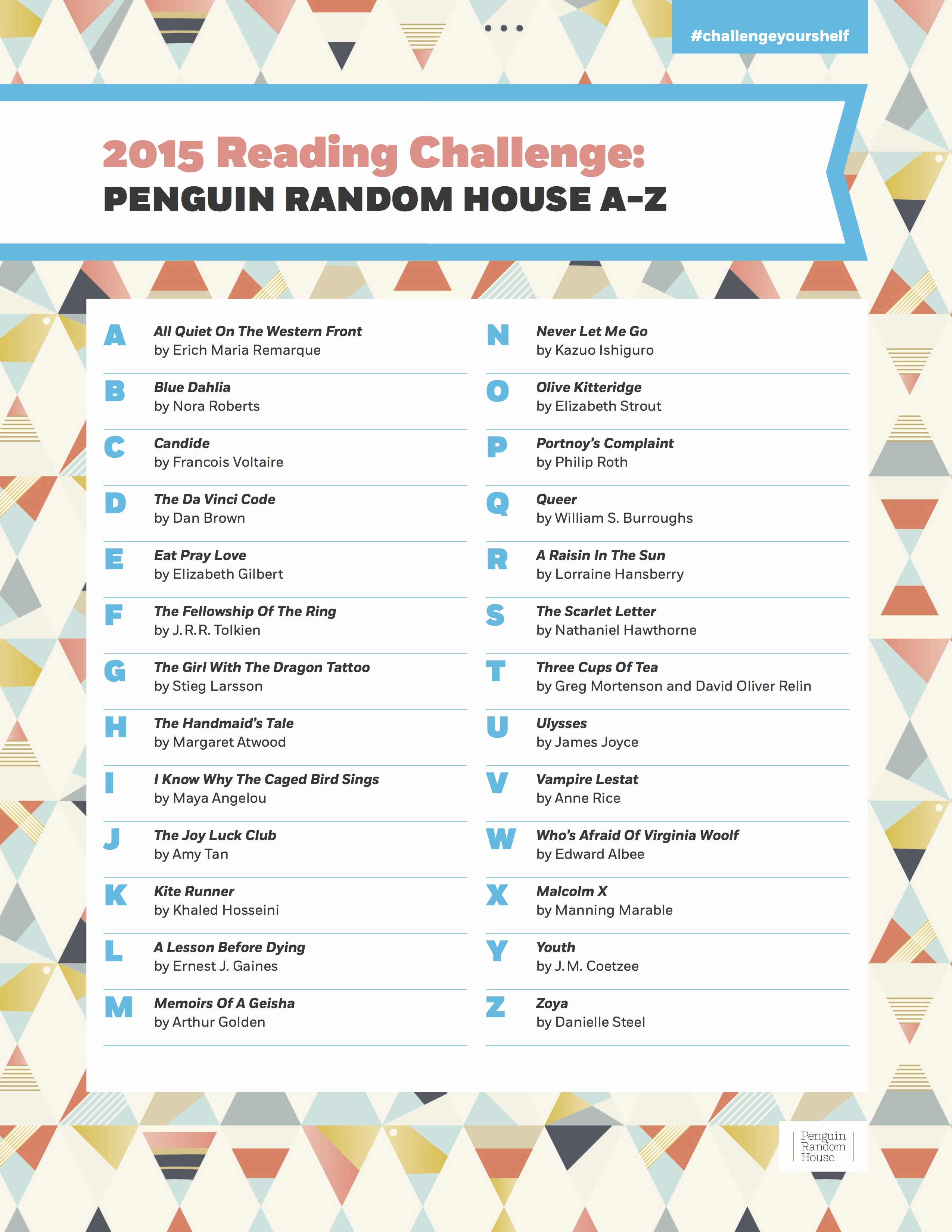
Who said reading can’t be competitive? Every few months, we’ll be challenging you to read a list of selected books. Print out the challenge and cross the titles off as you go. Show off how much you’ve read by taking a picture and tweeting @penguinrandom or Instagramming (@penguinrandomhouse) with the hashtag #challengeyourshelf.
There are always books on your to-be-read shelf, so why not challenge yourself? We picked 26 of our bestsellers, from A-Z to read. Show us how many you finish!
(click image to see full size and print out)
“An engrossing dual biography that uses recently opened Vatican archives to shed light on two men who exercised nearly absolute power over their realms.”
Congratulations to Mr. Kertzer, his editor David Ebershoff—who has edited his third Pulitzer-winning book in as many years—and everyone at the Random House Publishing Group for this proud and defining occasion for all of us at Penguin Random House.
This is the 124th time a book published by one of our current or past imprints has been honored with a Pulitzer, a humbling accomplishment unrivaled in trade-publishing history.
Rebecca Saletan, Vice President & Editorial Director, Riverhead Books, offers fascinating insights into her work with bestselling Russian-American author Masha Gessen on The Brothers: The Road to an American Tragedy.
On April 15, 2013, two homemade bombs fashioned from pressure cookers exploded near the finish line of the Boston Marathon, killing three people and wounding 264 others. The elder of the brothers suspected of committing this atrocity, Tamerlan Tsarnaev, died in the ensuing manhunt; Dzhokhar Tsarnaev was found guilty in a Boston court of all 30 counts he was charged with. How did such a nightmare come to pass? Gessen is uniquely endowed with the background, access, and talent to tell this probing and powerful story of dislocation, and the longing for clarity and identity that can reach the point of combustion. She explains who the brothers were and how they came to do what they appear to have done. Most crucially, she reconstructs the struggle between assimilation and alienation that ensued for each of the brothers, descendants of ethnic Chechens, fueling their apparent metamorphosis into a new breed of homegrown terrorist, with their feet on American soil but their loyalties elsewhere—a split in identity that seems to have incubated a deadly sense of mission.
Rebecca SaletanAt what point after the Boston Marathon bombings did the genesis of this book take place and how did you work with Masha to identify the most important elements and perspectives of this tragic story to present in book form?
It happened very quickly – within 10 days or so of the bombings. Masha was at the time still living in Moscow, and deeply immersed in researching and reporting her last book. She always thinks forward to her next project while immersed in the one she’s working on, but in this case, it wasn’t until a longtime friend suggested she take on the story of the Tsarnaev brothers that it occurred to either of us – and as soon as the idea surfaced, I realized there was no one better equipped to tell it. We immediately knew the story we were interested in wasn’t the ripped-from-the-headlines one of the bombings themselves – other books would cover that amply, and faster. The book we were interested in was about why such a tragedy comes to pass in the first place: What transpired in these brothers’ lives to make them decide to take such drastic and devastating action in a place that was as much home to them as any had ever been? By virtue of not only her background, her bilingual – actually, bicultural – fluency, and her astonishing feel for narrative, we knew she was the perfect person to tell that story. Masha herself came to the Boston area from Russia with her family in her teens, and had experienced firsthand the dislocations of the immigrant experience. She stayed in the US for a decade before she returned to Russia in her twenties to cover the transformations wracking her homeland, which included the wars in Chechnya. To report this book she traveled to places that would be dangerous if not impossible for most other reporters to access, including Dagestan and Kyrgyzstan.
What was the scope of the editor/author process as this project evolved from initial concept to finished book?
This is the fifth book of Masha’s I’ve had the privilege to publish, and we’ve developed an almost married-couple familiarity with each other’s ways at this point. She’s also an incredible storyteller who always develops a vision for what particular path she wants to take through her research and reporting to convey not only the facts but the perspective she’s arrived at. With her Putin biography, I made a major structural suggestion that resulted in a restructuring of the first half of the book – though not actually major rewriting – because I had a sense of where American readers need to be met in order to come on board the story she was telling – but in this case her sense of how to unfold the narrative was nearly flawless. She was writing fairly quickly, however, and I was seeing the book chapter by chapter, so my most useful input was line-by-line, to make the story flow as dramatically as possible and to make sure the themes she was developing resonated chapter to chapter. Sometimes I also suggested she cut back on editorializing and just let the story tell itself, reassuring her that the details she’d chosen were making the points she wanted to make. In other instances, I felt she needed to lead the reader a bit more explicitly toward the connections she was driving at. I think this is a big part of editing, standing out in the theater before the audience arrives and saying what reads clearly and doesn’t need to be hammered home, and what’s not quite coming across. Practically speaking, we have a great rhythm – Masha is a night owl whose most productive hours are from the late evening when her children go to bed until three or four in the morning, while I’m an early riser, especially when I’m in the thick of editing; so not infrequently she’d send me a chapter before she went to bed, and I’d have it back to her, with edits and comments, by the time she woke. The bombings were such a horrific atrocity that many people may not want to revisit. Just as many people, though, are still wondering, “Why and how could this happen?” What aspects of The Brothers do you feel address that question in ways not discussed before and will connect with readers most powerfully?
This is not a book about the bombings per se, and it is not about the victims and the many people who have been traumatized by the tragedy; that story has been well covered by others, in short and long form. This is a book that reconstructs the path someone might take to arrive at the decision to commit such an atrocity – what might have taken place in their background, their encounters with this culture, the shifts in their thinking. This is not to excuse or minimize it in any way. But it does call into question the received models we have been using – models of “radicalization” that are not borne out either by the research on terrorism or by the specifics of this story. We sense on some level, I think, that these models don’t make sense, but we continue to evoke them. In the process we react to such incidents in a way that inadvertently glorifies them and their perpetrators and, unfortunately, helps set the stage for more such episodes. I think this book is crucial reading for all of us because it helps us to narrate the story to ourselves in a way that actually fits the facts and might allow us to evolve a saner and ultimately safer response.
Learn more about the book here.
We know readers tend to be writers too, so twice a month, we’ll feature writing tips from our authors. Who better to offer advice, insight, and inspiration than the authors you admire? They’ll answer several questions about their work, share their go-to techniques and more. Now, get writing!
Do you ever base characters on people you know?
All the time! And I think you’d be hard-pressed to find a writer who wouldn’t say the same thing. But. Even if you do base a character on a person you know, that person becomes changed in small or large ways to accommodate the story you are trying to tell. So in the end, a real person becomes a made-up person. That’s the way it works for me in fiction, anyway.
How would you recommend creating and getting to know your characters?
For some writers, characters just come to them, though they are usually vague at first, ill formed. As the writer keeps on with the story, the characters reveal more and more about themselves.
There are times, though, when a character comes out of nowhere, fully formed; I love when that happens. HOW it happens, I have no idea. It’s like finding a four- leaf clover.
Some writers are very meticulous about keeping notebooks, compiling details that will go into making up a character, and so by the time they start writing, the character is pretty much determined: how he looks and acts and says is less of a surprise.
If you want to write, you need to find out what methods work best for you. It’s always best for me when it’s FUN writing a character, even the obnoxious ones–in fact, the obnoxious ones might be the most fun to write.
How is writing historical fiction different from other fiction?
I think what’s most important in historical fiction is that it feels like the story is actually taking place in whatever time you set it. People need to talk a certain way, have certain ways of doing things, have certain expectations of each other, certain moral codes. Clothes need to be right. Food. The political and social climate. You take on a lot of responsibility when you write historical fiction. You have a contract with a reader that you will take them somewhere else in time; you don’t want them feeling like they’re seeing behind the curtain. It’s much harder than contemporary fiction!
Is there something to do to get in the writing mood?
Yes. Write.
I don’t mean to sound flip with this answer. It seems to be true that if you just get that first sentence down, another will want to follow. That said, I’m almost always in the mood to write; it’s what I love doing most. I think if writing is an awful chore for you, if you have to trick yourself into sitting down and putting down lines, you might be better off in another line of work. Even if you’re a good writer, if you don’t like doing it, what’s the point?
What is your writing style, in five words or less?
Wine and food pairings are all well and good, but there’s no better pairing than two complementary books. Reading + Eating posts feature two titles that will inspire you to cook, read, eat, and enjoy. The gorgeous cookbook images, and handpicked recipes and quotes make for some delicious reading. Gabrielle Hamilton, famed chef and owner of the beloved Prune restaurant on the Lower East Side, tells her life of food and cooking in Blood, Bones & Butter. When it swept into bookstores in 2011, Anthony Bourdain called it, “Magnificent. Simply the best memoir by a chef ever. Ever.”
Listen to Hamilton read from her acclaimed memoir:
Paired with the memoir is Prune, Hamilton’s cookbook. It shares a name with her universally beloved restaurant and is refreshingly personal, scrappy and accessible.
“I came to see hunger as being as important a part of a stage as knife skills. Because so much starving on that trip led to such an enormous amount of time fantasizing about food, each craving became fanatically particular. Hunger was not general, ever, for just something, anything, to eat. My hunger grew so specific I could name every corner and fold of it.”
― Gabrielle Hamilton, Blood, Bones, and Butter: The Inadvertent Education of a Reluctant Chef
Try out Hamilton’s Beef Shortribs recipe from Prune! (Click image to see full size)
Dive in, get inspired, and get cooking!
If you’re planning a trip to New York City, we have you covered: Fodor’s New York City 2015. Happy eating!
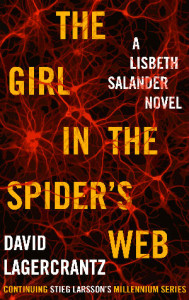
The worldwide #1 bestselling Millennium series, which was launched in the U.S. in 2008 with Stieg Larsson’s The Girl with the Dragon Tattoo, continues September 1 with the publication of Book IV in the series, the book’s title to be The Girl in the Spider’s Web. The announcement of the title and cover art reveal of the upcoming book by David Lagercrantz was made today by Sonny Mehta, Editor-in-Chief of Alfred A. Knopf, in concert with Millennium publishers around the world.
“David Lagercrantz’s familiarity and understanding of Stieg’s work as a journalist, coupled with his appreciation of Stieg’s work as a novelist, made him the perfect candidate to continue working on the Millennium series, and it is evident on every page of this extraordinary thriller,” said Mr. Mehta. “The Girl in the Spider’s Web is as good as its predecessors and uniquely of the moment. I know readers are going to be thrilled when they are reacquainted with both Lisbeth and Mikael in one of the most compelling Millennium novels to date.”
Peter Mendelsund, who created the iconic covers for the U.S. versions of the first three Millennium books, has designed the cover forThe Girl in the Spider’s Web as well. “Since the publication of The Girl with the Dragon Tattoo, we at Knopf have worked towards establishing a unique visual brand for the Millennium series – a unique visual brand for a truly unique series of thrillers. We’ve carried this thinking forward in creating our cover forThe Girl in the Spider’s Web, drawing on features from the first three jackets, while making subtle updates appropriate to this installment’s exciting new plot elements.”
The Millennium novels have sold over 80 million copies around the world since their initial publication (over 25 million of those copies in the U.S.). As with its predecessors,The Girl in the Spider’s Web will be published simultaneously in twenty-five countries around the world.
Further Afield features are from our greater Penguin Random House family. We pick interesting articles to keep you updated on genre-specific news, interviews, and more. Mary Morris, author of The Jazz Palace and several other novels, writes about six movies about the 1920s.
Morris writes,
“The Jazz Age, much like the 1960s, was a period of rebellion, a time when social mores were broken down, and everything changed. Women cut and bobbed their hair. They wore lipstick and shortened their skirts. Men carried flasks and drove around in cars, which also served as excellent places for sexual experimentation. It was also a time of deep personal and societal struggle.”
We know readers tend to be writers too, so twice a month, we’ll feature writing tips from our authors. Who better to offer advice, insight, and inspiration than the authors you admire? They’ll answer several questions about their work, share their go-to techniques and more. Now, get writing! After developing an idea, what is the first action you take when beginning to write?
I try to get started pretty much right away — for some reason I can never make myself outline anything, or even do all that much thinking or research before I start writing. I think I just need to see the story on the page before I know what to do with it or whether it’s working. So as soon as I have the very beginning of an idea, I usually try to start writing the story or novel as I think it might go, starting from the beginning. I don’t know if this is actually a good system — I almost always end up rewriting much of the beginning, and for a novel I typically spend about a year writing and rewriting before I get to a story that actually works. But so far it’s the only system I’ve been able to follow.
Is there something you do to get into a writing mood? Somewhere you go or something you do to get thinking?
These are pretty clichéd, but I like to make tea and sit in a chair by the window. Sometimes I even light a scented candle. If it’s a first draft, I usually write long-hand in a journal. I find the computer pretty distracting, and I can’t seem to get in a groove if I’m looking at the screen. The journal allows me to sort of slip into an alternate mental space where I can think about the story I’m trying to tell.
Did you always want to write? How did you start your career as an author?
I always wanted to write. Before I actually knew how to write I’d make my mom or my aunt take dictation. I produced several “books” this way. You could say I started my career as an author when I published my first short story in The Atlantic in 2005. But I didn’t necessarily feel like I’d started a career then. I wasn’t sure I could ever publish anything else, and for a long time I didn’t. When my first novel came out in 2011 I felt a little more like I had a career, but I still wasn’t sure if I’d ever be able to publish anything again. I guess I’m not sure I’ll ever fully feel like I have a career as an author — I might always feel uncertain about the next step, the next thing. I do feel like a writer most of the time now, which is different from having a career, but which still feels good.
Do you ever base characters off people you know? Why or why not?
Sometimes when I’m thinking about what a character looks like, I’ll imagine people I know, but usually not people I know well. I don’t usually base characters’ personalities on people I know — my writing isn’t usually very autobiographical, so the stories I’m writing often call for people with particular characteristics that wouldn’t necessarily match those of people I know. If anything I tend to base characters on aspects of myself. If I’m trying to think about how someone might behave in a situation, I might think about how I might act if I were a little stronger, or weaker, or meaner. And so sometimes my characters end up being an expression of a particular side of me, sometimes intentionally and sometimes not.
How is writing a novel different from the kind of writing you normally do?
I’m also a journalist, and writing a novel feels very different from that kind of writing in that it’s more inward. When I write a news story I’m talking to people and reading things and stitching it all together into a piece that says something about the outside world. When I write a novel I’m sort of going deep inside my own brain and building a new world in there, and then trying to communicate some of it on the page. Someday I’d love to have my brain scanned while I’m writing fiction and then while I’m writing non-fiction — I wonder if the activity would look really different.
Read more about Anna North’s book, The Life and Death of Sophie Starkhere.
Hop in the Backlist Time Machine! This feature is where Penguin Random House staff members recommend their favorite backlist titles – instead of the next best thing, these are the best old things. Sometimes we peer into the past on our own, to give a little extra attention to a book that still holds uptoday.
We asked one of our employees, Linda Cowen: SVP, Associate General Counsel in the Legal department, to share a favorite backlist book. She’s even memorized the first few lines of the book – see what she wrote below.
Justine, by Lawrence Durrell:
“The sea is high again today, with a thrilling flush of wind. In the midst of winter you can feel the invention of Spring. A sky of hot nude pearl until midday, crickets in sheltered places, and now the wind unpacking the great planes, ransacking the great planes.”
Why this book/lines?
I love fiction that doesn’t have a straight narrative/chronological plot. For instance, I love books of linked short stories where you don’t realize how the characters are connected until several stories in. Justine is the first book in Durrell’s Alexandria Quartet, which consists of four linked novels. They all tell a version of the same events from the points of view of four different characters, and in a slightly different style. You can’t get the whole picture unless you read all four, but also each stands on its own. And for Durrell, the city itself was the most important character. It’s quite magical, especially because pre-WWII Alexandria simply doesn’t exist in the same way anymore.
Of the four books Justine is the most lyrical, which makes sense because Justine herself is the most inscrutable character. These books also bring me back to when I first read them, in my early 20s, traveling for six weeks in Greece, a completely improvised trip. Even in the mid-1980s you could still go somewhere not too far away but be very remote, almost like time travel. I like to revisit them every few years, like visiting old friends, and also my own past. With that first line I’m immediately transported. My favorite edition is the Penguin Ink edition, with cover art by Robert Ryan. It’s just gorgeous and so evocative of the time. Just looking at it makes me want to start reading. I have a copy in my office.
– Linda F. Cowen
SVP, Associate General Counsel
Inspired by Justine? If you’re starting to dream of Egypt, Fodor’s has a great guide to Alexandria.
Editors get very passionate about books they work on – the Editor’s Desk series is his or her place to write in-depth about what makes a certain title special. Get the real inside-scoop on how books are shaped by the people who know them best.
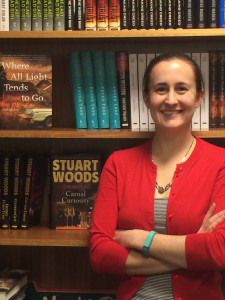
Putnam Editor Sara Minnich answers “Three Questions for an Editor” about her work on David Joy’s Where All Light Tends to Go. This highly praised debut novel is a savage and beautiful story of a young man seeking redemption.
In the meth-dealing family at the center of the book, killing a man is considered a rite of passage, but when eighteen-year-old Jacob McNeely botches a murder, he is torn between appeasing his kingpin father and leaving the mountains with the girl he loves. The world that Jacob inhabits is bleak and unrelenting in its violence and disregard for human life, and having known nothing more, he wonders if he can muster the strength to rise above it.
For a debut novelist, David Joy has a writing style that feels so natural and remarkably assured as he creates an off-the-grid world populated by authentic characters that are bound to cause readers to feel a wide range of emotions. What were your thoughts and impressions as you read the initial manuscript for the first time?
I was hooked within the first few pages of Where All Light Tends to Go.Both the writing style and the voice of the young protagonist were raw and gritty, utterly real. After promising opening pages, I was crossing my fingers in hope that the rest of the book would hold up – and it absolutely did. Shortly into the story things take a shocking and violent turn, and the pace only escalates from there. Mostly I remember being unable to put it down. The manuscript needed some work, but I knew from the first read that I loved it and that David was the real deal.
How would you describe the scope of the editor/author process as Where All Light Tends to Go evolved into a finished book?
The first draft that I read was in fairly solid shape in terms of the plot, pacing, and writing. The element David and I spent the most time revising over the course of three drafts was the relationship between the hero, Jacob McNeely, and his love interest Maggie. Maggie’s character needed to be fleshed out, and David did a lot of work to find her voice and to help the reader understand the magnetism between her and Jacob. Their relationship was fundamentally transformed from the first draft to the final book, in a way that brought a lot of heart and hope to a story that is ultimately quite dark.
This novel is not your traditional “book club” book, given the gritty nature of a lot of the stories that unfold in its pages, but it feels like a book that will spark a lot of discussions. What kinds of readers do you think will be most attracted to Where All Light Tends to Go and why?
The novel falls firmly in the category of country noir, so would be perfect for readers of Daniel Woodrell and Larry Brown. Fans of shows like “Breaking Bad” or “Justified” would also find much to enjoy – a strong sense of place, characters that leap off the page, a grim and intense story, and a relentless pace.
Read more about Where All Light Tends to Go by David Joy here.








 Paired with the memoir is
 ![Pages from Hamilton - Prune - beef shortribs[1]](https://assets.penguinrandomhouse.com/wp-content/uploads/2015/04/01075800/Pages-from-Hamilton-Prune-beef-shortribs1.jpg)



 Read more about Where All Light Tends to Go by David Joy


