Tag Archives: fiction

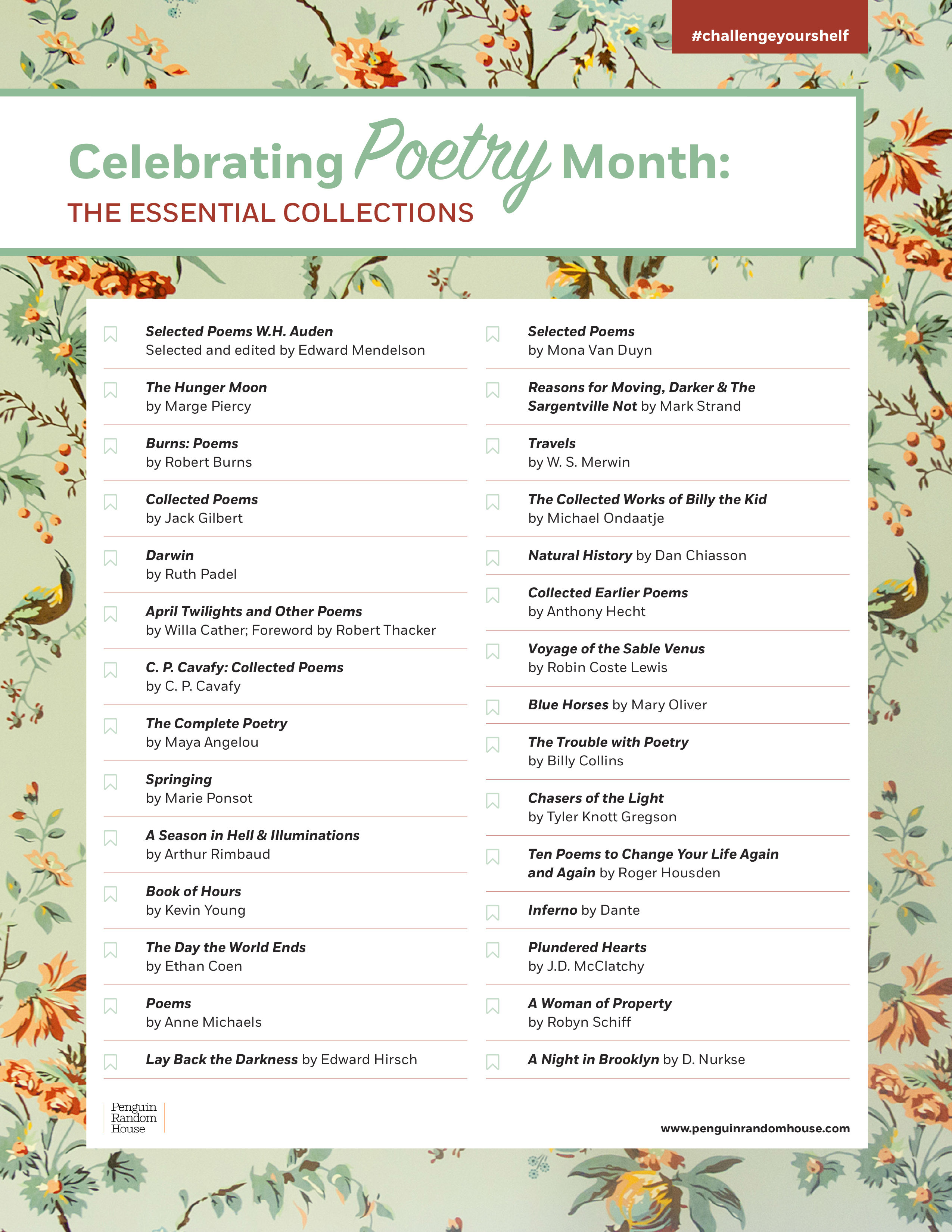
Challenge Your Shelf: Poetry Month Reading Challenge

Who said reading can’t be competitive? Every few months, we’ll be challenging you to read a list of selected books. Print out the challenge and cross the titles off as you go. Show off how much you’ve read by taking a picture and tweeting @penguinrandom or Instagramming (@penguinrandomhouse) with the hashtag #challengeyourshelf.

From the Editor’s Desk: Jake Morrissey, Executive Editor, on Three-Martini Lunch by Suzanne Rindell

Editors get very passionate about books they work on – the Editor’s Desk series is his or her place to write in-depth about what makes a certain title special. Get the real inside-scoop on how books are shaped by the people who know them best. The best present an author can give an editor is the gift of surprise. Editors spend their days reading a lot of manuscripts that don’t tell them anything new. So reading a story about a world you thought you understood framed in an unexpected way that prompts you to think differently about it, that’s hitting the publishing jackpot. Which is what I did when Three-Martini Lunch came across my desk. In this terrific novel, Suzanne Rindell delves into a world I knew something about – book publishing – but sets her story in the late 1950s, which was when big changes were about to take place. I thought I had a decent grasp of the era. I’m familiar with two other iconic New York stories from around that time: Rona Jaffe’s classic novel (and eventual movie) The Best of Everything and the television show Mad Men. In both of those, New York City is portrayed as one of the places to be in the mid-20th century. If you know anything about either The Best of Everything or Mad Men – or even Alfred Hitchcock’s 1959 movie North by Northwest – you see a New York that’s sleeker, cleaner, less crowded than it is today. And the roles of men and women were as clearly defined then as their ambitions: Success for men meant career and advancement; success for women marriage and family. In Three-Martini Lunch, Suzanne Rindell peers beyond that mid-century mindset and explores the lives and worlds of Miles, Cliff and Eden, three young people struggling to gain a toehold in New York and hoping that publishing is the way to do that. The lives they lead are a far cry from the expense-account lunches and pristine suburban enclaves of the publishing elite. These young people are drawn to Greenwich Village and its emerging beatnik culture, with its dark and smoke-filled bars, jazz clubs, and poetry readings. And they struggle to stretch their meager bank balances by living in cramped, ramshackle apartments and having just enough money for food and beer but not always both. Suzanne gives her characters fascinating opportunities to pursue their individual ambitions and indulge their temptations. Even more compelling, she shows readers how the choices they make to achieve their goals changes them. I’m not giving anything away when I say that what you think of Miles, Cliff, and Eden at the beginning of Three-Martini Lunch will not be what you think of them at the end. As I followed the characters’ journeys through successive drafts of the novel, I found myself reassessing my own ideas about what was possible in publishing, in New York, and in America during that time. It was an era on the cusp of upheaval and turmoil, and it’s that change that Suzanne Rindell explores so effectively – and so surprisingly – in Three-Martini Lunch. Which is one of the highest compliments I can pay. Learn more about Three-Martini Lunch below!

Writing Tips from Shawn Vestal, author of Daredevils

We know readers tend to be writers too, so we feature writing tips from our authors. Who better to offer advice, insight, and inspiration than the authors you admire? They’ll answer several questions about their work, share their go-to techniques and more. Now, get writing!  After developing an idea, what is the first action you take when beginning to write? I don’t usually develop an idea, and often when I do start with an idea, it falls apart in the writing. I typically have something much less than an idea that gives me the itch to write – a line, an image, an object (objects are compelling; I think of them as little pieces of grit that might accrue narrative mother-of-pearl). Lately, I have found myself writing stories inspired by titles – I get excited about something that sounds like an interesting title, and start to write a story off that excitement, and the stories often have only the loosest connection to the words in the title. I don’t quite get it, honestly. I end up in places I didn’t foresee. A couple of months ago, I stopped at a Seven-11 that had a huge sign in the window advertising a combo meal of a hot dog and soda. Built around the smaller text in the sign were two huge phrases – “Super Hot” and “Extra Large.” At a distance, they seemed to be combined into one phrase: Super Hot Extra Large. This is now the title of a story I am working on that I had no plans to write and no idea of before these magical words arrived in my mind and gave me an itch. Is there something you do to get into a writing mood? Somewhere you go or something you do to get thinking? I try to write regularly and steadily, whether or not I’m in the mood, and – like a lot of writers – I think it’s a mistake to wait for or rely upon inspiration. Inspiration often arrives after I’ve started working. But I am also not rigorous about a writing schedule. I write every day, but I don’t write fiction every day. My week is divided between writing newspaper columns at The Spokesman-Review in Spokane, and writing fiction and other work on the other days. I have come to feel that the time away from the current work in progress is crucial – time to think, to imagine myself more deeply into the characters and situations, and to begin to develop ideas for the next pages. This time away, thinking about the writing, is what energizes me most for the return, and so I cultivate it a little bit, and try to build that eagerness so I’m impatient to get started. What clichĂ©s or bad habits would you tell aspiring writers to avoid? Do you still experience them yourself? My worst habit is the desire to be done. I do enjoy writing, and I would even say I need to write on some compulsive level, but the sorry truth is that I am probably most motivated by the desire to have written, to have composed something worthy that I can try to swap for attention or vanity fuel. This has made me a reluctant reviser, and far too eager to consider a story or novel done when it still needs work. I try to overcome this in a few ways. The main one is by relying upon a couple of key friends as readers/editors who help push me. It’s also important for me to go through a kind of hot-cold cycle – a period of intense attention and effort to complete a draft (which will feel utterly complete and polished to me) followed by a stretch of ignoring the work until I can look at it again with fresh eyes and see some of the problems, so I am no longer reluctant to get in there and muck it up in an effort to fix it. Describe your writing style in 5 words or less. I often write a little long. What are three or four books that influenced your writing, or had a profound effect on you? So, so many. Here are a random few: Vonnegut’s Breakfast of Champions, which I read in my teens, gave me the idea that boundaries of what could be a book were much wider – and weirder – than I had realized. DeLillo’s White Noise, which I read as a young adult, impressed upon me a sense of the way both prose and ideas within a work could operate at slightly canted, surprising angles. I love the way his sentences move, the odd rhythms and combinations, and I love the way he incorporates bigger themes and ideas, in rhythms and combinations that are similarly unexpected. McCarthy’s Blood Meridian horrified me as it engrossed and captivated me, and while some of the book’s philosophizing is less interesting to me than it once was, there remains something unique in the energy of that experience that draws me back – the grotesqueries of westward expansion cast in language that draws beautifully upon venerable old verbal rhythms. It’s like a scripture telling the ugliest truth about Manifest Destiny. Kelly Link’s Magic for Beginners, which I read as a 40-something grad student, changed my attitude toward the literary possibilities of fantasy, science fiction, the surreal, magic, etc., and opened up a new and hopefully not-too-imitative strain in my writing. And then, when I had strayed perhaps too far from the here and now, Alice Munro’s “Runaway,” which I also read as a 40-something grad student, reminded once again of the possibilities for magic in lives that only seem routine. Thomas Bernhard’s Woodcutters is probably the book that’s in my head the most now. Reading his feverish, run-on rants makes me want to produce prose that can do that – lift readers and carry them with such force that they can no longer get hold of the riverbank. Learn more about Daredevils below.      

Writing Tips from Matt Marinovich, author of The Winter Girl

We know readers tend to be writers too, so we feature writing tips from our authors. Who better to offer advice, insight, and inspiration than the authors you admire? They’ll answer several questions about their work, share their go-to techniques and more. Now, get writing!  What writing techniques have you found most important or memorable? I write really fast, not worrying about making mistakes when I’m working on a first draft. I think novice writers make a mistake when they worry too much about where their novel is going, or get buried in too much outline. Surprise yourself, sentence by sentence; don’t worry about the next chapter. In reality, the first page of your novel is the most important of all. It’s where you define the pace and mood of your story. What’s the best piece of advice you have received? I was fortunate enough to study with the late Grace Paley. I remember showing her a story and she told me there was no conflict in it. I gave her this blank face, so she suddenly slapped her hands together, so that I could hear what conflict was. It was the simplest writing lesson I’ve ever had, but one that I’ve never forgotten. What are three or four books that influenced your writing, or had a profound affect on you? Isaac Babel’s Red Cavalry is fantastic. These are connected short stories based on the civil war in Russia and he has this enviable minimalistic style. He doesn’t waste a single word. Where I’m Calling From by Raymond Carver. Carver is the American version of Babel to me. These were the stories that blew me away in graduate school, especially the way the morality of each piece ends up being thrown upon the reader. I love writers who don’t tie things up neatly for the reader. Crime and Punishment by Dostoyevsky was one of those books I read as a kid that put me in a trance. Movies never had the same levitating effect on me as a novel like that. Describe your writing style in five words or less. An endless sense of dread. Learn more about The Winter Girl below: 

Congratulations to Ottessa Moshfegh on winning the Pen/Hemingway award!

Ottessa Moshfegh, author of Eileen, has won the 2016 PEN/Hemingway award for debut fiction! Her novel is a dark and gripping story of a young woman in a dismal 1960s New England town. When a mysterious stranger enters Eileen’s world, her life begins spinning into chaos. moshfegh The PEN/Hemingway Award is given for a novel or book of short stories by an American author who has not previously published a full-length book of fiction. The award ceremony will take place April 10th, 2016 at the JFK library. Listen to our interview with Moshfegh here.

From the Editor’s Desk: Carole Baron, editor of Maeve Binchy’s A Few of the Girls

Editors get very passionate about books they work on – the Editor’s Desk series is his or her place to write in-depth about what makes a certain title special. Get the real inside-scoop on how books are shaped by the people who know them best. As Maeve Binchy’s publisher and editor, we worked on every one of books together. She was a natural born storyteller whether she was writing a full length novel such as her first, Light a Penny Candle or her last, A Week in Winter. But Maeve was also a short story writer. Working as a columnist at the Irish Times honed her talents in setting up a story with a beginning, middle and end. But in her way, she could pack a whole novel in a 3,500 word short story. She was once asked “how long is a short story?” and her answer was: “It’s a bit like asking how long is a piece of string.” In other words, tell the story. And check out The Maeve Binchy Writer’s Club where she details how she asked herself nine questions before she set out to write any short story. Maeve wrote a lot of them, and now seemed like the time to share these with the world. What a treat it would be for all of Maeve’s considerable and loyal fans. Gordon Snell, Maeve’s husband, was on board. The first task was pulling altogether the short stories with the help of her UK publisher, her agent and her husband. We read every short story she ever wrote… maybe 100, maybe more. Some of her short stories have already been collected into books (I am thinking of “The Lilac Bus,” for example). Others were published in magazines or newspapers, mostly in the UK. Some were written for charity auctions and even as gifts for friends. Which stories should we include? How would they be organized? I was hoping that the organization of the stories could drive a narrative of life because after all, that’s what Maeve wrote about. Once the stories made the final cut, there was only one way I could go about it: I printed them all out—yes, on paper, this was not a job for the computer. I read and reread them, made a few notes, and then put them on my dining room table, trailed some onto the floor, and covered the couch with stories. I would move stories from place to place physically. I added colored paper to help sort out themes as they emerged. Maeve always wrote about relationships and love, about lousy friends, about family, and jobs, and holidays that changed people’s lives. After reading and sorting and crying and laughing, it was clear that the stories fell into natural categories: “Friends and Enemies,” “Love and Marriage,” “Your Cheating Heart,” “Relatives and Other Strangers,” “Work and No Play,” and “Holidays”… And a book was created: A Few of the Girls. So grab a copy and spend some time with Maeve … I think I’ll join you. I can never get enough of Maeve’s humor and wisdom. And if you want a taste of one of her perfect short stories, there is Vintage’s e-short “Dusty’s Winter” that won’t disappoint. Listen to an excerpt of A Few of the Girls from Penguin Random House Audio here!  Read more about Maeve Binchy’s book below.