Tag Archives: novel

Bookspotting: Kirsten is reading The Gracekeepers by Kirsty Logan and The Quality of Silence by Rosamund Lupton

Ever wonder what Penguin Random House employees are reading? We’re a bunch of professionally bookish people, so you can always count on us to have a book on hand… or thirty piled on our desks. Our Bookspotting feature shows off the range of readers behind the scenes at Penguin Random House.   kirsten Kirsten, Managing Editorial Assistant for Crown Publishing, is reading two books!  The Gracekeepers by Kirsty Logan and The Quality of Silence by Rosamund Lupton Show us what you’re reading by using the #bookspotting hashtag!  

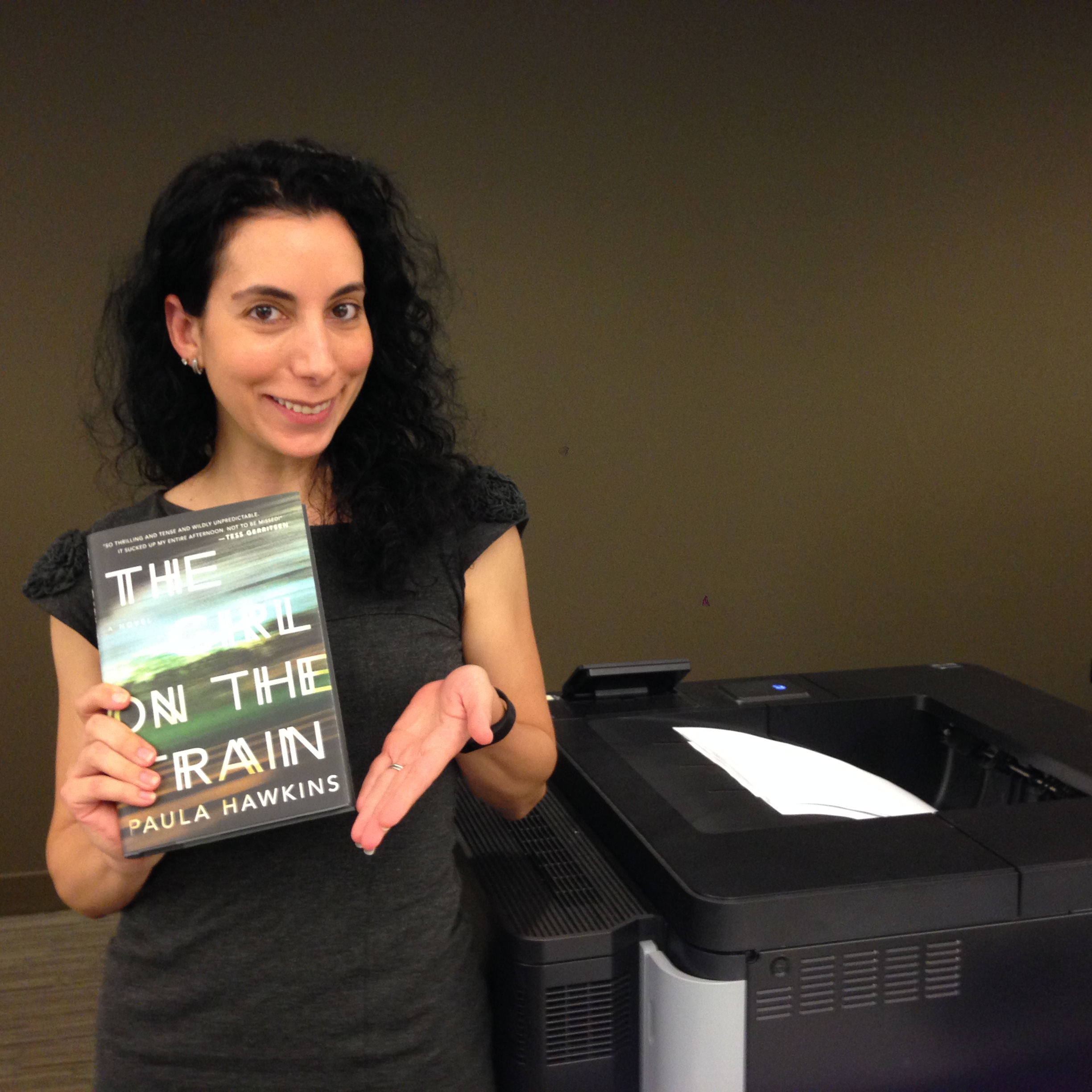
Bookspotting: Maria is reading The Girl on the Train by Paula Hawkins

Ever wonder what Penguin Random House employees are reading? We’re a bunch of professionally bookish people, so you can always count on us to have a book on hand… or thirty piled on our desks. Our Bookspotting feature shows off the range of readers behind the scenes at Penguin Random House.   Maria Spano Maria, Managing Editor at Crown Publishing, is reading The Girl on the Train by Paula Hawkins. Show us what you’re reading by using the #bookspotting hashtag!  

Bookspotting: Suzie is reading Neuromancer by William Gibson

Ever wonder what Penguin Random House employees are reading? We’re a bunch of professionally bookish people, so you can always count on us to have a book on hand… or thirty piled on our desks. Our Bookspotting feature shows off the range of readers behind the scenes at Penguin Random House.   suzie Suzie, VP & Director in the Consumer Marketing group , is reading Neuromancer by William Gibson. Show us what you’re reading by using the #bookspotting hashtag!  

Bookspotting: Molly is reading The Martian by Andy Weir

Ever wonder what Penguin Random House employees are reading? We’re a bunch of professionally bookish people, so you can always count on us to have a book on hand… or thirty piled on our desks. Our Bookspotting feature shows off the range of readers behind the scenes at Penguin Random House.   molly Molly, intern in the consumer marketing group, is reading The Martian by Andy Weir. Show us what you’re reading by using the #bookspotting hashtag!  

Challenge Your Shelf: Rock & Roll Reading Challenge

Who said reading can’t be competitive? Every few months, we’ll be challenging you to read a list of selected books. Print out the challenge and cross the titles off as you go. Show off how much you’ve read by taking a picture and tweeting @penguinrandom or Instagramming (@penguinrandomhouse) with the hashtag #challengeyourshelf. Check out all the books in the challenge below!

Learn all about Sabaa Tahir, author of An Ember in the Ashes

Sabaa Tahir wrote the popular new Young Adult novel, An Ember in the Ashes last year. On Word and Film, she shared some of her inspiration and background as a writer.
“I grew up feeling voiceless and powerless as a kid. I turned to books – fantasy books, in particular – to give me comfort. As I grew up I realized I could find that sense of power and voice if I simply started writing.”
Read more about Sabaa here and listen to her fantastic interview on Beaks and Geeks!  

Writing Tips from Miranda Beverly-Whittemore, author of Bittersweet

We know readers tend to be writers too, in this feature, we’ll share writing tips from our authors. Who better to offer advice, insight, and inspiration than the authors you admire? They’ll answer several questions about their work, share their go-to techniques and more. Now, get writing! How would you recommend creating and getting to know your characters? I believe that story comes from character; I have to know my characters inside and out in order to write a novel that’s halfway worth reading. That said, I’m also a big fan of trusting my gut. When I was starting my novel Bittersweet, Mabel Dagmar began speaking to me very early in the game, long before I knew how untrustworthy she is or exactly what had happened over the course of the summer in which the book takes place. I took dictation for about fifty pages, until I knew she had a hold on me; then I went back to the drawing board and really got to know her by thinking about her all the time, filling out a character sheet on her, and imagining who and what she would come in contact with that would challenge her. Once I know a character well, I’m able to ask what she wants, deep down, in her core. Everyone wants something. A novelist’s trick is to write a story that aligns many wants to support a thematic idea, without it looking like that’s what I’m doing. As plot grows, it’s valuable to understand whether a character’s desires align with that central idea; if they don’t, out she goes. Bittersweet is the story of Mabel getting what she wants, plain and simple, but it took me a long time to understand what that was and how the book would tell that story. I’m also a big believer in casting (in my mind) a real actor (preferably someone I’ve seen on screen in a number of different roles) to play each of my main characters. That way, when I’m stumped about how a character would drink a cup of coffee or walk down the street, it’s easy to see her with my own eyes (plus, then I get to call watching a movie “research,” which is just one of the thousand reasons I love my job). And revision is my best friend, because I can stretch the limits of my characters and then pull back in the next draft after I’ve learned how they would or wouldn’t react. After developing an idea, what is the first action you take when beginning to write? I need to write about fifty pages in order to understand whether the story I’ve imagined actually has legs; if I can’t make fifty pages work, then there’s no way I’ll be able to compose four hundred. In these first fifty I’m looking for moments that crack me up, that make me afraid, that feel risky, that open my up to questions about the book I didn’t know I had when I first started it. If I don’t discover something new in those early weeks of work, then I know I haven’t found my next book. Is there something you do to get into a writing mood? Somewhere you go or something you do to get thinking? I used to be much more precious about my writing rituals; becoming a mother definitely cured me of that! But strangely (or maybe not so strangely) my most productive two years of creative work to date came right after giving birth: I wrote a novel and two screenplays, and produced a short film. I think the secret lies in the preciousness of childcare; if I only have two hours to work in a day, I’m not going to squander it, whereas in the unscheduled days before my son was born, it was easy to while away the hours. I’m lucky to have both a home office and a great local cafĂ© (where I wrote most of Bittersweet). But if I’m alone at home, I’m just as likely to spread out on the dining room table as I am on my son’s bottom bunk. I’m currently in the final push on a novel called June. I’m writing from a pretty strict chapter outline that I’ve developed over the course of the past year. When I sit down to write on a given day, I use this outline as a roadmap. Its signposts and landmarks are the actions and beats I know need to be accomplished in the scene at hand, even if I don’t know exactly how I’ll get from A to B. The fun lies in discovering. Did you always want to write? How did you start your career as an author? As a kid I loved theater. In my childhood out in Oregon, I went to this amazing camp where we did Shakespeare every summer. As a result, without trying to ingrain the five-act structure inside myself, it is. Also, I grew up advocating for the characters I was inhabiting, as actors are wont to do. Both traits have served me well as a writer. Of course, I thought I wanted to be an actor, but in college I realized I’d have a lot more power (and probably be just as poor) in the writing life. I wrote a creative thesis in college. It was the first time I’d written anything longer than twenty pages, and I just fell in love. I realized I had it in me to create whole worlds. But I didn’t know if this could actually be my job until I was working at the Unterberg Poetry Center at the 92nd Street Y and met people like Joyce Carol Oates and Philip Roth and JosĂ© Saramago and Saul Bellow, and saw a more direct connection between the books I loved and the people who made them. While I was at the Y, I wrote The Effects of Light, which was to become my first published novel; got an agent; and then revised it for her for a year before we sold it. What’s the best piece of advice you have received? My parents were great believers in my sister and me pursuing creative fields. What they gave us wasn’t advice as much as it was philosophy. In my sister’s forthcoming documentary, my mom says “You know who you are by what you make,” and this idea still very much drives who I am. I’ve learned that I’m a lot happier when I’m working on a novel than when I’m not, mainly because when I’m writing a novel, I’m my most “me”—I recognize myself. I see this in my six-year-old too; he’s a lot happier when he’s engaged in a big, sweeping art project. Maybe that’s just him/us? Maybe that’s a trait many of us have as children, and we’re taught not to value it (because it’s not quantifiable or easily applied to a business model), so when we grow up, we leave it behind? A few months ago I was with my family up in the cabin in Vermont that inspired Bittersweet, and I looked around the main room: my father was transcribing his field notes from West Africa for use in the book he’s writing; my mother was working on her book series; my sister was working on her screenplay; my son was meticulously decorating a tall stack of valentines; and I was writing June. I often meet fellow parents who tell me they’re concerned because their child wants to become a writer or an artist. Yes, it can be a bumpy path, but it’s incredibly rewarding in some pretty fundamental ways that we don’t always honor culturally. I wish for the children of those parents to get to be given the gift I was, of belief and support. For all its hardship, I wouldn’t give up my career for anything! Read more about Miranda Beverly-Whittemore’s book, Bittersweet.
Writing Tips from Jules Moulin, author of Ally Hughes Has Sex Sometimes

We know readers tend to be writers too, so we feature writing tips from our authors. Who better to offer advice, insight, and inspiration than the authors you admire? They’ll answer several questions about their work, share their go-to techniques and more. Now, get writing!  What writing techniques have you found most important or memorable? For me, learning different ways to structure a story was crucial, and still is! I’m always on the lookout for great structuring tips. While outlining, in order to ensure causal plotting, I use the phrase “WHICH CAUSED” between scenes. For example: “The queen caught a cold. The queen died. The king died.” This isn’t causal plotting. But “The queen caught a cold.” WHICH CAUSED “The queen to die of that cold.” WHICH CAUSED “The king to die of heartbreak.” This helps me to make sure that one moment causes the next moment. How would you recommend creating and getting to know your characters? I have a background in journalism, so I recommend reporting — even for fiction. For Ally Hughes Has Sex Sometimes, I called a slew of Sex and Gender professors (not unlike my main character Ally) and interviewed them, asking questions about anything and everything including their jobs, daily schedules, likes and dislikes, opinions on current events, etc. After developing an idea, what is the first action you take when beginning to write? I actually do everything at once: I start writing scenes that I’m 90 percent sure will end up in the story, I start researching, and I start outlining. And most importantly, I start imagining the ending so that I can start planning the beginning. My outline is fluid and evolving — I go back and make changes to my outline throughout the writing process so that I complete the outline only a short while before I finish the book. Is there something you do to get into a writing mood? Somewhere you go or something you do to get thinking? Yes! I work in cafes mostly, where I have endless access to coffee and WiFi, and if I have serious, important writing to do, I plug into my earphones and listen to the Dave Matthews Band! Did you always want to write? How did you start your career as an author? No. I wanted to be an actress. I actually still do, but I’m too chicken. But everything I know about writing came from years and years of studying acting. I studied everywhere, with everyone; learned how to break down a scene, how to create and motivate character, how to write dialogue, etc. What’s the best piece of advice you have received? That you should try to write every day, even if it’s just for ten or twenty minutes. I don’t do this — but every writer I admire gives this advice and says they heed it! What clichĂ©s or bad habits would you tell aspiring writers to avoid? Do you still experience them yourself? My worst habit is not writing daily, for sure. I’m pretty good about not using adverbs. Adverbs are deadly, unless you’re J.K. Rowling, who uses them all the time, so go figure… Read more about Ally Hughes Has Sex Sometimes here.

Senior Editor at The Penguin Press, Virginia Smith Younce, on The Star Side of Bird Hill, by Naomi Jackson

Editors get very passionate about books they work on – the Editor’s Desk series is his or her place to write in-depth about what makes a certain title special. Get the real inside-scoop on how books are shaped by the people who know them best. I fell in love with Naomi Jackson’s debut novel about a matriarchal family in Barbados, The Star Side of Bird Hill, from the opening page. In short order, Jackson indelibly captures Barbados’ Bird Hill neighborhood and the two young Braithwaite sisters who have left Brooklyn to come and live there with their grandmother. From its very first line, Star Side plunges us in this very specific, very beautiful community: The people on the hill liked to say that God’s smile was the sun shining down on them. Jackson’s first descriptions of the girls at the heart of this novel are also stunning. Dionne, the elder sister, is “sixteen going on a bitter, if beautiful, forty-five.” Phaedra, age ten, saw “her skin had darkened to a deep cacao from running in the sun all day in spite of her grandmother’s protests… Glimpses of Phaedra’s future beauty peeked out from behind her pink heart-shaped glasses, which were held together with scotch tape.” Before I turned to the second page, I was fully immersed in this place, and I felt I had known these girls for years. Author Naomi Jackson grew up in a predominantly West Indian neighborhood in Brooklyn and spent summers in Barbados with her family. There is a strong autobiographical element to Star Side, which explores themes of immigration and identity, motherhood and family, sexual awakening and coming of age, and mental illness and belonging. After their mother’s breakdown in New York forces them into exile in Barbados, Dionne spends the summer in search of love, while Phaedra explores Bird Hill, where her family has lived for generations. The girls’ grandmother, Hyacinth, is a midwife and practitioner of the local spiritual practice of obeah. Hyacinth is a magical character, and the novel beautifully explores parenthood through her loves and losses. Her daughter Avril left Barbados for good when she fell for the girls’ father Errol. When Errol arrives to reclaim the sisters, the girls must choose between two worlds, as their mother once did. It has been so gratifying to see in-house readers, booksellers, and reviewers connect with this lyrical narrative. Jackson’s Barbados captured our imagination, and her characters are unforgettable, especially the heartbreaking young Phaedra.The Star Side of Bird Hill is an Indies Introduce selection, and many of our independent bookselling partners told me at BEA how excited they were to get this novel into the hands of their more advanced YA readers, as well as their adult readers who love transporting, literary fiction. I look forward to seeing many more readers fall for Star Side and the very talented Naomi Jackson. Read more about The Star Side of Bird Hill here.

Scott Moyers, VP Publisher of the Penguin Press and editor of Eileen, by Ottessa Moshfegh

Editors get very passionate about books they work on – the Editor’s Desk series is his or her place to write in-depth about what makes a certain title special. Get the real inside-scoop on how books are shaped by the people who know them best. Ottessa Moshfegh’s fiction is like a new species of wild animal. First there’s that stunned delight: I’ve never met this species before! Whoa, it feels kind of dangerous. Then there’s the inevitable effort to categorize it, to place it within a larger taxonomy. It’s been delightful to watch some of our smartest, most fearless writers come to grips with what makes Ottessa Moshfegh’s work so special, so hard to shake. Take Jeffrey Eugenides: “Moshfegh is a writer of significant control and range…. What distinguishes her writing is that unnamable quality that makes a new writer’s voice, against all odds and the deadening surround of lyrical postures, sound unique.” Or Rivka Galchen: “A scion of Nathaniel Hawthorne and Raymond Carver at once, Moshfegh transforms a poison into an intoxicant.” Those stories I read in the Paris Review stuck with me for keeps: these are very different psyches each to each, and the voices are utterly distinct, but each is an exploration of a mind that’s unsteady on its feet in a most arresting way, a triumph of unreliability, you could say – unreliable on just about every level imaginable. The world is a lot weirder than is commonly understood; Ottessa as an artist has a purchase on that weirdness and brings us into contact with it, in a way that is wildly electric. But those are the stories; like many I was very eager to see what this writer would do with a longer form. McGlue, her bravura novella, gave a tantalizing hint, but nothing quite prepared me for the narrative tricksiness, the storytelling cunning, of Eileen. My God, can this writer play the long game. I want to quote, if you’ll forgive me, from the starred Kirkus review, because it makes the point better, I think, than I can: “A woman recalls her mysterious escape from home in this taut, controlled noir about broken families and their proximity to violence…. The narrative masterfully taunts…. The release, when it comes, registers a genuine shock. And Moshfegh has such a fine command of language and her character that you can miss just how inside out Eileen’s life becomes in the course of the novel, the way the “loud, rabid inner circuitry of my mind” overtakes her. Is she inhumane or self-empowered? Deeply unreliable or justifiably jaded? Moshfegh keeps all options on the table…. A shadowy and superbly told story of how inner turmoil morphs into outer chaos.” Set in the 7 days leading up to Christmas in 1964 in a small town outside Boston, Eileen is the story of how a deeply unhappy young woman imprisoned by her circumstances finds a most unexpected accomplice who busts her out of her confinement, though arguably, as Bob Dylan sang, she uses a little too much force… While stylistically this reminds me of nothing so much as Shirley Jackson of The Birdcage and Vladimir Nabokov of King, Queen, Knave, in another sense this reminds me of the wonderful Celeste Ng’s Everything I Never Told You, in that there’s a political valence to this novel all the more powerful for being so beautifully sublimated in a powerful suspense novel. It’s a hell of a thing for a young woman to feel as unattractive as Eileen Dunlop is made to feel by the world around her; the wound is real. And so, though she makes choices you or I might perhaps not make – though perhaps you would! – I think few will say that in the end they’re not rooting for her to go all the way. Read more about Eileen here.