

Listen: Fiona Barton Talks Journalism, Tech, and More
Fiona Barton, author of the #1 International Bestselling novel, The Widow, talks about writing, journalism, media, and society.



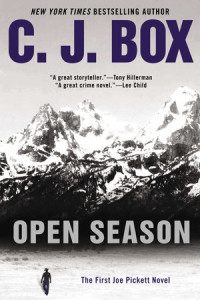 Although the first Joe Pickett novel (Open Season) was written as a one-off at the time, the characters, themes, location, and style introduced in that book provided a great framework for the series to grow. I’ve never had to regret the foundation laid in that book. Also, because the books take place in real time the characters mature and change from book to book. For example, Joe Pickett’s daughter Sheridan is seven years old in Open Season and now 22 in Off the Grid. Because the characters get older and benefit (or not) from previous situations in the books I think that helps keep the series fresh. Plus, since each book includes a theme or controversy unique to the story (endangered species, alternative energy, the ethics of hunting, or in the case of Off the Grid — domestic terrorism) they are all stand-alones in their own way.
A lot of your longtime fans will be happy that your character Nate Romanowski features prominently in Off the Grid. From a writer’s standpoint, what is involved in making Nate so interesting and unpredictable?
Unlike just about every other character in the series, Nate Romanowski is based on a friend of mine although I’ve exaggerated (Thank God) his personality. The buddy I grew up with was a big blonde middle linebacker who later went on to join the military and special forces. He took me falconry hunting and through him I was introduced to the very strange and fascinating world of falconers and the mindset that goes with it. And, of course, Nate carries one of the largest handguns in the world and he’s good with it.
For a reader coming to your Joe Pickett novels for the first time, which of your backlist titles, from Open Season onward, would you recommend they check out first and why?
Although the first Joe Pickett novel (Open Season) was written as a one-off at the time, the characters, themes, location, and style introduced in that book provided a great framework for the series to grow. I’ve never had to regret the foundation laid in that book. Also, because the books take place in real time the characters mature and change from book to book. For example, Joe Pickett’s daughter Sheridan is seven years old in Open Season and now 22 in Off the Grid. Because the characters get older and benefit (or not) from previous situations in the books I think that helps keep the series fresh. Plus, since each book includes a theme or controversy unique to the story (endangered species, alternative energy, the ethics of hunting, or in the case of Off the Grid — domestic terrorism) they are all stand-alones in their own way.
A lot of your longtime fans will be happy that your character Nate Romanowski features prominently in Off the Grid. From a writer’s standpoint, what is involved in making Nate so interesting and unpredictable?
Unlike just about every other character in the series, Nate Romanowski is based on a friend of mine although I’ve exaggerated (Thank God) his personality. The buddy I grew up with was a big blonde middle linebacker who later went on to join the military and special forces. He took me falconry hunting and through him I was introduced to the very strange and fascinating world of falconers and the mindset that goes with it. And, of course, Nate carries one of the largest handguns in the world and he’s good with it.
For a reader coming to your Joe Pickett novels for the first time, which of your backlist titles, from Open Season onward, would you recommend they check out first and why?
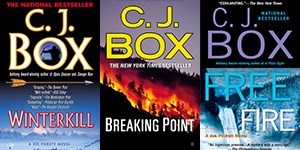 Tough question, since in their way each book stands alone. No reader would be hopelessly lost starting with any book in the series. Of course, those who’ve read them all say it’s important to start with OPEN SEASON so the reader can experience Joe’s family growing and changing, and I probably lean that direction. But there are certain books —Winterkill, Free Fire, Breaking Point, andOff the Grid – that I think could be good entry points into the series.
Find out more about C.J. Box’s books below.
Tough question, since in their way each book stands alone. No reader would be hopelessly lost starting with any book in the series. Of course, those who’ve read them all say it’s important to start with OPEN SEASON so the reader can experience Joe’s family growing and changing, and I probably lean that direction. But there are certain books —Winterkill, Free Fire, Breaking Point, andOff the Grid – that I think could be good entry points into the series.
Find out more about C.J. Box’s books below.
 Alissa, in Crown production, is reading My Brilliant Friend, by Elena Ferrante.

 Renée Rosen’s newest historical fiction novel is called White Collar Girl, and takes place in 1950’s Chicago.
What writing techniques have you found most important or memorable? For me the most important part of writing is editing. But within the world of editing I’ve come to truly value the importance of the paper edit. Before I turn my books in I always do a paper edits, and if time permits, I’ll do more than one. I’ve found that my work reads very differently on paper than it does on the screen. The paper edit stage is where I’ll catch things like word echoes, continuity errors, something like a three- page chapter following a thirty-page chapter and other problematic issues. Sometimes I’ll even print the manuscript out using a different font, which helps me see it with fresh eyes.
How would you recommend creating and getting to know your characters?
Creating characters that come to life on the page is really one of my greatest challenges. Just like with real people you meet, some characters come to you and you feel like you’ve known them all your life while others take time to reveal themselves. When I come across the latter type, I usually start by trying to find out as much about them as possible. For every one detail I use in the book, I’ll have ten or so others floating around in my head. I might begin with something as simple as their physical description and then I’ll drill all the way down to what the inside of their closet looks like. When all those little details come together the story generally starts to write itself. The characters take over and I become the vehicle that merely delivers their tale.
What’s the best piece of advice you have received?
I was fortunate enough to have studied with Carol Anshaw and I’ll never forget that she used to tell us that the first draft is you telling yourself the story. Don’t worry about how sloppy or full of holes it is, just get a beginning, middle and end down on paper. Once you have that foundation you might very well go back and change every word on every page but before you can do any fine tuning, you have to first tell yourself the story.
What are three or four books that influenced your writing, or had a profound affect on you?
Sister Carrie by Theodore Dreiser –I think my love of Chicago history started with my first reading of this book. It made me fall in love with the city.
Spoon River Anthology by Edgar Lee Masters—totally original and filled with wisdom in ever monologue. Each time I read it, I discover something new.
Simple Passion by Annie Ernaux—80 of the most powerful and brutally honest pages you’ll ever read. This slender book is one I treasure.
Anywhere But Here by Mona Simpson. This is such an amazing character-driven novel and when I first read it, I realized what was possible to do on the page.
Check out Rosen’s book below.
Renée Rosen’s newest historical fiction novel is called White Collar Girl, and takes place in 1950’s Chicago.
What writing techniques have you found most important or memorable? For me the most important part of writing is editing. But within the world of editing I’ve come to truly value the importance of the paper edit. Before I turn my books in I always do a paper edits, and if time permits, I’ll do more than one. I’ve found that my work reads very differently on paper than it does on the screen. The paper edit stage is where I’ll catch things like word echoes, continuity errors, something like a three- page chapter following a thirty-page chapter and other problematic issues. Sometimes I’ll even print the manuscript out using a different font, which helps me see it with fresh eyes.
How would you recommend creating and getting to know your characters?
Creating characters that come to life on the page is really one of my greatest challenges. Just like with real people you meet, some characters come to you and you feel like you’ve known them all your life while others take time to reveal themselves. When I come across the latter type, I usually start by trying to find out as much about them as possible. For every one detail I use in the book, I’ll have ten or so others floating around in my head. I might begin with something as simple as their physical description and then I’ll drill all the way down to what the inside of their closet looks like. When all those little details come together the story generally starts to write itself. The characters take over and I become the vehicle that merely delivers their tale.
What’s the best piece of advice you have received?
I was fortunate enough to have studied with Carol Anshaw and I’ll never forget that she used to tell us that the first draft is you telling yourself the story. Don’t worry about how sloppy or full of holes it is, just get a beginning, middle and end down on paper. Once you have that foundation you might very well go back and change every word on every page but before you can do any fine tuning, you have to first tell yourself the story.
What are three or four books that influenced your writing, or had a profound affect on you?
Sister Carrie by Theodore Dreiser –I think my love of Chicago history started with my first reading of this book. It made me fall in love with the city.
Spoon River Anthology by Edgar Lee Masters—totally original and filled with wisdom in ever monologue. Each time I read it, I discover something new.
Simple Passion by Annie Ernaux—80 of the most powerful and brutally honest pages you’ll ever read. This slender book is one I treasure.
Anywhere But Here by Mona Simpson. This is such an amazing character-driven novel and when I first read it, I realized what was possible to do on the page.
Check out Rosen’s book below.
 In “A,” Kinsey tells us she is 32, twice divorced, no kids, no pets, no houseplants. In short, she is independent and alone. What we learn as the series progresses is that she is also nobody’s sidekick. Unlike so many female characters in the mysteries that preceded her appearance, she is not a loyal helpmate or willing employee or second banana. Now, how refreshing is that? And when she finds herself in serious danger, she is tough enough to fight her way out—even when it means killing or maiming her attacker. But it bothers her that she has to. So in addition to being tough and honest, she has a conscience. Mayhem for mayhem’s sake is not on her resume. Her novels also do not depend on technology or gadgets for their denouements. Brains and determination are what matter. There are no James Bond gimmicks, and no saviors in white hats to come to Kinsey’s rescue.
Through Kinsey, Sue is able to wrestle with some very current social ills. She doesn’t preach, but she does observe. And her intelligence in these matters raises the books to another level. You won’t find her giving facile answers to homelessness, but you will find her pointing out all sides of the problem. How you take this is your call as a reader. Sue is not here to convert you—but she wants readers to understand the human toll such problems take. And she is not here to solve our social problems. She can’t tell us how to stop the abuse of elders, for example. But she can, in horrible detail, show you how it happens.
In “A,” Kinsey tells us she is 32, twice divorced, no kids, no pets, no houseplants. In short, she is independent and alone. What we learn as the series progresses is that she is also nobody’s sidekick. Unlike so many female characters in the mysteries that preceded her appearance, she is not a loyal helpmate or willing employee or second banana. Now, how refreshing is that? And when she finds herself in serious danger, she is tough enough to fight her way out—even when it means killing or maiming her attacker. But it bothers her that she has to. So in addition to being tough and honest, she has a conscience. Mayhem for mayhem’s sake is not on her resume. Her novels also do not depend on technology or gadgets for their denouements. Brains and determination are what matter. There are no James Bond gimmicks, and no saviors in white hats to come to Kinsey’s rescue.
Through Kinsey, Sue is able to wrestle with some very current social ills. She doesn’t preach, but she does observe. And her intelligence in these matters raises the books to another level. You won’t find her giving facile answers to homelessness, but you will find her pointing out all sides of the problem. How you take this is your call as a reader. Sue is not here to convert you—but she wants readers to understand the human toll such problems take. And she is not here to solve our social problems. She can’t tell us how to stop the abuse of elders, for example. But she can, in horrible detail, show you how it happens.
 Perhaps this makes the books sound “heavy.” They are hardly that. One of the very great attractions of Sue Grafton’s writing is just how clever (both witty and funny) Kinsey is and how tellingly Sue leads her characters into crazy (but all too real) human interactions. And a large part of her success in doing this is that she has such a terrific grasp of the human condition, which is another reason her characters resonate long after you’ve finished the book.
How would you describe the nature of your editor/author process when working with Sue Grafton and how has it evolved over the years?
Our relationship is based on trust and mutual respect. Sounds corny, but it’s true. There may have been a few bumps early on because Sue bore some real scars from her years of working with Hollywood know-it-alls (“They all seemed to be barely out of high school,” she has said). Books, however, are not movies, and editing is a matter of supporting the writer not taking over her book. (Some of you may know of instances of editors taking credit for the quality of their writer’s book. Personally, if the writing was that bad to begin with, I’d want no part of it.) With Sue, as the years and books progressed, our working relationship, never problematic to begin with, became a sheer delight. Sue is a professional and a dedicated craftswoman. I like to think the same applies to her editor.
There have been a few occasions during the writing when the plot line seems temporarily to stall out. Sue says dreaming often resolves a knotty plot line, and I say that what cannot be resolved in dreams is usually a relatively easy fix that a trusted reader can suggest. Mostly that first reader is her husband, Steve Humphrey. As someone who was long-married to a writer, I know the pitfalls that can happen when a spouse is called upon to read, but in the 34 years I’ve known them, their working relationship has been nothing short of miraculous.
What has contributed to the popularity of the Kinsey Millhone character and the series, and what elements in the new novel, X, do you feel will resonate most strongly with readers?
Sue never runs in place. I have read many writers who begin a series wonderfully and then, at about book 4 or 5, stall out. The books become padded, the plots are listless, the characters repeat themselves. Not so Sue. In fact, Sue brings a freshness and originality to each new book. Even those instances in which she needs to reintroduce a character from an earlier book or reprise some earlier plot line–so that a reader coming new to the series need not begin with “A”—are deftly handled and, for the veteran reader, often contain welcome new information. I think the reason the series continues to appeal so strongly is that Sue takes her writing very seriously. To turn in a listless effort would be to cheat her readers—and herself.
Perhaps this makes the books sound “heavy.” They are hardly that. One of the very great attractions of Sue Grafton’s writing is just how clever (both witty and funny) Kinsey is and how tellingly Sue leads her characters into crazy (but all too real) human interactions. And a large part of her success in doing this is that she has such a terrific grasp of the human condition, which is another reason her characters resonate long after you’ve finished the book.
How would you describe the nature of your editor/author process when working with Sue Grafton and how has it evolved over the years?
Our relationship is based on trust and mutual respect. Sounds corny, but it’s true. There may have been a few bumps early on because Sue bore some real scars from her years of working with Hollywood know-it-alls (“They all seemed to be barely out of high school,” she has said). Books, however, are not movies, and editing is a matter of supporting the writer not taking over her book. (Some of you may know of instances of editors taking credit for the quality of their writer’s book. Personally, if the writing was that bad to begin with, I’d want no part of it.) With Sue, as the years and books progressed, our working relationship, never problematic to begin with, became a sheer delight. Sue is a professional and a dedicated craftswoman. I like to think the same applies to her editor.
There have been a few occasions during the writing when the plot line seems temporarily to stall out. Sue says dreaming often resolves a knotty plot line, and I say that what cannot be resolved in dreams is usually a relatively easy fix that a trusted reader can suggest. Mostly that first reader is her husband, Steve Humphrey. As someone who was long-married to a writer, I know the pitfalls that can happen when a spouse is called upon to read, but in the 34 years I’ve known them, their working relationship has been nothing short of miraculous.
What has contributed to the popularity of the Kinsey Millhone character and the series, and what elements in the new novel, X, do you feel will resonate most strongly with readers?
Sue never runs in place. I have read many writers who begin a series wonderfully and then, at about book 4 or 5, stall out. The books become padded, the plots are listless, the characters repeat themselves. Not so Sue. In fact, Sue brings a freshness and originality to each new book. Even those instances in which she needs to reintroduce a character from an earlier book or reprise some earlier plot line–so that a reader coming new to the series need not begin with “A”—are deftly handled and, for the veteran reader, often contain welcome new information. I think the reason the series continues to appeal so strongly is that Sue takes her writing very seriously. To turn in a listless effort would be to cheat her readers—and herself.
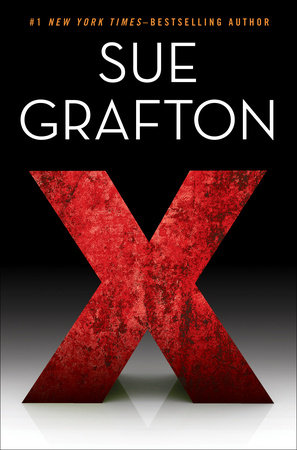
 The second part of your question is harder to answer because it would give away much of the plot of X. Let me just say this: There are three extraordinary plot lines in X. The reader will initially be hard pressed to know which is the prime plot, which secondary. But all are supremely interesting. One is outrageous—but many of us will be familiar with the neighbors from hell and, in its own way, it is very comic. Another is a complex scam that has grown out of the broken marriage of two hot-tempered people who should have taken the time to cool down. And the third? It is the harrowing story of a vicious sociopathic serial killer who has left a trail of dead women going back nearly thirty years. The victims have either been declared suicides or they have simply vanished. The killer is at large, and Kinsey is in his sight lines. Dark, chilling, and clever, X is also infinitely wise in the matter of human misbehavior—or why we are often our own worst enemy.
Read more about X here.
The second part of your question is harder to answer because it would give away much of the plot of X. Let me just say this: There are three extraordinary plot lines in X. The reader will initially be hard pressed to know which is the prime plot, which secondary. But all are supremely interesting. One is outrageous—but many of us will be familiar with the neighbors from hell and, in its own way, it is very comic. Another is a complex scam that has grown out of the broken marriage of two hot-tempered people who should have taken the time to cool down. And the third? It is the harrowing story of a vicious sociopathic serial killer who has left a trail of dead women going back nearly thirty years. The victims have either been declared suicides or they have simply vanished. The killer is at large, and Kinsey is in his sight lines. Dark, chilling, and clever, X is also infinitely wise in the matter of human misbehavior—or why we are often our own worst enemy.
Read more about X here. 


