Senior Editor at The Penguin Press, Virginia Smith Younce, on The Star Side of Bird Hill, by Naomi Jackson

Editors get very passionate about books they work on – the Editor’s Desk series is his or her place to write in-depth about what makes a certain title special. Get the real inside-scoop on how books are shaped by the people who know them best. I fell in love with Naomi Jackson’s debut novel about a matriarchal family in Barbados, The Star Side of Bird Hill, from the opening page. In short order, Jackson indelibly captures Barbados’ Bird Hill neighborhood and the two young Braithwaite sisters who have left Brooklyn to come and live there with their grandmother. From its very first line, Star Side plunges us in this very specific, very beautiful community: The people on the hill liked to say that God’s smile was the sun shining down on them. Jackson’s first descriptions of the girls at the heart of this novel are also stunning. Dionne, the elder sister, is “sixteen going on a bitter, if beautiful, forty-five.” Phaedra, age ten, saw “her skin had darkened to a deep cacao from running in the sun all day in spite of her grandmother’s protests… Glimpses of Phaedra’s future beauty peeked out from behind her pink heart-shaped glasses, which were held together with scotch tape.” Before I turned to the second page, I was fully immersed in this place, and I felt I had known these girls for years. Author Naomi Jackson grew up in a predominantly West Indian neighborhood in Brooklyn and spent summers in Barbados with her family. There is a strong autobiographical element to Star Side, which explores themes of immigration and identity, motherhood and family, sexual awakening and coming of age, and mental illness and belonging. After their mother’s breakdown in New York forces them into exile in Barbados, Dionne spends the summer in search of love, while Phaedra explores Bird Hill, where her family has lived for generations. The girls’ grandmother, Hyacinth, is a midwife and practitioner of the local spiritual practice of obeah. Hyacinth is a magical character, and the novel beautifully explores parenthood through her loves and losses. Her daughter Avril left Barbados for good when she fell for the girls’ father Errol. When Errol arrives to reclaim the sisters, the girls must choose between two worlds, as their mother once did. It has been so gratifying to see in-house readers, booksellers, and reviewers connect with this lyrical narrative. Jackson’s Barbados captured our imagination, and her characters are unforgettable, especially the heartbreaking young Phaedra.The Star Side of Bird Hill is an Indies Introduce selection, and many of our independent bookselling partners told me at BEA how excited they were to get this novel into the hands of their more advanced YA readers, as well as their adult readers who love transporting, literary fiction. I look forward to seeing many more readers fall for Star Side and the very talented Naomi Jackson. Read more about The Star Side of Bird Hill here.

Scott Moyers, VP Publisher of the Penguin Press and editor of Eileen, by Ottessa Moshfegh

Editors get very passionate about books they work on – the Editor’s Desk series is his or her place to write in-depth about what makes a certain title special. Get the real inside-scoop on how books are shaped by the people who know them best. Ottessa Moshfegh’s fiction is like a new species of wild animal. First there’s that stunned delight: I’ve never met this species before! Whoa, it feels kind of dangerous. Then there’s the inevitable effort to categorize it, to place it within a larger taxonomy. It’s been delightful to watch some of our smartest, most fearless writers come to grips with what makes Ottessa Moshfegh’s work so special, so hard to shake. Take Jeffrey Eugenides: “Moshfegh is a writer of significant control and range…. What distinguishes her writing is that unnamable quality that makes a new writer’s voice, against all odds and the deadening surround of lyrical postures, sound unique.” Or Rivka Galchen: “A scion of Nathaniel Hawthorne and Raymond Carver at once, Moshfegh transforms a poison into an intoxicant.” Those stories I read in the Paris Review stuck with me for keeps: these are very different psyches each to each, and the voices are utterly distinct, but each is an exploration of a mind that’s unsteady on its feet in a most arresting way, a triumph of unreliability, you could say – unreliable on just about every level imaginable. The world is a lot weirder than is commonly understood; Ottessa as an artist has a purchase on that weirdness and brings us into contact with it, in a way that is wildly electric. But those are the stories; like many I was very eager to see what this writer would do with a longer form. McGlue, her bravura novella, gave a tantalizing hint, but nothing quite prepared me for the narrative tricksiness, the storytelling cunning, of Eileen. My God, can this writer play the long game. I want to quote, if you’ll forgive me, from the starred Kirkus review, because it makes the point better, I think, than I can: “A woman recalls her mysterious escape from home in this taut, controlled noir about broken families and their proximity to violence…. The narrative masterfully taunts…. The release, when it comes, registers a genuine shock. And Moshfegh has such a fine command of language and her character that you can miss just how inside out Eileen’s life becomes in the course of the novel, the way the “loud, rabid inner circuitry of my mind” overtakes her. Is she inhumane or self-empowered? Deeply unreliable or justifiably jaded? Moshfegh keeps all options on the table…. A shadowy and superbly told story of how inner turmoil morphs into outer chaos.” Set in the 7 days leading up to Christmas in 1964 in a small town outside Boston, Eileen is the story of how a deeply unhappy young woman imprisoned by her circumstances finds a most unexpected accomplice who busts her out of her confinement, though arguably, as Bob Dylan sang, she uses a little too much force… While stylistically this reminds me of nothing so much as Shirley Jackson of The Birdcage and Vladimir Nabokov of King, Queen, Knave, in another sense this reminds me of the wonderful Celeste Ng’s Everything I Never Told You, in that there’s a political valence to this novel all the more powerful for being so beautifully sublimated in a powerful suspense novel. It’s a hell of a thing for a young woman to feel as unattractive as Eileen Dunlop is made to feel by the world around her; the wound is real. And so, though she makes choices you or I might perhaps not make – though perhaps you would! – I think few will say that in the end they’re not rooting for her to go all the way. Read more about Eileen here.

From the Editor’s Desk: Becky Cole, Editor of Stir

Editors get very passionate about books they work on – the Editor’s Desk series is his or her place to write in-depth about what makes a certain title special. Get the real inside-scoop on how books are shaped by the people who know them best. When the proposal for Stir came in, it was subtitled “How My Brain Exploded and I Got Cooking.” What I found in those pages just about made my own brain explode. Here was a memoir by a first-time writer who had survived a traumatic brain injury, a Harvard Ph.D candidate who lost sight in one eye, her sense of smell, and a chunk of her skull so large that she had to wear a hockey helmet to protect her brain, impressive enough, but what made the proposal a standout was not her injury, but the way she wrote about how food and the simple everyday acts of cooking, baking, stirring, sautĂ©ing, and sharing it, helped her to heal. As she writes in the book, getting well meant finding her everyday, and she found hers in the kitchen. This stunning book didn’t fit neatly into any category in the bookstore, but everyone at Penguin Random House who read it loved it, and we knew we had to publish Stir. Every author takes an approach to writing that makes sense to them. Some outline, others write set pieces to be stitched together later. Some write almost in a fugue state, getting the book down on paper from beginning to end, barely stopping to put in commas. Jessica was not that kind of writer. She was careful, precise. Every word worked at the sentence level. The challenge with Stir was broader—we didn’t want the book to be pigeon-holed as a recovery memoir, but we also knew that her illness was the natural beginning of her story. During editorial talks, we spent much of our time discussing how to weave various strands together. First, of course, there was the aneurysm. Then, there was the food—the facts of cooking it and eating it and recovering because of it. Beyond those two main threads, there was a love story between Jessica and her unflappable husband, Eli, including their attempts to start a family (spoiler: they do! as anyone who follows her wonderful blog, sweetamandine.com knows from the pictures of her two adorable daughters she posts there); an ode to the constellation of women in her life—her mother, stepmother, grandmothers, her Aunt Fran, and close friends—whose influence she feels strongly in the kitchen; and, finally, the story of how she came to a new understanding of the link between food and identity. As we’d talk, Jessica would occasionally ask me, “How do you think I should…?” We’d mull it over and then she would go off and come up with a perfect solution. When I said as much, more often than not, she’d respond that she had simply looked at a memoir she admired to see how that writer succeeded in doing whatever it was Jessica herself was trying to do. She was applying the skills she’d honed as an academic to the process of writing a memoir. She read and dissected every memoir she could get her hands on —Wild, The Liar’s Club, Eat, Pray, Love, and My Stroke of Insight, and dozens of others– to pick them apart and learn how they performed different feats of narrative and storytelling. She marked her copy of Wild with a “Pivot!” in the margins next to the places Cheryl Strayed switched from one subject to another without losing the reader, and then figured out a way to make the technique her own in Stir. It was as if she was reading to defend her dissertation and her dissertation was how to tell the story of her life. Again and again, I could see her incorporating the lessons she’d gleaned from the writers she loved into her own book. One day, she sent me a document I’m not sure I was meant to see. It was an eleven page spreadsheet with columns delineating plot, characters, conflict, what we learn (general), what we learn (food), and “to do.” It showed an awareness of how the book was working—or not—from a structural perspective, which helped to keep everything in balance. Another time, she sent me a file that had all of the material dealing with Eli in one document so she could make sure the story hung together, which it did. This all sounds terribly clinical, but the book that came out of it is anything but, despite a good part of it taking place in and out of hospitals after brain surgery. What I love about Jessica’s writing, especially her writing about food, is how unfussy it is—the opposite of academic writing with its particular conventions, and different, too, from a certain type of food writing, the kind with sumptuous descriptions of dishes that sound like menu items at a restaurant where almost no one can afford to eat. Jessica, however, writes every bit as much for the person who swoons over grass-fed butter as she does for someone who savors a Ritz cracker melting on her tongue. She writes exquisitely but without pomp about how the way we prepare food and who we eat it with connects us to our past, our future, and our true selves. The moments where she connects to food shine brightly on the page. She writes about the smell of cucumber when her olfactory nerves kick in again, the mushrooms chopped for a favorite pasta dish when she first returns to the kitchen, and an almond cake resting on a counter that acts as a Proust’s madeleine of sorts as it lets her know, as she writes, that food had something to teach her, and that it felt good to listen. I am glad that she did. Read more about Stir here.

From the Editor’s Desk: Laura Perciasepe, editor of Lovers On All Saints’ Day, by Juan Gabriel Vásquez

Editors get very passionate about books they work on – the Editor’s Desk series is his or her place to write in-depth about what makes a certain title special. Get the real inside-scoop on how books are shaped by the people who know them best. A few summers ago, Juan Gabriel Vásquez’s novel The Sound of Things Falling had just taken the literary world by storm. Bestselling, universally praised, hailed as “brilliant” on the cover of the New York Times Book review by Edmund White, the novel was a huge moment for Juan. Riverhead had published two earlier critically acclaimed novels of his as well: The Informers and The Secret History of Costaguana. He happened to be in New York, visiting from Bogota, Colombia, for the Brooklyn Book Festival where he wowed crowds with his mellifluous voice. I met up with Juan and his wife, Mariana, before his Festival events and we had a bagel brunch on the roof of my apartment building in Brooklyn – a quintessential borough activity. As we talked about future books by Juan, he mentioned an earlier book of his – Los Amantes de Todos los Santos (which we’ve translated as Lovers on All Saints’ Day) – a collection of stories that he had always felt was some of his best writing. And it had never been translated into English, not one story. I remembered his translator, the inimitable Anne McLean, confiding in me that the stories had always been some of her favorite writing of Juan’s too. I got jealous: they all loved this book and I had never read it! We hatched a plan then and there to bring this book out to American readers, to get it translated into English for the first time. One of the wonderful things about this story collection is how different it is from Juan’s novels. It takes place in Europe – mostly in France and Belgium – which had for many years been the place where Juan lived as an ex-pat, far from Colombia and South America. The influence of European writers, of a moody, earthy, ancient perspective, resounds through these stories. Juan references the idea that a story collection is like a novel where none of the characters know each other. They exist in a universe, struggling, loving, making grave mistakes and small triumphs, and at the end of this crescendo of a collection, you come away with an overwhelming sense of loss and love, of humanity at its most burdened and brilliant. This collection showcases the breadth of Juan’s ability; he is truly one of the great writers of our time, in any language, and I’m proud to bring all of his writing to American readers – past, present, and future. Learn more about Lovers on All Saints’ Day here.

From the Editor’s Desk: Samuel Nicholson, editor of Book of Numbers by Joshua Cohen

Editors get very passionate about books they work on – the Editor’s Desk series is his or her place to write in-depth about what makes a certain title special. Get the real inside-scoop on how books are shaped by the people who know them best. I was 25 when the proposal for Book of Numbers first appeared in my Inbox, and it was my very first acquisition. Over the previous years, I’d edited several novels, and, like all editors, had been perpetually on the lookout for something that recreated the feeling of magic I had reading my favorite books when I was young. Alongside those professional endeavors, though, in my private life as a reader I was eager to see something that reflected and explored the experiences of people my age: the first generation to grow up with the Internet. In my mind, at least, the so-called Digital Revolution and the Internet in particular have changed our culture and society in ways that are just beginning to be understood. Of course, everyone knows how much time everyone else spends online these days, and the manner in which we do our shopping, socializing, dating, and reading. But it’s the subtle ways the Internet has changed us – the ways it infiltrates our consciousness, for good and for ill – that interest me the most.
Photo by Carolyn Meers
  I was always a little surprised that there weren’t more literary novelists taking a hard look at this phenomenon, because no medium is better suited to examining the personal, the private, the inner life than the novel. I wanted to read something that looked at life with the Internet from the bottom up – something that got into the dirty details of how the Internet affects our thoughts and behavior on a daily level (a poet once said that all art has to begin in “the foul rag and bone shop of the heart”). I distinctly remember reading the manuscript of Book of Numbers at home on my couch the night it came in. It only took me about fifteen pages before I knew: This Is It. And as I continued to read on, what started as recognition quickly turned to awe. It felt then as if Josh’s novel was updating the world – like it was pushing literary culture into the digital age, and pushing digital culture to acknowledge its debt to literature, to the human heart, to human beings. On top of that, it was funny, and exuberant, and just sheer entertainment on the highest level. That said, the work was not finished at acquisition. Indeed, Josh and I spent quite a lot of time collaborating on the novel, making sure every sentence was as close to perfect as we could get it. Every Friday afternoon, from the first week of January 2014 until the end of December, Josh and I met in an office in 1745 Broadway. We went through the entire book, covering twenty pages a week. And then we went through it again. And again. And again, and again. This time working with Josh was, without a doubt, the highlight of my career thus far. Nothing is more fun than sitting with a world-class writer (laughing and joking the whole time) and tweaking a scene, a paragraph, a word, until it’s just right. At least, that’s my idea of fun. The reception of the book has been wonderful, and I’m as proud of the book itself as I’ve been of anything, but it was those hours working together with Josh, when nobody else in the world was paying attention, that I’ll remember most. Read more about Book of Numbers here.

Editor’s Desk: Wendy McCurdy, Executive Editor at Berkley Books on A Week at the Lake by Wendy Wax

Editors get very passionate about books they work on – the Editor’s Desk series is his or her place to write in-depth about what makes a certain title special. Get the real inside-scoop on how books are shaped by the people who know them best. The friendship between women can be one of the most significant bonds we ever experience. Our female friends sustain us through the pivotal moments of our lives; they support us in times of crisis and share in our joys. They laugh and cry with us through every exhaustively recounted detail of our daily trials and tribulations. This is the territory that author Wendy Wax explores so winningly in her new novel, A Week at the Lake, which is at heart the story of friendship—the friendship between Emma, Mackenzie, and Serena. These three women met in college, and afterwards pursued their separate dreams—theatre, costume design, television–achieving varying degrees of fame and fortune. But every summer they would spend a blissful week together at a summerhouse on Lake George—a week filled with shared confidences; certainly much laughter, and possibly a few tears. week Why this wonderful tradition began to unravel and the three of them drift apart is a bit of a mystery, but when the story opens, Emma, Mackenzie, and Serena are about to get together for their first “week at the lake” in five years. Fate, of course, is about to take a hand… I will resist the impulse to give away the plot. Suffice it to say that this will be a week unlike any they have experienced in the past. Wendy Wax clearly knows from personal experience what it’s like to be part of a close-knit group of women. Over the years, I have often heard her refer to authors Karen White and Susan Crandall as her “BFFs”. I know that these three musketeers have their own annual retreat, during which they claim to get enormous amounts of writing done, fortified by pinot noir and Talenti salted caramel gelato. It’s no wonder, then, that Wendy is able to portray her three main characters in A Week at the Lake with so much insight, affection, and humor, and make us fall in love with every one of them. In the end, there may be a little of Emma, Mackenzie, and Serena in each of us. For myself, I know that the only thing my own friends and I are missing is that gorgeous summerhouse on Lake George! Read more about A Week at the Lake here.

From the Editor’s Desk: Kara Cesare, editor of The Truth According to Us by Annie Barrows

Editors get very passionate about books they work on – the Editor’s Desk series is his or her place to write in-depth about what makes a certain title special. Get the real inside-scoop on how books are shaped by the people who know them best. I recently had the very good fortune of watching Annie Barrows sign her newest adult novel, The Truth According to Us, in the PRH booth at BEA (Book Expo of America). Not only did I get to observe how fans responded to seeing Annie, but I got to speak with them as they were waiting patiently in line. I met so many fans of The Guernsey Literary and Potato Peel Pie Society —the novel she wrote seven years ago with her beloved aunt, Mary Ann Shaffer, who has since passed away—and heard how it embedded itself in readers’ hearts and minds and is as treasured now as it was so many years ago. I also met so many fans of Ivy and Bean —the iconic children’s book series Annie has been writing for years and has touched so many lives—old and new. Photo KC What was clear to me was that Annie has the ability to intimately connect to you through her work, no matter what she writes and no matter who her intended audience is—whether it’s an adult novel or one for children. And what’s truly remarkable to me is how organic it was for her to blend elements of both those worlds into her new novel, The Truth According to Us. Annie feels at her best when she’s writing from the perspective of a young narrator, which is why twelve- year-old Willa Romeyn shines as one of the powerful and endearing voices in The Truth According to Us. She’s been compared quite a bit, by reviewers and readers alike, to having shades of Scout Finch from To Kill a Mockingbird. Willa’s voice is joined by those of two adult characters, her beloved Aunt Jottie (beloved aunts seem to be a theme here!) and Layla Beck, a senator’s daughter who is assigned to write the first official history of Macedonia, West Virginia, and is taking the small town by storm. This union of youth and wisdom is exactly what makes The Truth According to Us, and Annie, so special. I think it’s Annie’s love for her characters that inspires us to love them as well—no matter their age. And I think it’s the wisdom and charm she infuses in every book she writes that makes you feel connected to her world—and yours—just a little bit more. Aunt Jottie advises Willa: “What you need is some of that Macedonian virtue. Ferocious and devoted folks are just hell on a stick when it comes to digging up secrets. You just try keeping a secret from a virtuous Macedonian.” That thought came to me often in the line at BEA, because as devoted as Macedonians are to figuring out the truth, we as readers are as devoted to Annie for bringing it all to light for us. Read more about The Truth According to Us here. 

From the Editor’s Desk: Melanie Tortoroli, editor at Viking, on Bourbon Empire by Reid Mitenbuler

Editors get very passionate about books they work on – the Editor’s Desk series is his or her place to write in-depth about what makes a certain title special. Get the real inside-scoop on how books are shaped by the people who know them best. “If you have to recommend just one bourbon to me….” Naturally, this was my first question for Reid Mitenbuler, author of Bourbon Empire. There are some perks to be an editor, and working with an expert on American booze writing a book on the history of bourbon means personalized recommendations. His answer: Buffalo Trace. A lot was riding on his answer: whether or not I, as an equal opportunity drinker of spirits, would buy him and his book depended on my liking his selection. His reasoning certainly sold me: here was an inexpensive bottle ($30) that wasn’t too sweet, or too woodsy. It would go down smooth, he assured me. And the package was cool but wouldn’t win me any hipster points. Spoiler alert: I loved it. And so began a partnership that was about as much what to drink as how to structure the narrative. MelanieTortoroli_EditorsDesk In many ways the book itself depended on Reid’s unique take on what makes a bourbon good, and how to cut through the marketing hype and tales long made up about a lone man (it’s always a man) toiling on a single still, with a single barrel, to bring you an exemplary bottle of whiskey. Every chapter we worked on became a lesson in reality versus myth. There’s a reason we don’t know the name Lewis Rosensthiel but we know Jack Daniels, or Evan Williams. Rosenthiel is the man responsible for the legislation that cemented bourbon as an American-made whiskey. He was also Jewish, and as savvy a businessman as you’re likely to encounter in the annals of American lobbying. He had a surplus stock of whiskey to sell—a surplus that would, quite literally, evaporate into thin air—and how better to get bottles moving than to limit your competition from overseas. Only Americans could make and sell bourbon, and this definition has stuck. Of course getting to the heart of Reid’s nuanced portrait of American booze—a ride that includes stops at the National Museum of Health and Medicine, to peer at the whiskey-soaked bones of dead Civil War soldiers; at the Kentucky Derby, to sample the world’s finest mint julep; and at the Jim Beam laboratory for the future bourbon flavors—required careful research on my part, too. By which I mean: more bourbon tasting. Memorial Day weekend, 2014, in the thick of pouring over pages of Reid’s first draft, I did my patriotic duty as Method editor and went to the liquor store. There’s a wonderful chapter on the creative genius behind Maker’s Mark—and I sipped on Maker’s Mark. Reid’s brilliant final chapters look at the boom of craft distilleries, and I tried my first rye whiskey, from Tuthilltown Spirits, based in upstate New York. As a reader I love the context for my drink choices. And Bourbon Empire delivers on this and so many others levels. You’ll never look at a liquor store shelf—or bar menu—the same again. Read more about Bourbon Empire here.

From the Editor’s Desk: Marian Wood, VP and Editor of Marian Wood Books on Black Glass by Karen Joy Fowler

Editors get very passionate about books they work on – the Editor’s Desk series is his or her place to write in-depth about what makes a certain title special. Get the real inside-scoop on how books are shaped by the people who know them best. Karen Joy Fowler and I have been together since 1990, when her agent sent me the manuscript of what was to become KJ’s first novel. That agent had discriminating taste and kept a small list. She also very quietly took the measure of the editors she met. I had known her for years and saw very little in the way of submissions. She placed her clients well and the marriages tended to last. So when the manuscript arrived, I was both curious and interested. Nabokov is famously on record as saying “you will know great fiction when the hairs on the back of your neck stand on end as you read.” It’s been my good fortune to have that happen many times though not having it happen is more the norm. With Karen Fowler’s Sarah Canary, it happened immediately and continued to the last page. Her agent had taken my measure over the years and now she hit a home run. That novel—quirky, subversive, funny and, yes, sad, was a literary success. Of the many glowing reviews, the one I still treasure came in as a prepublication comment. I should preface this by saying that in my wayward youth, I had gone to graduate school, reading politics and philosophy and, as a teaching assistant, handling the introductory comparative politics course. I loved the teaching and hated the grad school but I soldiered on until the day came when I realized I would never fit into the white, male- dominated world of academia. And I also realized that poetry and fiction mattered more to me than statistical analyses and grantsmanship. The revelation—not quite as dramatic as Paul on the road to Damascus but still undeniable—was made real when I found myself immersed in the poetry, memoirs, and short fictions of W. S. Merwin. I did not personally know Merwin, but from his work I sensed KJ’s novel would strike a chord and I sent him a bound galley. The result was all an editor could hope for. This U.S. Poet Lauriat and winner of just about every major literary prize had this to say: “An enchanted and enchanting narrative . . . a work with the suggestive authority and the evanescent power of myth. Her storytelling gifts are exhilarating.” KJ now has six novels to her credit, the most recent—We Are All Completely Beside Ourselves—a best seller on both sides of the Atlantic, earned her the PEN/Faulkner Award and made her a finalist for the Man Booker in the first year that prize was opened to Americans. Just this past week the Knopf publicist for Judy Blume’s new adult novel told us that as her tour began, all she wanted to talk about was WAACBO and she urged her audiences to read it. But then, from the beginning it was clear to me that KJ was a writer’s writer and her fans are legion—from Michael Chabon to Ann Packer, from Kaled Hosseini to Ursula Le Guin. If you have yet to read KJ, a good place to begin would be Black Glass: fifteen gemlike tales that showcase the extraordinary talents of this prizewinning writer. I published it in 1998 and its reception far outpaced what publishers expect from short story collections. Nationally (and very favorably) reviewed, it went on become a Ballantine Reader’s Circle paperback, with Ballantine simultaneously promoting all of her backlist. But that was seventeen years ago. The stories have worn well, and Putnam believed, following on the success of WAACBO, there was a new audience, a new generation to reach out to with this collection. But publishing short stories is still hard, and publishing a collection that has already had one incarnation can be a publicist’s nightmare. I’m happy to report that KJ’s terrific publicist (Katie Grinch) came through. At the end of May, Esquire magazine presented its summer reading list and Black Glass was one of their ten fiction selections. Not bad for a republished story collection! And KJ is set to revisit the Diane Rehm show this summer. She is also still touring, largely now to college campuses—several having made WAACBO the freshman read for the incoming class. In Black Glass, KJ lets her wit and vision roam freely, turning accepted norms inside out and fairy tales upside down—forcing us to reconsider our unquestioned verities and proving yet again that she is among our most subversive writers. By turns tender and funny, these stories are also dark and acerbic—the unexpected sting that jolts us out of our comfort zone. A master of the sly feint and cunning conceit, Fowler toys with figures from myth, history, and pop culture, upsetting all our expectations. So here is Carrie Nation loose again in the land, breaking up topless bars and radicalizing women as she preaches clean living to men more intent on babes and booze. And here is Mrs. Gulliver, her patience with her long-voyaging Lemuel worn thin: money is short and the kids can’t even remember what their dad looks like. And what of Tonto, the ever faithful companion, now turning forty without so much as a birthday phone call from that masked man? Playing with time, chance, and reality, Black Glass is, as Kirkus said, filled with “ferociously imaginative stories in an accomplished and risk-taking work from one of our most interesting writers.” The New York Times Book Review: “There is much that is fantastical about Black Glass, but also much that is rooted in a solid emotional reality; in fine-edged and discerning prose, Fowler manages to re-create both life’s extraordinary and its ordinary magic.” San Francisco Chronicle: “[An] astonishing voice . . . at once lyric and ironic, satiric and nostalgic. Fowler can tell tales that engage and enchant.” The Washington Post: “’Black Glass,’ Fowler’s longest story, is one of those marvels that defeat criticism. It’s a piece of bravura virtuosity, which Fowler also manages to make extremely funny. You reread the story, intent on discovering how she did it, and end up losing yourself again to wonder and enjoyment.” The Boston Globe: “Arresting . . . each piece puts us on notice in its own way that an intriguing intelligence is at work.” So, is this multitalented woman a monster? Well, no. No, no, and no again. KJ emerged from the politics that was Berkley in the sixties and she never lost her commitment to fair play and justice. She is a warm and generous woman with a brilliant mind. If you want to know more about her, read her prefatory essay in this new edition of Black Glass. Oh, and one more thing: She wasn’t an English major and did an MA in southeast Asian history. Plus she does not have an MFA in writing. Thank heaven there are still writers who do not follow that cookie cutter path. Read more about Black Glass here.
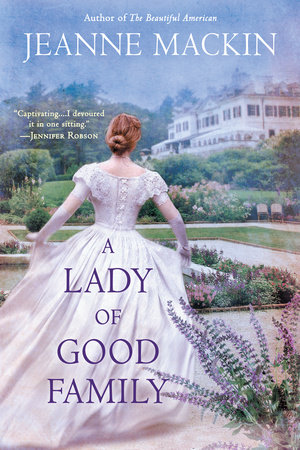
From the Editor’s Desk: Ellen Edwards, executive editor at NAL, on A Lady of Good Family by Jeanne Mackin

Editors get very passionate about books they work on – the Editor’s Desk series is his or her place to write in-depth about what makes a certain title special. Get the real inside-scoop on how books are shaped by the people who know them best. Two years ago, Jeanne Mackin had finished her first novel for NAL and was casting about for a new subject. In The Beautiful American, Jeanne had written about Vogue model/photographer Lee Miller, a lover of surreal artist Man Ray in 1930s Paris and the first woman to photograph the Nazi concentration camps after their liberation, and she was looking for another historical figure with artistic associations. One name came to my mind. I had recently visited the Bronx Botanical Gardens and spent time in the Peggy Rockefeller Rose Garden, designed by Beatrix Farrand. I’d learned that although the garden wasn’t created until the 1980s, Beatrix Farrand designed it in 1916. And somewhere I’d read that Beatrix was also a niece of Edith Wharton. Gardens and books—the combination certainly appealed to me, and I was delighted to learn that it appealed to Jeanne as well. “You know I wrote the Cornell book on herbs and flowers,” she told me. I hadn’t known, but we both felt she’d found her subject. Finding the story wasn’t nearly as easy. Jeanne called me, lamenting, “Beatrix led such a normal, responsible life. Where’s the conflict? How do I make her interesting?” I encouraged her as best I could, but Jeanne found a solution that went far beyond anything I could have imagined. Instead of writing a straightforward fictional biography, she borrowed a narrative style from Henry James, who was also a close friend of Beatrix, and created a narrator named Daisy (ring any bells?) who tells a small but crucial portion of Beatrix’s life story through the lens of her own experience. For good measure, Jeanne includes a ghost, inspired by James’s The Turn of the Screw. In fact, there is more than one ghost. And Jeanne writes a love story for the young Beatrix, despite Beatrix having been known in her early years for ignoring the strong expectation that she marry and instead pursuing a career—something that women, especially women of her class, never did. A Lady of Good Family is a beguiling narrative with echoes of novels by Wharton and James that explores relationships between mothers and daughters, husbands and wives, and art and artists during a time of great change for women. Like Willa Cather’s The Song of the Lark, it is also the story of a woman finding the courage to defy convention and follow her true passion; and of the forces that shape her as both a creative artist and as a woman. Set in Europe and New York during the Gilded Age and the early 20th century, A Lady of Good Family brings Beatrix Farrand to full and vibrant life, and proves that in the hands of a talented writer, even someone with a “normal, responsible life” can become utterly compelling. And now I have had the pleasure of visiting some of the gardens that Beatrix designed. I especially recommend Dumbarton Oaks, just outside Washington, DC. And, of course, the Peggy Rockefeller Rose Garden in our own backyard. Read more about A Lady of Good Family here.