

Writing Tips From Dinty W. Moore, author of Dear Mister Essay Writer Guy

We know readers tend to be writers too, so we feature writing tips from our authors. Who better to offer advice, insight, and inspiration than the authors you admire? They’ll answer several questions about their work, share their go-to techniques and more. Now, get writing!  What writing techniques have you found most important or memorable? There is no secret to my technique beyond revising again and again and again, both for meaning and for the rhythm and sound. As many other writes have confessed, my early drafts are sloppy, flat, confused, and disappointing. Four or five drafts into a project, and maybe I begin to see what is there. The difference, in my mind, between writers who are successful in finding an audience and those who struggle, is when and where in the revision process a writer gives up and settles for “good enough.” Learn to be just a bit tougher on your own work than the toughest editor you have worked with and you’ll find that editors suddenly love your work. How would you recommend creating and getting to know your characters? Though I started as a fiction writer, for the last fifteen years I’ve focused on what is called creative nonfiction, or literary nonfiction. But I’m glad this question is here, because it gives me the chance to point out that even in memoir, even in a piece of literary journalism, the people on the page function as “characters.” They are real people, not imagined, but the reader has never met them, so you have to build these individuals up just as a novelists builds up an imaginary character: let us see them cross the room, let us see them fidget, let us hear the peculiarities of their speech, let us in on what seems important to them. People are contradictory and enormously complex. Try to show a glint of that. After developing an idea, what is the first action you take when beginning to write? I check my e-mail, look out the window, get up for more coffee, linger near the refrigerator, jump up onto the internet to find news of Donald Trump’s latest insanity, and then berate myself for being such a procrastinator. Is there something you do to get into a writing mood? Somewhere you go or something you do to get thinking? No. It is a job. The way I get into writing is to say, “time to get to work.” Did you always want to write? I always wanted to write, and penned silly plays and stories even in second grade, but I grew up lower middle class, my dad was a car mechanic, and I barely knew people who read books much less people who wrote them, so it wasn’t until I neared the age of 30, having washed out of four or five other career pursuits, that I finally decided, let’s try to do this. Let’s try to write a book. What’s the best piece of advice you have received? The novelist Vance Bourjaily once told me that he doesn’t even try to write the first chapter of a novel until he has written a complete draft from somewhere in the second chapter to the end. Only then does he know what has to go at the start. Now this may or may not be a useful technique, but it made clear to me that writing a book – or an essay, or a story, or a poem – is an act of discovery. You don’t sit down and say what you want to say. You sit down with questions, see where they lead you, follow them into unexpected territory, and then many drafts later go back and fix the writing so it all points in the same direction. Describe your writing style in 5 words or less. Sentences are fascinating puzzles. Read more about Dear Mister Essay Writer Guy here.

Penguin Random House Internships – The Inside Scoop, Part 1

For book lovers, snagging a summer internship in publishing is a very big deal. Now that it’s almost time to head back to school, we asked our interns about their experiences at Penguin Random House.  DK Publicity Intern: Lauren DĂ­az Morgan After moving to New York City in hopes of beginning a career in publishing, I was overjoyed to be accepted to Penguin Random House’s Summer Internship Program. But when I found out that my summer assignment would be in Publicity with DK, a nonfiction imprint for children and adults, I grew a bit nervous. Though I had experience interning at my university press back in college, I knew nothing about publicity, and I wasn’t sure how interesting it would be to work with nonfiction titles. To my surprise and delight, I have found myself to be very happy both with my department and with DK. Lauren Morgan As a publicity intern, I am involved in reaching out to media outlets and generating interest in our books. This generally consists of brainstorming and researching outlets to which we can pitch our books; writing a press release that gives a brief summary of the book and explains why it is interesting, useful, or important; and mailing out a copy of the book along with a press release to each outlet, hoping that they will find it interesting enough to review. This can be especially fun at DK, where we publish such a wide array of titles. In one day, I can put together a press release and mailing for a book on cheese, another for a book about the Pope, and a third for a children’s sticker book. While I spend most of my time on the steps of this process, there are new tasks that pop up every day, whether they be helping to schedule an author tour or assisting with our holiday gift guide. Publicity is a new field for me, but I’ve learned so much in the past five weeks, and I’m glad to say that I’m really enjoying every day. I’m so grateful to have this opportunity with DK, and I’m eager to learn more as I continue working this summer.
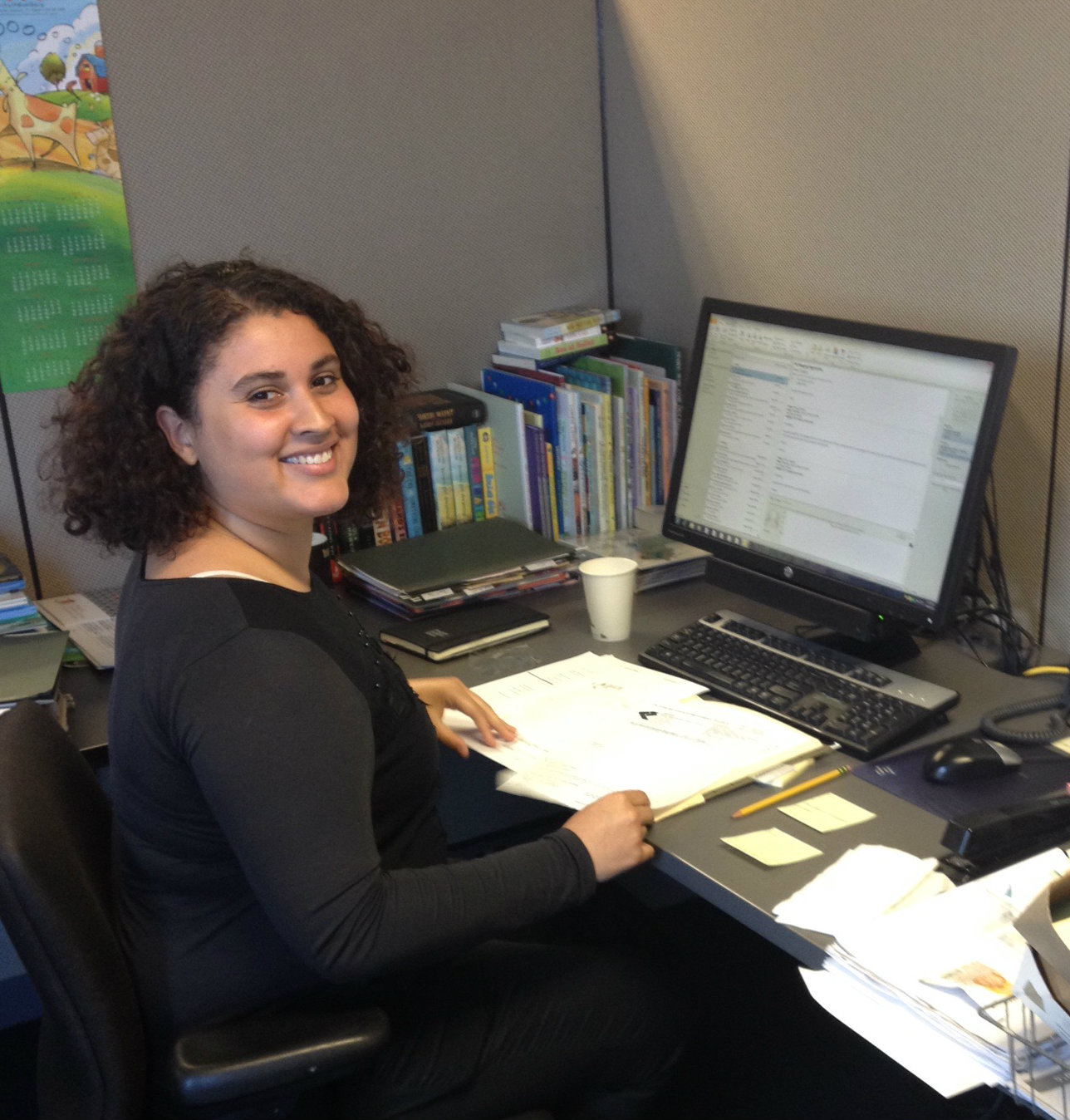
Young Readers Production Intern: Denise Conejo

As an intern, working in production is like taking in the view from the top of the empire state building watching and observing the busy, bustling crowds below. I get a breadth of the publishing arc, I get to see it all happen and know the logistics of how it happens. While some may not appreciate the more business and formulaic side of publishing that production may well be it happens to fulfill my compulsive side to be neat and organized. A lot of my day to day tasks include working with excel sheets, excel sheets and some more excel sheets. They’re like the veins that keep production pumping. I help maintain sheets for estimates, royalties, trim size/page count, as well as updating statuses on SAP and Filemaker Pro for titles being reprinted. Denise Conejo And then there’s digital, one of my favorite parts of production. This really surprised me because I’ve always hated reading books from a tablet. Regardless, I found that I enjoyed the immediacy of seeing the end product. It takes about a month to see a turnaround for an e-book, while it takes 6-9 months for a printed title! My tasks with digital production include writing memos to Aptara (the company who puts together the e-books) giving specific and detailed instructions on what we want the final product to look like. Once the files are made and returned to me, I check it to make sure it is exactly what we wanted. Afterwards, I circulate it to various departments where they give the “OK” or tell us what needs to be worked on. Easy! I’ve learned so much about the process of publishing already, so for the next and last 5 weeks of my internship I can only imagine how much more I will gain from the people who make this department work so smoothly.

Thanks to all our interns for all your hard work! You’ll be missed! 

Scott Moyers, VP Publisher of the Penguin Press and editor of Eileen, by Ottessa Moshfegh

Editors get very passionate about books they work on – the Editor’s Desk series is his or her place to write in-depth about what makes a certain title special. Get the real inside-scoop on how books are shaped by the people who know them best. Ottessa Moshfegh’s fiction is like a new species of wild animal. First there’s that stunned delight: I’ve never met this species before! Whoa, it feels kind of dangerous. Then there’s the inevitable effort to categorize it, to place it within a larger taxonomy. It’s been delightful to watch some of our smartest, most fearless writers come to grips with what makes Ottessa Moshfegh’s work so special, so hard to shake. Take Jeffrey Eugenides: “Moshfegh is a writer of significant control and range
. What distinguishes her writing is that unnamable quality that makes a new writer’s voice, against all odds and the deadening surround of lyrical postures, sound unique.” Or Rivka Galchen: “A scion of Nathaniel Hawthorne and Raymond Carver at once, Moshfegh transforms a poison into an intoxicant.” Those stories I read in the Paris Review stuck with me for keeps: these are very different psyches each to each, and the voices are utterly distinct, but each is an exploration of a mind that’s unsteady on its feet in a most arresting way, a triumph of unreliability, you could say – unreliable on just about every level imaginable. The world is a lot weirder than is commonly understood; Ottessa as an artist has a purchase on that weirdness and brings us into contact with it, in a way that is wildly electric. But those are the stories; like many I was very eager to see what this writer would do with a longer form. McGlue, her bravura novella, gave a tantalizing hint, but nothing quite prepared me for the narrative tricksiness, the storytelling cunning, of Eileen. My God, can this writer play the long game. I want to quote, if you’ll forgive me, from the starred Kirkus review, because it makes the point better, I think, than I can: “A woman recalls her mysterious escape from home in this taut, controlled noir about broken families and their proximity to violence
. The narrative masterfully taunts
. The release, when it comes, registers a genuine shock. And Moshfegh has such a fine command of language and her character that you can miss just how inside out Eileen’s life becomes in the course of the novel, the way the “loud, rabid inner circuitry of my mind” overtakes her. Is she inhumane or self-empowered? Deeply unreliable or justifiably jaded? Moshfegh keeps all options on the table
. A shadowy and superbly told story of how inner turmoil morphs into outer chaos.” Set in the 7 days leading up to Christmas in 1964 in a small town outside Boston, Eileen is the story of how a deeply unhappy young woman imprisoned by her circumstances finds a most unexpected accomplice who busts her out of her confinement, though arguably, as Bob Dylan sang, she uses a little too much force
 While stylistically this reminds me of nothing so much as Shirley Jackson of The Birdcage and Vladimir Nabokov of King, Queen, Knave, in another sense this reminds me of the wonderful Celeste Ng’s Everything I Never Told You, in that there’s a political valence to this novel all the more powerful for being so beautifully sublimated in a powerful suspense novel. It’s a hell of a thing for a young woman to feel as unattractive as Eileen Dunlop is made to feel by the world around her; the wound is real. And so, though she makes choices you or I might perhaps not make – though perhaps you would! – I think few will say that in the end they’re not rooting for her to go all the way. Read more about Eileen here.

Writing Tips from Megan Crane, author of Make You Burn

We know readers tend to be writers too, so we feature writing tips from our authors. Who better to offer advice, insight, and inspiration than the authors you admire? They’ll answer several questions about their work, share their go-to techniques and more. Now, get writing!  Is there something you do to get into a writing mood? Somewhere you go or something you do to get thinking? I’m a big believer in the “writing retreat.” Sometimes writing retreats involve locking myself in a hotel room for a few days to really throw some words on the page—other times these retreats involve gathering with my writer friends in a variety of inspiring, usually beautiful places, where the word count might not be high but the camaraderie and daydreaming leads to a whole lot more writing down the road. This is how The Deacons of Bourbon Street series came into being. Last spring, Maisey Yates, Rachael Johns, and I roomed together at the RT Convention held in New Orleans. We spent a lot more time wandering that fascinating, mysterious city than we did at the conference. When an editor (perhaps jokingly!) suggested we should write a multi-author series together since we got along so well, we jumped at the idea. New Orleans and gritty bikers seemed to go hand in hand for us, and once we settled on that premise, it seemed inevitable that we should pull in Jackie Ashenden, renowned for her dark and sexy stories, to round us out. And all because we visited New Orleans! After developing an idea, what is the first action you take when beginning to write? We sent a lot of emails back and forth, since we live all over the place—Maisey and I on the west coast of the US, Rachael on the west coast of Australia, and Jackie in New Zealand. But we also spent some time on Skype. We talked a lot about biker books, about characters, about the kinds of things we liked and the sorts of stories we wanted to tell. We fashioned an overarching plot and then we decided who our characters would be within that plot. We came up with a synopsis for all four books and once that had the enthusiastic support of our agents, we settled down and wrote a chapter each to introduce our characters and stories. That was the most fun—to see all the conversations and ideas we’d thrown around come together into these four fantastic stories. All set in our decadent version of New Orleans’s famous French Quarter. How did you handle plot and character continuity across four books? We talked a lot. Communication is key when it comes to working on multi-author projects. We discussed timing and plot points and the characters’ relationships with each other endlessly. We also sent each other/the whole group the scenes where their characters appeared in our books. The goal was always to make the characters feel seamless across all the books, and to show how they all functioned as this group of sworn brothers, reunited after years in exile. I think we pulled it off, but of course, that’s for readers to decide! Is there something you do to get into a writing mood? Somewhere you go or something you do to get thinking? I was lucky enough to write my book a few months after everyone else did. This was particularly helpful because it meant that I’d already read how the series ended and could write directly toward it—always a huge advantage! So one of the things I did to get in the writing mood was to read those other books and immerse myself in the world. Another thing I did was to curate “inspiration boards” on Pinterest. Looking at moody reference pictures (many featuring Charlie Hunnam, of course, as everyone’s favorite biker inspiration Jax Teller) was another way to get myself in the right mindset. I also relied pretty heavily on a mix I made of songs that brought me into the right headspace. One in particular (Arctic Monkeys, “Do I Wanna Know?”) was and is such a perfect encapsulation of my hero in this book that all I have to do is listen to that awesome opening and I’m right back there in the Priory with Ajax
 Do you ever base characters off people you know? Why or why not? I have some family members who are more familiar with biker clubs than I am, but I didn’t base any characters on them. Though I did appreciate it when they didn’t laugh at me when I told them what kind of book I was writing! The truth is that reality doesn’t make great fiction. Characters are always better when they’re entirely themselves instead of pale imitations of real people. “Larger-than-life” makes a good story and fascinating characters. “Just like life” is something we can all do all by ourselves, without a good book. I prefer books. Learn more about Make you Burn here.

What Should I Read on Vacation? Penguin Random House employees share their picks

Heading to the beach in the dog-days of summer? Taking some time off to unwind and catch up on your reading? Penguin Random House employees never go on vacation without a good book – see below to learn what professional book-people read on their off-time. Kristen Fritz, Senior Director, Content Marketing, Digital Marketplace Her vacation read: The Narrow Road to the Deep North by Richard Flanagan
Guatemala
The view from my reading spot in San Marcos La Laguna, Guatemala

“As I was situated along the shore of the soothing, somewhat eerie, very magical Lake Atitlan in Guatemala for a week last spring, Richard Flanagan’s 2014 Man Booker-winning novel, The Narrow Road to the Deep North, proved to be the kind of book in which I got deeply lost while silently willing the world to stay away and let me read.”

Lindsay Jacobsen, Senior Coordinator, Consumer Engagement  Her vacation read: Is Everyone Hanging Out Without Me? (And Other Concerns)

“Sometimes you begin a book on vacation and find that the story doesn’t match your destination. The book, Is Everyone Hanging Out Without Me? (And Other Concerns) by Mindy Kaling was the perfect companion on my trip to Ocho Rios, Jamaica. Her sparkly-eyed dreams of fame and materialism seamlessly complement a self-serving Caribbean beach getaway. While hanging out with Mindy, I laughed and I cried. I read out loud to no one. I used the book as protection from the sun. I was so enthralled, I even neglected my piña colada.”

Nancy Sheppard, Vice President, Director, Advertising and Promotions, Penguin Publishing Group Her vacation read: The Magicians, by Lev Grossman The Magicians

“Here I am with the great staff at City Lit Books while on vacation in my old neighborhood, Logan Square in Chicago. I was there handselling my favorite vacation read, The Magicians by Lev Grossman, in paperback!”

  Check out all our bestsellers to find more vacation-reading inspiration!

Writing Tips from Jennifer Steil, author of The Ambassador’s Wife

We know readers tend to be writers too, so we feature writing tips from our authors. Who better to offer advice, insight, and inspiration than the authors you admire? They’ll answer several questions about their work, share their go-to techniques and more. Now, get writing!  After developing an idea, what is the first action you take when beginning to write? Usually when I sit down (or often, stand up) to write, I start by re-reading and editing the previous day’s work. That gets me back into the world of the book. Then I just carry on with the story from where I left off. I am a somewhat disorganized writer. I don’t write outlines or think too far ahead when writing a first draft. I write fast first drafts that I finish in three to ten months, and then spend a couple of years editing. I often think of scenes as puzzle pieces or quilting squares, shuffling them around until they make sense. I do, however, often write a basic timeline so I can remember when pivotal events happen and how old everyone is. But the story itself emerges only when I am actually writing. Often I have no idea where the plot is heading until it emerges from my fingers. For this reason, I am a serious rewriter. I write at least a dozen drafts of each book. Much of the structure, plotting, and pacing emerges in later drafts. I think of my first drafts as skeletons, and each successive draft as layering on muscle, veins, fat, skin, hair, etc. Until it is a fully living book. Is there something you do to get into a writing mood? Somewhere you go or something you do to get thinking? One thing I learned fairly early on is that I cannot afford to wait to be in the right mood. For me, writing needs to be a daily discipline, like exercise. I do it no matter what mood I am in. The hardest part is getting myself to the computer and shutting off the Internet. Once I open the document and start working, I am suddenly in the mood. Work inspires work. Also, when you have a small child and the various diplomatic obligations that come along with being an ambassador’s wife, you write in every unscheduled moment, whenever those moments are. Did you always want to write? How did you start your career as an author? I have kept a journal since the day I learned how to write, but I never thought of myself as a writer until graduate school. I majored in theater in college and worked for several years as an actor. But eventually I became frustrated with the limited roles available to women. I wanted to play paleontologists and astrophysicists but ended up playing ingĂ©nues and prostitutes. It got old. I began writing some of the things I wished my characters would say and decided to go back to school. After getting an MFA in fiction writing and an MS in journalism, I worked in newspapers and magazines for years before finally writing my first book. I don’t think that first book would have happened, however, had I not taken an enormous risk by moving to Yemen to take over a newspaper. From the moment I accepted that job, I think I knew I was going to have a lot to write about! What’s the best piece of advice you have received? One evening in 1992 I was sitting in a bar in Bainbridge Island, Washington with a friend who is a brilliant and prolific composer. I was going on and on about various ideas I had for short stories, and he said, “You know, there comes a time when you have to stop talking about what you are going to do and start doing it.” I went straight home that night and wrote a short story. I still think about that conversation twenty years later. It gets me into the chair (or standing in front of the computer—I often write standing up). What clichĂ©s or bad habits would you tell aspiring writers to avoid? Do you still experience them yourself? Don’t wait to feel inspired. If you’re serious about writing you should be writing every day. Treat it like any other job. Schedule time for it, even if you only have a half hour a day. Turn off the Internet. Check Twitter and Facebook after you write, not before. I indulge in this bad habit too often. I write best when I schedule specific times of day to check social media. If you need to do research online, make notes in your draft of things to look up later, when you are done writing. Don’t ever send out a first draft. While there are a few writers out there who produce genius first drafts, most of us do not. Rewrite, rewrite, and rewrite your story until you feel you have absolutely taken it as far as you can. Then get a writer you trust to edit it. Rewrite some more. Take at least a day between drafts so that you can approach your work with fresh eyes. Do you ever base characters on people you know? Why or why not? Yes. But though real people often provide the initial spark or inspiration, the characters swiftly take on a life of their own. Ultimately I don’t think any of the characters I create resemble the people who originally inspired them except in the most superficial of ways. I observe the people around me with the eyes of a journalist, noting quirks and interesting phrases. There is so much rich material just floating around. The imagination takes off from there. Read more about The Ambassador’s Wife here.

Reading & Eating: The Broad Fork, by Hugh Acheson and Under Magnolia, by Frances Mayes

Wine and food pairings are all well and good, but there’s no better pairing than two complementary books. Reading + Eating posts feature two titles that will inspire you to cook, read, eat, and enjoy. The gorgeous cookbook images, and handpicked recipes and quotes make for some delicious reading.  This month, we’ve paired Frances Mayes’ gorgeous memoir about growing up in the South with The Broad Fork, a lush cookbook from beloved chef, Hugh Acheson. collage

In Under Magnolia, beloved author Frances Mayes returns with a lyrical and evocative memoir of her childhood in the South. Under Magnolia is a searingly honest, humorous, and moving ode to family and place, and a thoughtful meditation on the ways they define us, or cause us to define ourselves.

“As gothic as anything Faulkner could have dreamed up, populated by characters straight out of a Flannery O’Connor story
a thorny memoir that strips away the polite Southern masks, sweet magnolias be damned. Unforgettable.” – Atlanta Journal Constitution

“With perfect-pitch language, Mayes unblinkingly describes her growing-up years
 One can almost taste the mushiness of ‘a pot of once-green beans falling apart in salt pork’; one can almost smell the cloying scent of honeysuckle, gardenias and overripe peaches that infuse the always-too-humid air.”– USAToday.com

Read more about Under Magnolia here.

The author of The Broad Fork, Hugh Acheson, is a James Beard Award-winning chef and partner of the restaurants Five & Ten, The National, and Empire South in Georgia. In this beautiful new cookbook, he focuses on seasonal produce, balance, and flavor. See below for two wonderful recipes from the book.

455_Ache_9780385345026_art_r1 POACHED SHRIMP OVER RADISHES WITH SALSA VERDE Serves 4, as an appetizer Poached shrimp take about three minutes. Salsa verde can be made ahead. Radishes take a minute to cut up, if that. The broth assembles in a minute and is cooked for fifteen before the shrimp go in. I guess what I am saying is that I realize you’re busy but this is so easy, so fast, and so impressive that you need to go and make it. When buying shrimp, hopefully you find them fresh. But if not, shrimp are one of the few things that freeze well, so find fishmongers whom you trust and buy from them. They’ll know which ones are going to put a smile on your face. 1 pound shrimp (16 to 20 count) 1 teaspoon olive oil ÂŒ cup dry vermouth 3 cups chicken stock ÂŒ pound (œ stick) unsalted butter 1 sprig fresh thyme 1 leek, white and light green parts well washed and cut into 1-inch lengths Kosher salt 12 radishes, quartered œ cup minced celery with leaves ÂŒ cup Salsa Verde 1. Peel the shrimp, leaving the tails on and reserving the shells. (Even better if you have the heads, but if you’re buying head-on, buy about 1œ pounds.) Set aside. 2. In a 4-quart saucepan, heat the olive oil over medium-high heat. When the oil shimmers, add the shrimp shells (and heads if you have them) and cook for 3 minutes, until bright pink and aromatic. Add the vermouth and deglaze the pan. Add the chicken stock, butter, thyme sprig, leek, and kosher salt to taste. Bring to a boil and then simmer over low heat for 15 minutes. Strain the mixture and return the liquid to the pan over medium heat. Discard the strained solids. 3. Season the shrimp with kosher salt, and immerse them in the poaching liquid. Cover and cook for 3 minutes or until the shrimp are just cooked through. 4. Arrange the radishes and the celery in individual bowls for serving. Divide the shrimp among the bowls, and then ladle some of the poaching liquid over them. Finish each bowl with salsa verde, and serve. 272_Ache_9780385345026_art_r1 STEAMED ARTICHOKES WITH DRAWN THYME BUTTER Serves 4, as a side I was a wee little guy when Pops was doing a sabbatical in Palo Alto, at venerable Stanford University, but I remember eating egg rolls and artichokes with drawn butter. Now that may not have been in the same meal, but that’s how my memory puts them: together. The egg rolls were (amazingly enough) homemade by my mum and the artichokes came from a couple hours south of us. Big, green, thistly orbs. And I fell for them—hook, line, and sinker. Now my kids love the hunt to get to the heart of the artichoke, scraping each leaf with their teeth and getting all they can from their beauty. 7 tablespoons unsalted butter 1 cup sliced yellow onion 1 tablespoon fresh thyme leaves ÂŒ cup fresh flat-leaf parsley leaves 2 large globe artichokes, top 2 inches sliced off 1 cup dry white wine Kosher salt 1 lemon, cut into wedges 1. Place a stockpot over low heat and melt 1 tablespoon of the butter in it. Once the butter starts to foam, add the onion, half of the thyme, and the parsley, and begin to sweat the onion. While you prepare the artichokes, the onions will happily hang out over low heat. 2. Tear off the first few outer leaves from the bottom of each artichoke, as well as any attached to the stem. Using a vegetable peeler, shave the stems until you reach the white inner part. Add the artichokes to the pot, stem side up. Then add the white wine and enough water to cover the artichokes. Bring to a boil over high heat, add enough salt to make the liquid pleasantly salty, and then lower to a simmer. To keep them submerged, place a plate that’s just small enough to fit inside the pot over the artichokes. Cover the pot with a lid and cook the artichokes for about 20 minutes, or until you can slide a knife into the stem with no resistance. 3. Remove the plate and then the artichokes from the liquid, and place the artichokes on a cutting board to cool. When they are cool enough to handle, use a chef’s knife to carefully slice each artichoke in half, starting at the tip of the stem. This will expose the heart of the artichoke. Just above the heart you will see a fuzzy part, which is called the “choke.” Using a small spoon, remove the choke. You will be left with the heart and the fleshy leaves. 4. Melt the remaining 6 tablespoons butter in a small saucepot and add the remaining thyme leaves. Once the butter is fully melted, set it aside. 5. Place the artichokes on a large platter and season with salt, to taste. Garnish with the lemon wedges. Serve with the reserved melted butter for dippin’. Read more about The Broad Fork here.

From the Editor’s Desk: Becky Cole, Editor of Stir

Editors get very passionate about books they work on – the Editor’s Desk series is his or her place to write in-depth about what makes a certain title special. Get the real inside-scoop on how books are shaped by the people who know them best. When the proposal for Stir came in, it was subtitled “How My Brain Exploded and I Got Cooking.” What I found in those pages just about made my own brain explode. Here was a memoir by a first-time writer who had survived a traumatic brain injury, a Harvard Ph.D candidate who lost sight in one eye, her sense of smell, and a chunk of her skull so large that she had to wear a hockey helmet to protect her brain, impressive enough, but what made the proposal a standout was not her injury, but the way she wrote about how food and the simple everyday acts of cooking, baking, stirring, sautĂ©ing, and sharing it, helped her to heal. As she writes in the book, getting well meant finding her everyday, and she found hers in the kitchen. This stunning book didn’t fit neatly into any category in the bookstore, but everyone at Penguin Random House who read it loved it, and we knew we had to publish Stir. Every author takes an approach to writing that makes sense to them. Some outline, others write set pieces to be stitched together later. Some write almost in a fugue state, getting the book down on paper from beginning to end, barely stopping to put in commas. Jessica was not that kind of writer. She was careful, precise. Every word worked at the sentence level. The challenge with Stir was broader—we didn’t want the book to be pigeon-holed as a recovery memoir, but we also knew that her illness was the natural beginning of her story. During editorial talks, we spent much of our time discussing how to weave various strands together. First, of course, there was the aneurysm. Then, there was the food—the facts of cooking it and eating it and recovering because of it. Beyond those two main threads, there was a love story between Jessica and her unflappable husband, Eli, including their attempts to start a family (spoiler: they do! as anyone who follows her wonderful blog, sweetamandine.com knows from the pictures of her two adorable daughters she posts there); an ode to the constellation of women in her life—her mother, stepmother, grandmothers, her Aunt Fran, and close friends—whose influence she feels strongly in the kitchen; and, finally, the story of how she came to a new understanding of the link between food and identity. As we’d talk, Jessica would occasionally ask me, “How do you think I should
?” We’d mull it over and then she would go off and come up with a perfect solution. When I said as much, more often than not, she’d respond that she had simply looked at a memoir she admired to see how that writer succeeded in doing whatever it was Jessica herself was trying to do. She was applying the skills she’d honed as an academic to the process of writing a memoir. She read and dissected every memoir she could get her hands on —Wild, The Liar’s Club, Eat, Pray, Love, and My Stroke of Insight, and dozens of others– to pick them apart and learn how they performed different feats of narrative and storytelling. She marked her copy of Wild with a “Pivot!” in the margins next to the places Cheryl Strayed switched from one subject to another without losing the reader, and then figured out a way to make the technique her own in Stir. It was as if she was reading to defend her dissertation and her dissertation was how to tell the story of her life. Again and again, I could see her incorporating the lessons she’d gleaned from the writers she loved into her own book. One day, she sent me a document I’m not sure I was meant to see. It was an eleven page spreadsheet with columns delineating plot, characters, conflict, what we learn (general), what we learn (food), and “to do.” It showed an awareness of how the book was working—or not—from a structural perspective, which helped to keep everything in balance. Another time, she sent me a file that had all of the material dealing with Eli in one document so she could make sure the story hung together, which it did. This all sounds terribly clinical, but the book that came out of it is anything but, despite a good part of it taking place in and out of hospitals after brain surgery. What I love about Jessica’s writing, especially her writing about food, is how unfussy it is—the opposite of academic writing with its particular conventions, and different, too, from a certain type of food writing, the kind with sumptuous descriptions of dishes that sound like menu items at a restaurant where almost no one can afford to eat. Jessica, however, writes every bit as much for the person who swoons over grass-fed butter as she does for someone who savors a Ritz cracker melting on her tongue. She writes exquisitely but without pomp about how the way we prepare food and who we eat it with connects us to our past, our future, and our true selves. The moments where she connects to food shine brightly on the page. She writes about the smell of cucumber when her olfactory nerves kick in again, the mushrooms chopped for a favorite pasta dish when she first returns to the kitchen, and an almond cake resting on a counter that acts as a Proust’s madeleine of sorts as it lets her know, as she writes, that food had something to teach her, and that it felt good to listen. I am glad that she did. Read more about Stir here.

Writing Tips: Robin Kirman, author of Bradstreet Gate

We know readers tend to be writers too, so we feature writing tips from our authors. Who better to offer advice, insight, and inspiration than the authors you admire? They’ll answer several questions about their work, share their go-to techniques and more. Now, get writing!  What’s the best piece of advice you have received? At a talk at Columbia, Philip Roth said something that has stayed with me since; I’m not sure it counts as advice as much as a description of his writing process. He said that he lets himself write freely for some time and then rereads the material, pen in hand, and circles whatever feels alive. This idea, of live material, is what I take to be essential to good literary writing. I’ve come to believe most anything wrong with a first draft can be fixed later—plot can be focused and adjusted, endings changed, themes emphasized, characters and sentences refined, and so on—but what cannot be accomplished later is breathing life into something flat or false. Did you always want to write? How did you start your career as an author? I came to fiction writing later than most writers I know: not until my mid-twenties. Before then the writing I’d done was almost entirely academic; for a while I’d seriously considered a career in philosophy. When I think about my first attempts at fiction, they seem to me very much influenced by philosophy: back then I started every story or novel with a concept, and developed it pretty linearly. Readers of Bradstreet Gate might be surprised to hear this; that book proceeds so differently, following characters in often unpredictable directions. That improvisational feeling took me a lot of work and time to achieve. Is there something you do to get into a writing mood? Somewhere you go or something you do to get thinking? The best way to get into a writing mood really is to just start writing—if not writing in the most ambitious sense (new scenes, preciously crafted sentences) then just sketching, thinking through ideas on paper. I often do start writing on paper, developing thoughts in notebooks, until I have some material to work with and sufficient momentum to get back to a scene. What writing techniques have you found most important or memorable? I do a terrific amount of exploratory writing; that is, writing that probably won’t make it into the final book but that allows me to play with my characters and their situations until the material shapes and reshapes itself into a form I like. Often, I continue to do this even later in the process: once I’ve worked up one scene or one idea, I’ll make myself do another version or two—an altered course of events, a new reaction from my character—just to see if something more interesting happens. That way I have a means to evaluate my choices, and it’s a good way to avoid crutches and clichĂ©s. Do you ever base characters off people you know? Why or why not? I’d say my characters contain some elements of people I know, but often several people in combination, and I still try to leave most of my characters’ biographies and sensibilities to invention. For me, sticking too closely to real people would be confining, and possibly prevent me from the important work of having to think through the experience of my characters myself. Maybe it’s that I understand those around me less well than I like to imagine, but copying actual people hasn’t proven as useful in my writing as it seems to be for others—or worth risking the consequence of terrifying family and friends. Learn more about Bradstreet Gate here.