Today, we are commemorating The Battle of Bull Run (First), which occurred on July 21, 1861.
Read an excerpt from Our Man in Charleston: Britain’s Secret Agent in the Civil War South by Christopher Dickey:
On the morning of July 21, 1861, William Howard Russell [editor’s note: an Irish journalist with
The Times] was running late for a battle. Confederate troops under Gen. P. G. T. Beauregard, whom he knew from Charleston, and the Union Army under Gen. Irvin McDowell, whom he’d met several times, were now massed around a little rivulet called Bull Run near the Manassas Gap Railroad junction. Everybody in Washington seemed to think this first major battle would be a Northern victory. It might be the beginning of serious fighting. It might be the end of it. Whatever happened, there was no question, Russell had to be there to see it.
Since Russell’s return from the South to the Federal capital, nothing had gone right for him. While he’d been away, and despite his reams of reporting, Delane and the other editors of the
Times of London had taken a stand of clear sympathy with the secessionists. They reflected the interests of an elite with commercial concerns about cotton and contempt for the American notion of a republic. They also embraced the idea that, because Lincoln and Seward insisted this war was not about freeing the slaves, then truly that was the case. And for the masses, there was the appeal of the Southerners as underdogs struggling against the subjugation of Washington. The
Times editors had become just the apostles of the fait accompli that Seward had feared. So even though the paper still ran Russell’s articles about the inadequacies of the Southern military position, the arrogance of King Cotton, and the monstrosity of slavery, its editorials were such that Russell found the
Times “assailed on all sides as a Secession organ, favorable to the rebels and exceedingly hostile to the Federal government and the cause of the Union.” The net result for its correspondent was that he no longer had the kind of access to the Union military that he’d wanted and expected. Seward would still see him, but War Department passes were hard to come by, and on the eve of combat no one would give him the countersign so he could get through checkpoints to see the battle begin at dawn.
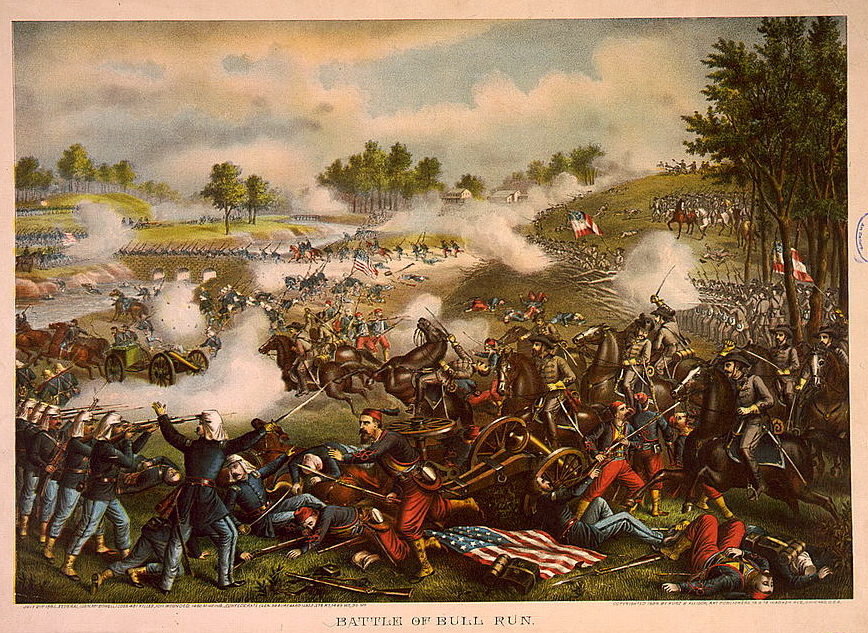
Not until midday did Russell finally get close enough to the fighting to hear “the thudding noise, like taps with a gentle hand upon a muffled drum” of artillery in action. Among congressmen and other dignitaries, many of them accompanied by their wives, he watched from atop a hill above Centreville as distant wisps of smoke marked the opposing lines. He ate a sandwich. He drank some Bordeaux he’d packed in his case. By the time he drew closer to the fighting, the Union forces were pulling back; then, suddenly, they were fleeing in a rout so complete that he could hardly believe his eyes.
Russell was on a borrowed nag threading his way toward the action when he heard loud shouts ahead of him and saw several wagons coming from the direction of the battlefield. The drivers were trying to force their way past the ammunition carts coming up the narrow road. A thick cloud of dust rose behind them. Men were running beside the carts, between them. “Every moment the crowd increased, drivers and men cried out with the most vehement gestures, ‘Turn back! Turn back! We are whipped.’ They seized the heads of the horses and swore at the opposing drivers.” A breathless officer with an empty scabbard dangling by his side got wedged for a second between a wagon and Russell’s horse.
“What is the matter, sir?” Russell asked. “What is all this about?
“Why, it means we are pretty badly whipped,” said the officer, “and that’s the truth.” Then he scrambled away.
The heat, the uproar, and the dust were “beyond description,” Russell wrote afterward. And it all got worse when some cavalry soldiers, flourishing their sabers, tried to force their way through the mob, shouting, “Make way for the general!”
Russell had made it to a white house where two field guns were positioned, when suddenly troops came pouring out of the nearby forest. The gunners were about to blast away when an officer or a sergeant shouted, “Stop! Stop! They are our own men.” In a few minutes a whole battalion had run past in utter disorder. “We are pursued by their cavalry,” one told Russell. “They have cut us all to pieces.”
After a while there was nothing the world’s greatest war correspondent could do but fall in with the tide of men fleeing the fighting. In all his battles, he had never seen anything like this: “Infantry soldiers on mules and draught horses, with the harness clinging to their heels, as much frightened as their riders; Negro servants on their masters’ chargers; ambulances crowded with unwounded soldiers; wagons swarming with men who threw out the contents in the road to make room; grinding through a shouting, screaming mass of men on foot, who were literally yelling with rage at every halt and shrieking out, ‘Here are the cavalry! Will you get on?’” They talked “prodigious nonsense,” Russell said, “describing batteries tier over tier, and ambuscades, and blood running knee-deep.” As he rode through the crowd, men grabbed at Russell’s stirrups and saddle. He kept telling them over and over again not to be in such a hurry. “There’s no enemy to pursue you. All the cavalry in the world could not get at you.” But, as he soon realized, he “might as well have talked to the stones.”
It was a long way back to Washington that day. But after several brushes with violent deserters, drunken soldiers, and more panic-stricken officers, Russell made his way in the moonlight to the Long Bridge across the Potomac and into the capital. He told anyone who asked him that the Union commander would regroup and resume the battle the next morning. But when he awoke in his boardinghouse on Pennsylvania Avenue, he found the city full of uniformed rabble. “The great Army of the Potomac,” he wrote, “is in the streets of Washington instead of on its way to Richmond.”
The Federal capital was essentially defenseless. “The inmates of the White House are in a state of the utmost trepidation,” Russell wrote, “and Mr. Lincoln, who sat in the telegraph operator’s room with General Scott and Mr. Seward, listening to the dispatches as they arrived from the scene of the action, left in despair when the fatal words tripped from the needle and the defeat was already revealed to him.”
For the South, “here is a golden opportunity,” said Russell. “If the Confederates do not grasp that which will never come again on such terms, it stamps them with mediocrity.” But the rebels stayed where they were, and the fact that they did not march on Washington suggested this would be a long war.
As Russell studied the city, its politicians, and its dispositions in the aftermath of the battle, he did not agree with “many who think the contest is now over.” He figured the Northerners had learned a lesson about “the nature of the conflict on which they have entered” and would be roused to action. But when the
Times ran Russell’s article on the battle, his balanced judgment about the lessons learned got no play. The whole effect of his account of the rout was to reinforce the editors’ image of a South that not only would fight, but that could fight better than the North and, therefore, should soon be free of it.
Read more about the American Civil War and the untold story of the Robert Bunch: an unlikely Englishman who hated the slave trade and whose actions helped determine the fate of our nation in Our Man in Charleston.
“A perfect book about an imperfect spy.” —Joan Didion 








 What was clear to me was that Annie has the ability to intimately connect to you through her work, no matter what she writes and no matter who her intended audience is—whether it’s an adult novel or one for children. And what’s truly remarkable to me is how organic it was for her to blend elements of both those worlds into her new novel, The Truth According to Us.
Annie feels at her best when she’s writing from the perspective of a young narrator, which is why twelve- year-old Willa Romeyn shines as one of the powerful and endearing voices in The Truth According to Us. She’s been compared quite a bit, by reviewers and readers alike, to having shades of Scout Finch from To Kill a Mockingbird. Willa’s voice is joined by those of two adult characters, her beloved Aunt Jottie (beloved aunts seem to be a theme here!) and Layla Beck, a senator’s daughter who is assigned to write the first official history of Macedonia, West Virginia, and is taking the small town by storm. This union of youth and wisdom is exactly what makes The Truth According to Us, and Annie, so special.
I think it’s Annie’s love for her characters that inspires us to love them as well—no matter their age. And I think it’s the wisdom and charm she infuses in every book she writes that makes you feel connected to her world—and yours—just a little bit more.
Aunt Jottie advises Willa: “What you need is some of that Macedonian virtue. Ferocious and devoted folks are just hell on a stick when it comes to digging up secrets. You just try keeping a secret from a virtuous Macedonian.” That thought came to me often in the line at BEA, because as devoted as Macedonians are to figuring out the truth, we as readers are as devoted to Annie for bringing it all to light for us.
Read more about The Truth According to Us
What was clear to me was that Annie has the ability to intimately connect to you through her work, no matter what she writes and no matter who her intended audience is—whether it’s an adult novel or one for children. And what’s truly remarkable to me is how organic it was for her to blend elements of both those worlds into her new novel, The Truth According to Us.
Annie feels at her best when she’s writing from the perspective of a young narrator, which is why twelve- year-old Willa Romeyn shines as one of the powerful and endearing voices in The Truth According to Us. She’s been compared quite a bit, by reviewers and readers alike, to having shades of Scout Finch from To Kill a Mockingbird. Willa’s voice is joined by those of two adult characters, her beloved Aunt Jottie (beloved aunts seem to be a theme here!) and Layla Beck, a senator’s daughter who is assigned to write the first official history of Macedonia, West Virginia, and is taking the small town by storm. This union of youth and wisdom is exactly what makes The Truth According to Us, and Annie, so special.
I think it’s Annie’s love for her characters that inspires us to love them as well—no matter their age. And I think it’s the wisdom and charm she infuses in every book she writes that makes you feel connected to her world—and yours—just a little bit more.
Aunt Jottie advises Willa: “What you need is some of that Macedonian virtue. Ferocious and devoted folks are just hell on a stick when it comes to digging up secrets. You just try keeping a secret from a virtuous Macedonian.” That thought came to me often in the line at BEA, because as devoted as Macedonians are to figuring out the truth, we as readers are as devoted to Annie for bringing it all to light for us.
Read more about The Truth According to Us 


