Tag Archives: historical fiction
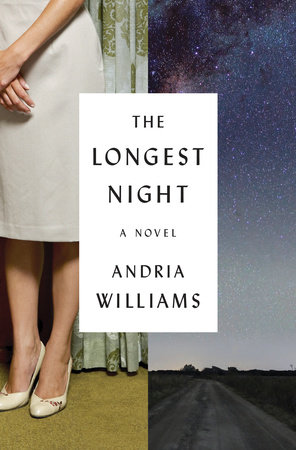
Andrea Walker, Executive Editor at Random House, on The Longest Night by Andria Williams
Editors get very passionate about books they work on – the Editor’s Desk series is his or her place to write in-depth about what makes a certain title special. Get the real inside-scoop on how books are shaped by the people who know them best.
Andria Williams’ debut novel The Longest Night is a book about many things—the Cold War, the American West, gender roles in the 1960s, the birth of nuclear power—but above all it is a portrait of a marriage and the forces that challenge it. I was immediately drawn into the story by the opening scene of the novel—a man named Paul, racing through the night on a rural road, passing an ambulance and fire trucks that are rushing away from an accident that he is driving towards. What is taking him there, compelling him to put himself in terrible danger? Who is he trying to save?
Before we can get answers to this question the novel flashes back to a blindingly hot summer day, three years earlier. A young family are driving cross-country from Virginia to Idaho Falls, where the husband, Paul, has been stationed for his next army tour. They stop at a lake in northern Utah where local teenagers are diving from the rocks. The wife, Nat, is desperate to cool off, and leaves her one and three year old daughters while she climbs to the top of the cliff and dives in, fully clothed. When she emerges from the lake Paul is furious—embarrassed, ashamed, scared she could have hurt herself. But as a reader, I was fascinated. I wanted to know what Nat was looking for in that moment of freedom. Did she just want to escape the demands of being a wife and mother for those brief seconds? Did she want to show her husband that she was her own person, still?  Did she want to set an example of fearlessness for her daughters, or was she not thinking of them at all?

When I describe Andria’s novel I often say that it reminds me of Revolutionary Road, if such a book were set in the American West. That is to say—it is a story about frustrated ambition; domesticity; the stifling social norms of a small town, ruled by a cabal of wives who never fail to match the color of their centerpieces to the tablecloths. Yet it is also a story about how love changes in a marriage—how it is shaped by distance and separation; the birth of children; by our challenges in reconciling our adult selves with our adolescent ones. It is a story rooted in a uniquely specific time and place, that is utterly universal in its implications. I hope you will enjoy reading it.
Read more about the book here.
Bookspotting: Alissa is reading My Brilliant Friend by Elena Ferrante
Alissa, in Crown production, is reading My Brilliant Friend, by Elena Ferrante.
Bookspotting: Alex is reading The Scarlatti Inheritance by Robert Ludlum
Alex, in Crown production, is reading The Scarlatti Inheritance by Robert Ludlum.
Show us what you’re reading by using the #bookspotting hashtag!
Bookspotting: Lindsay is reading The Blind Assassin by Margaret Atwood
Lindsay, Consumer Marketing,  is reading The Blind Assassin by Margaret Atwood.
Show us what you’re reading by using the #bookspotting hashtag!
Writing Tips from Renee Rosen, author of White Collar Girl
RenĂ©e Rosen’s newest historical fiction novel is called White Collar Girl, and takes place in 1950’s Chicago.
What writing techniques have you found most important or memorable? For me the most important part of writing is editing. But within the world of editing I’ve come to truly value the importance of the paper edit. Before I turn my books in I always do a paper edits, and if time permits, I’ll do more than one. I’ve found that my work reads very differently on paper than it does on the screen. The paper edit stage is where I’ll catch things like word echoes, continuity errors, something like a three- page chapter following a thirty-page chapter and other problematic issues. Sometimes I’ll even print the manuscript out using a different font, which helps me see it with fresh eyes.
How would you recommend creating and getting to know your characters?
Creating characters that come to life on the page is really one of my greatest challenges. Just like with real people you meet, some characters come to you and you feel like you’ve known them all your life while others take time to reveal themselves. When I come across the latter type, I usually start by trying to find out as much about them as possible. For every one detail I use in the book, I’ll have ten or so others floating around in my head. I might begin with something as simple as their physical description and then I’ll drill all the way down to what the inside of their closet looks like. When all those little details come together the story generally starts to write itself. The characters take over and I become the vehicle that merely delivers their tale.
What’s the best piece of advice you have received?
I was fortunate enough to have studied with Carol Anshaw and I’ll never forget that she used to tell us that the first draft is you telling yourself the story. Don’t worry about how sloppy or full of holes it is, just get a beginning, middle and end down on paper. Once you have that foundation you might very well go back and change every word on every page but before you can do any fine tuning, you have to first tell yourself the story.
What are three or four books that influenced your writing, or had a profound affect on you?
Sister Carrie by Theodore Dreiser –I think my love of Chicago history started with my first reading of this book. It made me fall in love with the city.
Spoon River Anthology by Edgar Lee Masters—totally original and filled with wisdom in ever monologue. Each time I read it, I discover something new.
Simple Passion by Annie Ernaux—80 of the most powerful and brutally honest pages you’ll ever read. This slender book is one I treasure.
Anywhere But Here by Mona Simpson. This is such an amazing character-driven novel and when I first read it, I realized what was possible to do on the page.
Check out Rosen’s book below.
Listen: Geraldine Brooks Talks Historical Fiction, Music, and Family
Writing Tips from Thomas Mallon, author of Finale
Listen: Live at BEA, Rebecca Makkai Talks Heritage, History, and Art
From the Editor’s Desk: Kara Cesare, editor of The Truth According to Us by Annie Barrows
What was clear to me was that Annie has the ability to intimately connect to you through her work, no matter what she writes and no matter who her intended audience is—whether it’s an adult novel or one for children. And what’s truly remarkable to me is how organic it was for her to blend elements of both those worlds into her new novel, The Truth According to Us.
Annie feels at her best when she’s writing from the perspective of a young narrator, which is why twelve- year-old Willa Romeyn shines as one of the powerful and endearing voices in The Truth According to Us. She’s been compared quite a bit, by reviewers and readers alike, to having shades of Scout Finch from To Kill a Mockingbird. Willa’s voice is joined by those of two adult characters, her beloved Aunt Jottie (beloved aunts seem to be a theme here!) and Layla Beck, a senator’s daughter who is assigned to write the first official history of Macedonia, West Virginia, and is taking the small town by storm. This union of youth and wisdom is exactly what makes The Truth According to Us, and Annie, so special.
I think it’s Annie’s love for her characters that inspires us to love them as well—no matter their age. And I think it’s the wisdom and charm she infuses in every book she writes that makes you feel connected to her world—and yours—just a little bit more.
Aunt Jottie advises Willa: “What you need is some of that Macedonian virtue. Ferocious and devoted folks are just hell on a stick when it comes to digging up secrets. You just try keeping a secret from a virtuous Macedonian.” That thought came to me often in the line at BEA, because as devoted as Macedonians are to figuring out the truth, we as readers are as devoted to Annie for bringing it all to light for us.
Read more about The Truth According to Us here.Â