Tag Archives: novel

From the Editor’s Desk: Jake Morrissey, Executive Editor, on Three-Martini Lunch by Suzanne Rindell

Editors get very passionate about books they work on – the Editor’s Desk series is his or her place to write in-depth about what makes a certain title special. Get the real inside-scoop on how books are shaped by the people who know them best. The best present an author can give an editor is the gift of surprise. Editors spend their days reading a lot of manuscripts that don’t tell them anything new. So reading a story about a world you thought you understood framed in an unexpected way that prompts you to think differently about it, that’s hitting the publishing jackpot. Which is what I did when Three-Martini Lunch came across my desk. In this terrific novel, Suzanne Rindell delves into a world I knew something about – book publishing – but sets her story in the late 1950s, which was when big changes were about to take place. I thought I had a decent grasp of the era. I’m familiar with two other iconic New York stories from around that time: Rona Jaffe’s classic novel (and eventual movie) The Best of Everything and the television show Mad Men. In both of those, New York City is portrayed as one of the places to be in the mid-20th century. If you know anything about either The Best of Everything or Mad Men – or even Alfred Hitchcock’s 1959 movie North by Northwest – you see a New York that’s sleeker, cleaner, less crowded than it is today. And the roles of men and women were as clearly defined then as their ambitions: Success for men meant career and advancement; success for women marriage and family. In Three-Martini Lunch, Suzanne Rindell peers beyond that mid-century mindset and explores the lives and worlds of Miles, Cliff and Eden, three young people struggling to gain a toehold in New York and hoping that publishing is the way to do that. The lives they lead are a far cry from the expense-account lunches and pristine suburban enclaves of the publishing elite. These young people are drawn to Greenwich Village and its emerging beatnik culture, with its dark and smoke-filled bars, jazz clubs, and poetry readings. And they struggle to stretch their meager bank balances by living in cramped, ramshackle apartments and having just enough money for food and beer but not always both. Suzanne gives her characters fascinating opportunities to pursue their individual ambitions and indulge their temptations. Even more compelling, she shows readers how the choices they make to achieve their goals changes them. I’m not giving anything away when I say that what you think of Miles, Cliff, and Eden at the beginning of Three-Martini Lunch will not be what you think of them at the end. As I followed the characters’ journeys through successive drafts of the novel, I found myself reassessing my own ideas about what was possible in publishing, in New York, and in America during that time. It was an era on the cusp of upheaval and turmoil, and it’s that change that Suzanne Rindell explores so effectively – and so surprisingly – in Three-Martini Lunch. Which is one of the highest compliments I can pay. Learn more about Three-Martini Lunch below!

Congratulations to Ottessa Moshfegh on winning the Pen/Hemingway award!

Ottessa Moshfegh, author of Eileen, has won the 2016 PEN/Hemingway award for debut fiction! Her novel is a dark and gripping story of a young woman in a dismal 1960s New England town. When a mysterious stranger enters Eileen’s world, her life begins spinning into chaos. moshfegh The PEN/Hemingway Award is given for a novel or book of short stories by an American author who has not previously published a full-length book of fiction. The award ceremony will take place April 10th, 2016 at the JFK library. Listen to our interview with Moshfegh here.

From the Editor’s Desk: Linda Marrow, Editor of Try Not To Breathe

Editors get very passionate about books they work on – the Editor’s Desk series is his or her place to write in-depth about what makes a certain title special. Get the real inside-scoop on how books are shaped by the people who know them best.

The manuscript of Try Not To Breathe came in to me at about 9:30 one night and due to some happy intersection of title and description and still being too awake to go to bed, I made a cup of tea at about 10 and decided to glance at a page or two before turning in.  At about 1 a.m. I forced myself away from the book for the night but could barely fall asleep – so full was my head and my heart of the story of the two young women Holly Seddon had created.  When I was in the world on her pages I had that magical and delicious feeling every lifelong reader knows when your actual surroundings melt away and all you can see are the streets and houses the characters are seeing. I finished reading the manuscript the next night and for days after I couldn’t stop thinking about Amy and Alex and what both joined and separated them.

Hopefully without giving too much away, the novel is about two women, Alex and Amy, both 30 years old and from the same area of England, where they grew up going to neighboring schools. Told in alternating points of view, their lives intersect in a way that will change everything for both of them. Alex is a journalist whose life has spiraled completely out of control. She had seen tremendous success as a writer very early in her twenties when she beautifully and movingly documented the last year of her mother’s struggle with terminal illness. During this time she became incredibly sought after in London magazine circles and also married the love of her life. But when her mother dies, Alex loses her moorings and plummets into alcohol and reckless behavior, finally moving back to the house she had grown up in.

When Alex is at her local hospital one day working on a small, routine story (the only kind of writing work she can now get)about vegetative cases – she finds herself staring at a young woman, a patient, asleep. The girl looks familiar to her, and suddenly she realizes that  this is Amy Stevenson, a girl who had disappeared when both she and Alex were 15, only to be found near death in the woods. Amy has been in a coma ever since, and the police were never able to discover who had assaulted this girl. Amy’s family and the whole town were left mystified and damaged.

Alex finds herself haunted by her own memories of that time and cannot stop herself from beginning to investigate the story. She realizes that in the fifteen years since the attack, Amy has gone from being at the center of notoriety to having been nearly completely forgotten.

Of the many themes explored by Holly in the novel, two are favorites of mine. One is the phenomenon of locked in syndrome, which Holly researched and uses so brilliantly for the character of Amy, showing us the heartbreak of a young girl trapped mutely within her body.  My other favorite is the music of the novel. From its title on, Holly has imbued her book with a perfect soundtrack as iconic song after song from the early to mid-90s seems to play in the background. And by the end one can see that Try Not To Breathe isn’t just an R.E.M. song title but helps introduce one of the most compelling facets of the novel – the false promise of control, and the beauty and wonder of watching Alex measure out just enough courage each day to fight her demons one more time.

Listen to an excerpt from the book here:

Read more about Try Not To Breathe below.

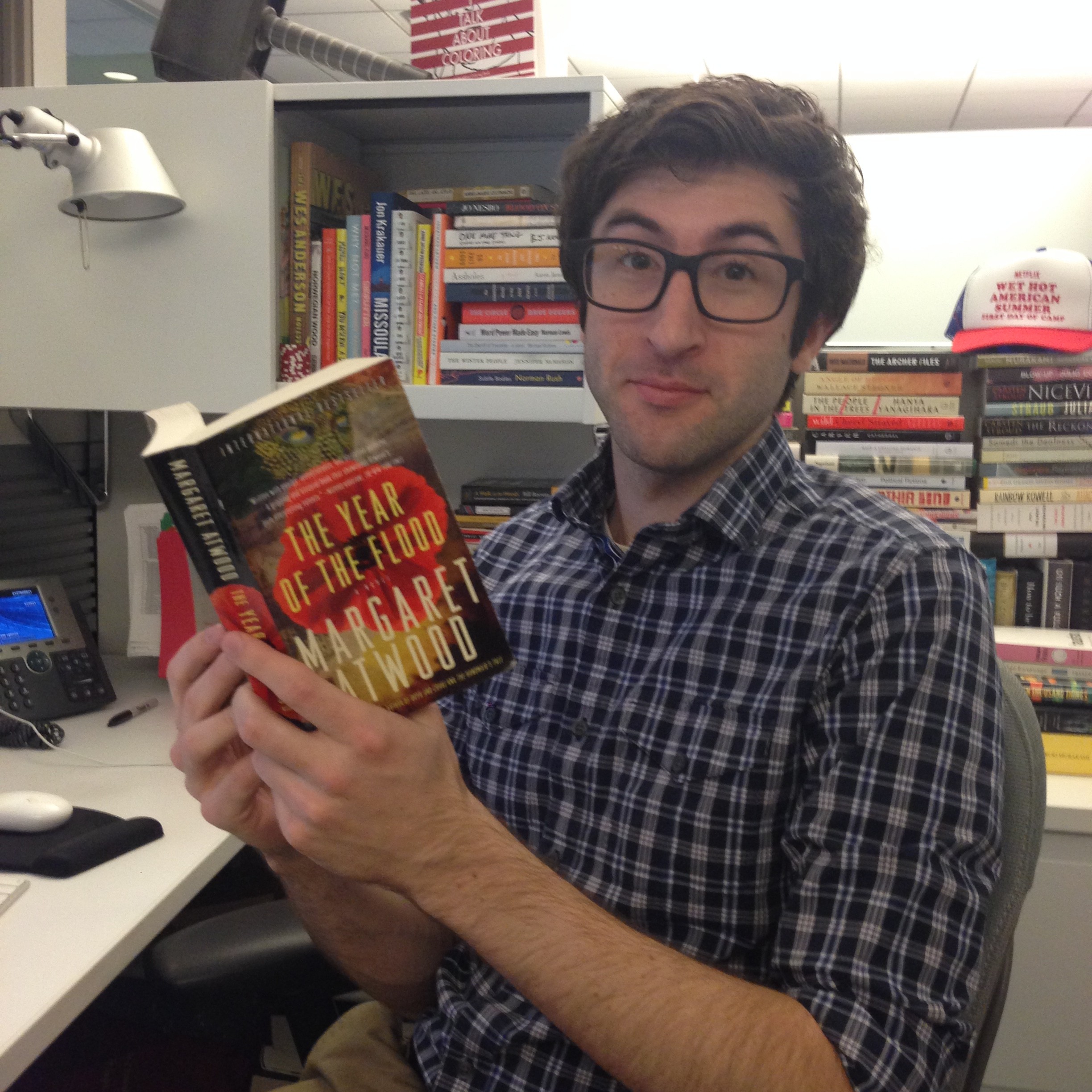
Bookspotting: Adam is reading The Year of the Flood by Margaret Atwood

Ever wonder what Penguin Random House employees are reading? We’re a bunch of professionally bookish people, so you can always count on us to have a book on hand… or thirty piled on our desks. Our Bookspotting feature shows off the range of readers behind the scenes at Penguin Random House. adam maid Adam, Social Media and Digital Publishing for Vintage and Anchor books, is reading The Year of the Flood by Margaret Atwood. Find out more about the book here:  

Deb Garrison, Senior Editor at Pantheon, on The Stargazer’s Sister by Carrie Brown

The Stargazer’s Sister, Carrie Brown’s novel based on the life of Caroline (Lina) Herschel, the sister of the great 19th century astronomer William Herschel, and a noted astronomer herself, is my third project with Carrie and the first time we’ve worked on a historical novel together. In many respects this felt different, because of Carrie’s desire to be loyal to a life about which there is much on record—Lina Herschel has been the subject of biographies, alongside her brother—and to the actual stargazing they conducted. Carrie’s acknowledgments include a professor of physics and graduate students in the field, who helped her understand the mathematics of the brother-sister duo and the skies they observed with revolutionary results. Their success was due to, among other factors, William’s single-minded passion to build a telescope bigger than seemed possible—a wonderful episode in the novel where we see how truly remarkable it is when science is in the making: there are people who think of things that no one has thought of before and find ways to carry out their vision, despite the skepticism that surrounds them. I was awed by the world Carrie made vivid to me and at the same time, a good litmus test for the casual reader who may not have any particular interest in chasing comets but who cares deeply about women’s lives. Carrie’s job was to be historically accurate but to also help us understand the wonder of who Lina was—to invent a voice for her, and to create living episodes for this budding feminist. Lina was a career woman so much before her time that it seems ludicrous to use the term; she had a vocation, and made major sacrifices for it. She also sacrificed much to be by her brother’s side, to run his household in Bath, cooking and cleaning and keeping accounts for a thriving scientific enterprise that took place quite literally in the siblings’ backyard. As Carrie shows us, Lina had an unwavering if complex loyalty to William, who saved her from a life of misery at the hands of her aging and unhappy mother in Hanover, Germany. Because Lina was scarred and her growth stunted by typhus in her youth, she was not suitable to be married off; William recognized Lina’s superior intellectual gifts, paying for the ongoing care of his mother in order to free Lina from imprisonment as her caretaker and drudge-mate forever. What ensues is that she became his own caretaker and drudge-mate, yet also the necessary enabler of his genius—one mathematically gifted enough to work out the calculations needed to record what he sees in the skies during their obsessive and sometimes bone-chilling nightly observations. In The Stargazer’s Sister, Carrie moves the reader with a grace and insight similar to that of her previous Pantheon titles, The Rope Walk, about a ten-year-old girl losing innocence and discovering adult fallibility, and The Last First Day, about the wife of a beloved prep school headmaster. Whether historical or not, her novels expose the tenderness and uncertainty of female strength as it comes into being. Her interest in the female psyche and how it develops, is revealed to its bearer, and is bodied forth in true acts in the world, hovers between the lines throughout her work. Without caring especially for what shines in the sky (though Carrie does beautifully with the vastness of heaven, its treasures suddenly near to the eye for the first time in history), a reader can be fully riveted by Lina’s story – that of a girl with a curious and potent brain becoming a woman by following her entirely unique path. I am delighted to read the excellent reviews so far for this winning novel! Learn more about the book below!