Tag Archives: novel

What Should I Read on Vacation? Penguin Random House employees share their picks

Heading to the beach in the dog-days of summer? Taking some time off to unwind and catch up on your reading? Penguin Random House employees never go on vacation without a good book – see below to learn what professional book-people read on their off-time. Kristen Fritz, Senior Director, Content Marketing, Digital Marketplace Her vacation read: The Narrow Road to the Deep North by Richard Flanagan
Guatemala
The view from my reading spot in San Marcos La Laguna, Guatemala

“As I was situated along the shore of the soothing, somewhat eerie, very magical Lake Atitlan in Guatemala for a week last spring, Richard Flanagan’s 2014 Man Booker-winning novel, The Narrow Road to the Deep North, proved to be the kind of book in which I got deeply lost while silently willing the world to stay away and let me read.”

Lindsay Jacobsen, Senior Coordinator, Consumer Engagement  Her vacation read: Is Everyone Hanging Out Without Me? (And Other Concerns)

“Sometimes you begin a book on vacation and find that the story doesn’t match your destination. The book, Is Everyone Hanging Out Without Me? (And Other Concerns) by Mindy Kaling was the perfect companion on my trip to Ocho Rios, Jamaica. Her sparkly-eyed dreams of fame and materialism seamlessly complement a self-serving Caribbean beach getaway. While hanging out with Mindy, I laughed and I cried. I read out loud to no one. I used the book as protection from the sun. I was so enthralled, I even neglected my piña colada.”

Nancy Sheppard, Vice President, Director, Advertising and Promotions, Penguin Publishing Group Her vacation read: The Magicians, by Lev Grossman The Magicians

“Here I am with the great staff at City Lit Books while on vacation in my old neighborhood, Logan Square in Chicago. I was there handselling my favorite vacation read, The Magicians by Lev Grossman, in paperback!”

  Check out all our bestsellers to find more vacation-reading inspiration!

Writing Tips from Jennifer Steil, author of The Ambassador’s Wife

We know readers tend to be writers too, so we feature writing tips from our authors. Who better to offer advice, insight, and inspiration than the authors you admire? They’ll answer several questions about their work, share their go-to techniques and more. Now, get writing!  After developing an idea, what is the first action you take when beginning to write? Usually when I sit down (or often, stand up) to write, I start by re-reading and editing the previous day’s work. That gets me back into the world of the book. Then I just carry on with the story from where I left off. I am a somewhat disorganized writer. I don’t write outlines or think too far ahead when writing a first draft. I write fast first drafts that I finish in three to ten months, and then spend a couple of years editing. I often think of scenes as puzzle pieces or quilting squares, shuffling them around until they make sense. I do, however, often write a basic timeline so I can remember when pivotal events happen and how old everyone is. But the story itself emerges only when I am actually writing. Often I have no idea where the plot is heading until it emerges from my fingers. For this reason, I am a serious rewriter. I write at least a dozen drafts of each book. Much of the structure, plotting, and pacing emerges in later drafts. I think of my first drafts as skeletons, and each successive draft as layering on muscle, veins, fat, skin, hair, etc. Until it is a fully living book. Is there something you do to get into a writing mood? Somewhere you go or something you do to get thinking? One thing I learned fairly early on is that I cannot afford to wait to be in the right mood. For me, writing needs to be a daily discipline, like exercise. I do it no matter what mood I am in. The hardest part is getting myself to the computer and shutting off the Internet. Once I open the document and start working, I am suddenly in the mood. Work inspires work. Also, when you have a small child and the various diplomatic obligations that come along with being an ambassador’s wife, you write in every unscheduled moment, whenever those moments are. Did you always want to write? How did you start your career as an author? I have kept a journal since the day I learned how to write, but I never thought of myself as a writer until graduate school. I majored in theater in college and worked for several years as an actor. But eventually I became frustrated with the limited roles available to women. I wanted to play paleontologists and astrophysicists but ended up playing ingĂ©nues and prostitutes. It got old. I began writing some of the things I wished my characters would say and decided to go back to school. After getting an MFA in fiction writing and an MS in journalism, I worked in newspapers and magazines for years before finally writing my first book. I don’t think that first book would have happened, however, had I not taken an enormous risk by moving to Yemen to take over a newspaper. From the moment I accepted that job, I think I knew I was going to have a lot to write about! What’s the best piece of advice you have received? One evening in 1992 I was sitting in a bar in Bainbridge Island, Washington with a friend who is a brilliant and prolific composer. I was going on and on about various ideas I had for short stories, and he said, “You know, there comes a time when you have to stop talking about what you are going to do and start doing it.” I went straight home that night and wrote a short story. I still think about that conversation twenty years later. It gets me into the chair (or standing in front of the computer—I often write standing up). What clichĂ©s or bad habits would you tell aspiring writers to avoid? Do you still experience them yourself? Don’t wait to feel inspired. If you’re serious about writing you should be writing every day. Treat it like any other job. Schedule time for it, even if you only have a half hour a day. Turn off the Internet. Check Twitter and Facebook after you write, not before. I indulge in this bad habit too often. I write best when I schedule specific times of day to check social media. If you need to do research online, make notes in your draft of things to look up later, when you are done writing. Don’t ever send out a first draft. While there are a few writers out there who produce genius first drafts, most of us do not. Rewrite, rewrite, and rewrite your story until you feel you have absolutely taken it as far as you can. Then get a writer you trust to edit it. Rewrite some more. Take at least a day between drafts so that you can approach your work with fresh eyes. Do you ever base characters on people you know? Why or why not? Yes. But though real people often provide the initial spark or inspiration, the characters swiftly take on a life of their own. Ultimately I don’t think any of the characters I create resemble the people who originally inspired them except in the most superficial of ways. I observe the people around me with the eyes of a journalist, noting quirks and interesting phrases. There is so much rich material just floating around. The imagination takes off from there. Read more about The Ambassador’s Wife here.

Writing Tips from Dianne Emley, author of Killing Secrets

We know readers tend to be writers too, so we feature writing tips from our authors. Who better to offer advice, insight, and inspiration than the authors you admire? They’ll answer several questions about their work, share their go-to techniques and more. Now, get writing!  Is there something you do to get into a writing mood? Somewhere you go or something you do to get thinking? In the early morning, I consume coffee, turn on my computer, plant my butt in my desk chair in my home office, and let my cats get settled into their usual spots. I quickly check email and look at the headlines on a news site to see if the world has blown up outside my bubble. If I don’t need to duck for cover, I start working. I stay off social media until noon (that’s my plan, anyway). Each of my books has its own digital journal: it’s for stream of consciousness stuff, whatever’s on my mind. I open the journal for my current book and type like mad for a few minutes. It helps me discharge anything that’s weighing on me so I can move on. Then I open my manuscript and revise the last few pages I wrote the prior day, which leads into the new day’s work. For those days when the work just isn’t happening, I make deals with myself. Write for 45 minutes and get up and do something else for 15. Write until lunchtime and then do something else. Oddly, times of personal crisis are excellent writing periods for me because what better escape is there than to immerse yourself in a good book? How would you recommend creating and getting to know your characters? I start by naming them. By going through that process, I think through their history, circumstances, and personalities. When was she born? What’s her ethnicity? What’s her birth order in the family? Was she raised in a traditional two-parent family or something else? Would her parents have selected a popular name of the era or something unique? Does she come from a modest background or is she well heeled? Does she later change her name or go by a nickname? Is her name evocative of who she is? The protagonist of my current series of suspense novels is Nan Vining. She’s rooted in tradition and family, so I named after her grandmother, Nanette. But she’s tough, so her nickname, “Nan,” is clipped and direct. I liked the surname Vining because it’s uncommon and has a lot of consonants, which for me makes a tougher sounding name than one with many vowels. Also, it evokes a vine, which is appropriate for Nan who’s tenacious and steady. Her name is a great fit for her, but I’ve changed names when a character has evolved and the name no longer works. Thank goodness for “Find and Replace.” Did you always want to write? How did you start your career as an author? I fell in love with writing and reading before I really learned how to do either one. When I was about four years old, I could write my name, with the Ns backward, and three words: yes, no, zoo. My mom was a reader and I was fascinated with her books. I’d look through the pages and pick out the few words I could read. When I got to the white area after a chapter break, I thought that space was there for me to finish the story. I’d take a crayon and have at it, writing, “yes, no, zoo,” and signing my name with backward Ns. It didn’t make my mom too happy to find me scribbling in her books. After I truly learned how to read and write, I wrote compulsively—letters, diaries, stories—but didn’t attempt to publish anything. I didn’t feel I was good enough. Many years later, I took a creative writing class at UCLA, where I started my first novel. After three years, while working fulltime at a day job, I finished that book and got it published. I’ve been writing and publishing fiction ever since. What’s the best piece of advice you have received? Finish that first draft, even if it’s a big, flawed mess. And then the next best piece of advice I’ve received comes into play: Writing is about rewriting. What are the perks and challenges of writing a come-back character? Five years passed between my last Detective Nan Vining thriller and my latest one, Killing Secrets. During that time, I wrote a standalone, The Night Visitor, and several short stories. The challenge in returning to the Nan Vining series came from reconnecting with the four earlier books and wondering whether I could still channel the writer who had created that vibrant world. I was afraid I’d somehow lost my feel for Nan, her daughter Emily, her work partner and lover Jim Kissick, and the other characters as well as the dark thread that runs through the series. My doubts disappeared when I started Killing Secrets and it felt entirely natural, as if I’d come home. It felt great to return to this familiar tableau, but also to break new ground. I’ve just signed a contract with Alibi to write the sixth and seventh in the Nan Vining series and I’m excited to see where the journey takes the characters and me. Read More about Killing Secrets here.

From the Editor’s Desk: Samuel Nicholson, editor of Book of Numbers by Joshua Cohen

Editors get very passionate about books they work on – the Editor’s Desk series is his or her place to write in-depth about what makes a certain title special. Get the real inside-scoop on how books are shaped by the people who know them best. I was 25 when the proposal for Book of Numbers first appeared in my Inbox, and it was my very first acquisition. Over the previous years, I’d edited several novels, and, like all editors, had been perpetually on the lookout for something that recreated the feeling of magic I had reading my favorite books when I was young. Alongside those professional endeavors, though, in my private life as a reader I was eager to see something that reflected and explored the experiences of people my age: the first generation to grow up with the Internet. In my mind, at least, the so-called Digital Revolution and the Internet in particular have changed our culture and society in ways that are just beginning to be understood. Of course, everyone knows how much time everyone else spends online these days, and the manner in which we do our shopping, socializing, dating, and reading. But it’s the subtle ways the Internet has changed us – the ways it infiltrates our consciousness, for good and for ill – that interest me the most.
Photo by Carolyn Meers
  I was always a little surprised that there weren’t more literary novelists taking a hard look at this phenomenon, because no medium is better suited to examining the personal, the private, the inner life than the novel. I wanted to read something that looked at life with the Internet from the bottom up – something that got into the dirty details of how the Internet affects our thoughts and behavior on a daily level (a poet once said that all art has to begin in “the foul rag and bone shop of the heart”). I distinctly remember reading the manuscript of Book of Numbers at home on my couch the night it came in. It only took me about fifteen pages before I knew: This Is It. And as I continued to read on, what started as recognition quickly turned to awe. It felt then as if Josh’s novel was updating the world – like it was pushing literary culture into the digital age, and pushing digital culture to acknowledge its debt to literature, to the human heart, to human beings. On top of that, it was funny, and exuberant, and just sheer entertainment on the highest level. That said, the work was not finished at acquisition. Indeed, Josh and I spent quite a lot of time collaborating on the novel, making sure every sentence was as close to perfect as we could get it. Every Friday afternoon, from the first week of January 2014 until the end of December, Josh and I met in an office in 1745 Broadway. We went through the entire book, covering twenty pages a week. And then we went through it again. And again. And again, and again. This time working with Josh was, without a doubt, the highlight of my career thus far. Nothing is more fun than sitting with a world-class writer (laughing and joking the whole time) and tweaking a scene, a paragraph, a word, until it’s just right. At least, that’s my idea of fun. The reception of the book has been wonderful, and I’m as proud of the book itself as I’ve been of anything, but it was those hours working together with Josh, when nobody else in the world was paying attention, that I’ll remember most. Read more about Book of Numbers here.

Editor’s Desk: Wendy McCurdy, Executive Editor at Berkley Books on A Week at the Lake by Wendy Wax

Editors get very passionate about books they work on – the Editor’s Desk series is his or her place to write in-depth about what makes a certain title special. Get the real inside-scoop on how books are shaped by the people who know them best. The friendship between women can be one of the most significant bonds we ever experience. Our female friends sustain us through the pivotal moments of our lives; they support us in times of crisis and share in our joys. They laugh and cry with us through every exhaustively recounted detail of our daily trials and tribulations. This is the territory that author Wendy Wax explores so winningly in her new novel, A Week at the Lake, which is at heart the story of friendship—the friendship between Emma, Mackenzie, and Serena. These three women met in college, and afterwards pursued their separate dreams—theatre, costume design, television–achieving varying degrees of fame and fortune. But every summer they would spend a blissful week together at a summerhouse on Lake George—a week filled with shared confidences; certainly much laughter, and possibly a few tears. week Why this wonderful tradition began to unravel and the three of them drift apart is a bit of a mystery, but when the story opens, Emma, Mackenzie, and Serena are about to get together for their first “week at the lake” in five years. Fate, of course, is about to take a hand… I will resist the impulse to give away the plot. Suffice it to say that this will be a week unlike any they have experienced in the past. Wendy Wax clearly knows from personal experience what it’s like to be part of a close-knit group of women. Over the years, I have often heard her refer to authors Karen White and Susan Crandall as her “BFFs”. I know that these three musketeers have their own annual retreat, during which they claim to get enormous amounts of writing done, fortified by pinot noir and Talenti salted caramel gelato. It’s no wonder, then, that Wendy is able to portray her three main characters in A Week at the Lake with so much insight, affection, and humor, and make us fall in love with every one of them. In the end, there may be a little of Emma, Mackenzie, and Serena in each of us. For myself, I know that the only thing my own friends and I are missing is that gorgeous summerhouse on Lake George! Read more about A Week at the Lake here.

Writing Tips from Brenda Bowen, author of Enchanted August

We know readers tend to be writers too, so twice a month, we’ll feature writing tips from our authors. Who better to offer advice, insight, and inspiration than the authors you admire? They’ll answer several questions about their work, share their go-to techniques and more. Now, get writing!  How would you recommend creating and getting to know your characters? As an editor, I always asked writers (of novels and even of picture books): “Who is this character in your head? Is he/she based on someone you know? Can you see that person doing what you have your character do?” As an author, I ask myself the same thing. Of course, all of one’s characters have a little bit of oneself in them, but I do find that having a specific image—of a friend, an acquaintance, a child, a person glimpsed on the subway—really helps me focus and be specific. Specificity is the skeleton key that unlocks the doors of good writing. When a character speaks, the language must be specific to her; she must not be able to speak any other way. When a character makes a choice of beer or shaving cream, he must own those choices; they must come from everything else I know about the character. I think hard about what a character would reach for in the fridge, and why. None of that reasoning, of course, should show on the page (unless it’s a plot point). But as a writer you need to know if it’s boxers or briefs, sports bra or push-up, for every character. You have to know where the hidden tattoos are, and the scars. After developing an idea, what is the first action you take when beginning to write? I write copy! That’s the first thing I do. I write what you would find on a jacket flap, or the back cover of a paperback. When I was an editor, and especially an assistant, writing copy was always the most enjoyable part of the job. The better written the book, the easier it is to write copy, even when the book has a challenging structure or tackles difficult ideas. I write copy to see where the story is going. Usually I can eke out a whole first “act” for a book by pretending I’m writing the flap for the finished draft. If a first act emerges and I’m interested in seeing where the story goes, I’ll give it a try as a book. Is there something you do to get into a writing mood? Somewhere you go or something you do to get thinking? While writing Enchanted August, I almost always wore headphones and played birdsong or “nature sounds.” Those soundtracks let me believe that I was in Maine. I would go to YouTube and find videos with hours of recorded sounds of the outdoors. You have to be careful not to play the same one too many times or you get to know what nuthatch is going to start calling out after which rumble of thunder, but other than that, it’s a great way (for me) to escape city sounds or household sounds or sounds at the café where I usually write. And a shout-out to that café: It’s The Hungarian Pastry Shop on Manhattan’s Upper West Side. I started going there when I first came to New York in 1981 and basically never stopped. The Pastry Shop is located just a few blocks from Columbia University, so it’s filled with people studying or reading or writing. It’s almost like a library. There’s no internet service and there are no electrical outlets, so you can only write as long as your computer charge lasts and you can’t get distracted by going online. If you go to the Pastry Shop for a visit, don’t be disappointed that the coffee isn’t great, but do order an ishler. Two hazelnut cookies filled with chocolate mousse and covered in dark chocolate. A sumptuous reward for a good afternoon’s writing. Did you always want to write? How did you start your career as an author? I never thought I wanted to write but I have been writing since I was very young. I used to write Regency romances when I was about eleven or twelve, about characters named Charles and Caroline who bore a marked resemblance to Mr. Darcy and Elizabeth Bennet. (I read Pride and Prejudice in one sitting when I was eleven years old. My mother thought I had been out at the neighbor’s all day, when actually I was upstairs reading through lunch and dinner. I came down to the kitchen in a daze and have essentially never recovered.) I began working as an editorial assistant at a publishing company right after college. I wanted nothing more than to be an editor, and I was, for many years. After a while, editors, especially of children’s books, tend to take on the writing mantle. I helped artists write their picture books. I turned out quickie celebrity bios. I wrote a couple of Pokemon chapter books. (“I choose you!”) Then in 2004 or so, I wrote two early readers under a pen name, Margaret McNamara. Too Many Valentines and 100 Days (Plus One) were set at Robin Hill School, and over ten years the stories stretched into a thirty-book series. Then, I began to write more picture books about things like pumpkins, apples, George Washington, poetry, and a heavenly library. (If you’re interested, you can find out more on my website.) Just a few years ago, I so wanted an author of mine to write a book from Tinker Bell’s point of view that I stole my own idea and wrote a six-book series called the Fairy Bell Sisters, about Tinker Bell’s little sisters, who live on an island in what many would recognize to be Maine. Their success (and I mean the fact that I finished them all, on time, and they were beautifully published) led me to be emboldened enough to write Enchanted August. Describe your writing style in five words or less. If you mean how I write in terms of process: Must. Not. Edit. While. Writing. Read more about Enchanted August here.

Challenge Your Shelf: Book Club Summer Reading Challenge

Who said reading can’t be competitive? Every few months, we’ll be challenging you to read a list of selected books. Print out the challenge and cross the titles off as you go. Show off how much you’ve read by taking a picture and tweeting @penguinrandom or Instagramming (@penguinrandomhouse) with the hashtag #challengeyourshelf. 500

Writing Tips from Patricia Park, author of Re Jane

We know readers tend to be writers too, so twice a month, we’ll feature writing tips from our authors. Who better to offer advice, insight, and inspiration than the authors you admire? They’ll answer several questions about their work, share their go-to techniques and more. Now, get writing!  How would you recommend creating and getting to know your characters? I start by keeping a “dossier” on each character: the usual basics like their age, hometown, birth order, the contents of their fridge. I snoop around—showing up at their tenth birthday parties (then their sixteenth and their fortieth). I write diary entries in their voice. Later in the process I’ll write the same scene from each character’s point of view—a tip I learned from hearing an interview with Jonathan Lethem. Is there something you do to get into a writing mood? Somewhere you go or something you do to get thinking? Running helps my writing—both require a lot of endurance. My favorite runs cross both bridges and bodies of water. I find that after a long run, I’m just too physically exhausted to be overly self-critical when I sit down to work, which then makes the writing flow more easily.
park
Patricia Park – Photo: © Allana Taranto
  Did you always want to write? How did you start your career as an author? I’ve known pretty much since I first learned to write. My first (unpublished) manuscript was called Messy Bessy—an illustrated series about an unkempt schoolgirl who grows up and has twenty kids. In elementary school I wanted to be a writer slash nun, but I was afraid the church would make me censor my writing. What’s the best piece of advice you have received? Daydream about your characters. That way, you’re still doing work on your novel even when you’re waiting for the subway, at the gym, on line at the grocery store…. What clichĂ©s or bad habits would you tell aspiring writers to avoid? Do you still experience them yourself? I try not to write about an experience until after I’ve been away from it for a few days (or years). Otherwise you gain no perspective on it because it’s so immediate. Also, you tend to sound whiny. So I’ll write down the facts of what happened immediately in my diary, but then I file them away, and later—much later—I can reflect on that experience in the context of a larger narrative. Describe your writing style in five words or less. A chocolate-covered broccoli. (Wait, what?) Read more about Re Jane here.

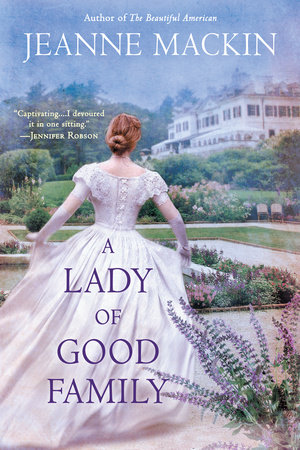
From the Editor’s Desk: Ellen Edwards, executive editor at NAL, on A Lady of Good Family by Jeanne Mackin

Editors get very passionate about books they work on – the Editor’s Desk series is his or her place to write in-depth about what makes a certain title special. Get the real inside-scoop on how books are shaped by the people who know them best. Two years ago, Jeanne Mackin had finished her first novel for NAL and was casting about for a new subject. In The Beautiful American, Jeanne had written about Vogue model/photographer Lee Miller, a lover of surreal artist Man Ray in 1930s Paris and the first woman to photograph the Nazi concentration camps after their liberation, and she was looking for another historical figure with artistic associations. One name came to my mind. I had recently visited the Bronx Botanical Gardens and spent time in the Peggy Rockefeller Rose Garden, designed by Beatrix Farrand. I’d learned that although the garden wasn’t created until the 1980s, Beatrix Farrand designed it in 1916. And somewhere I’d read that Beatrix was also a niece of Edith Wharton. Gardens and books—the combination certainly appealed to me, and I was delighted to learn that it appealed to Jeanne as well. “You know I wrote the Cornell book on herbs and flowers,” she told me. I hadn’t known, but we both felt she’d found her subject. Finding the story wasn’t nearly as easy. Jeanne called me, lamenting, “Beatrix led such a normal, responsible life. Where’s the conflict? How do I make her interesting?” I encouraged her as best I could, but Jeanne found a solution that went far beyond anything I could have imagined. Instead of writing a straightforward fictional biography, she borrowed a narrative style from Henry James, who was also a close friend of Beatrix, and created a narrator named Daisy (ring any bells?) who tells a small but crucial portion of Beatrix’s life story through the lens of her own experience. For good measure, Jeanne includes a ghost, inspired by James’s The Turn of the Screw. In fact, there is more than one ghost. And Jeanne writes a love story for the young Beatrix, despite Beatrix having been known in her early years for ignoring the strong expectation that she marry and instead pursuing a career—something that women, especially women of her class, never did. A Lady of Good Family is a beguiling narrative with echoes of novels by Wharton and James that explores relationships between mothers and daughters, husbands and wives, and art and artists during a time of great change for women. Like Willa Cather’s The Song of the Lark, it is also the story of a woman finding the courage to defy convention and follow her true passion; and of the forces that shape her as both a creative artist and as a woman. Set in Europe and New York during the Gilded Age and the early 20th century, A Lady of Good Family brings Beatrix Farrand to full and vibrant life, and proves that in the hands of a talented writer, even someone with a “normal, responsible life” can become utterly compelling. And now I have had the pleasure of visiting some of the gardens that Beatrix designed. I especially recommend Dumbarton Oaks, just outside Washington, DC. And, of course, the Peggy Rockefeller Rose Garden in our own backyard. Read more about A Lady of Good Family here.