Writing Tips from Allison Amend, author of Enchanted Islands

We know readers tend to be writers too, so we feature writing tips from our authors. Who better to offer advice, insight, and inspiration than the authors you admire? They’ll answer several questions about their work, share their go-to techniques and more. Now, get writing! 

What’s the best piece of advice you have received?

My graduate professor Frank Conroy said that we only get three exclamations points in our whole career! And I just used one. He meant, of course, that the prose itself should convey emphasis. He also stressed that habit is a writer’s best weapon. I’m still working on that one.

What clichés or bad habits would you tell aspiring writers to avoid? Do you still experience them yourself?

I am terribly guilty of what I call “three adjective syndrome” wherein I describe something with no fewer than three adjectives. Usually, that means the third adjective is the one I want, and the first two are just approximations until I get there, but I still have to go back and cull the first two adjectives from the pack. Relatedly, my first drafts have so many clichés it’s like they are going out of style (get it?). I think that’s fine for a first draft. They’re just marking places where I need to go back and think of better comparisons, so I try not to judge myself too harshly.

 Do you ever base characters off people you know? Why or why not?

 All characters and no characters are based on people I know. If fiction comes from imagination, then all people contribute to the pool from which I draw.  I like to borrow traits and sayings from everyone, but I have never attempted to reproduce on the page a person I know in real life. Even when I do “heavily borrow” from a person, quoting something he or she actually said, he/she never recognizes herself. That said, my father thinks he’s every character in my books.

What are three or four books that influenced your writing, or had a profound affect on you?

One Hundred Years of Solitude

Madame Bovary

A Visit From the Goon Squad

The Handmaid’s Tale

Learn more about the book below:

The Life of a Book: An interview with Aileen Boyle, VP, Associate Publisher, Director of Marketing and Publicity for Blue Rider Press and Plume.

We’re going deep inside the making of a book, with interviews from Penguin Random House employees in editorial, marketing, sales, and more.  If you’ve ever wondered about all the behind-the-scenes work that goes into making your favorite books, this is the series for you.   Today we’re featuring an interview with  Aileen Boyle: VP, Associate Publisher, Director of Marketing and Publicity for Blue Rider Press and Plume.  What do you think is special or unique about this book? Why will readers want to get their hands on it?

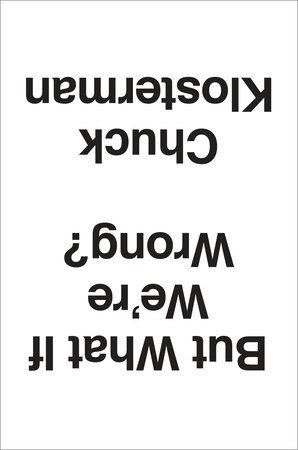
Where to start? In this particular case, the reader should feel free to judge a book by its cover: the contents may turn your worldview upside down, or at least challenge you. 

Designer Paul Sahre and art director Jason Booher hit it out of the park – this book could sit under glass at the Whitney and fit right in.  Great design is such a helpful tool for a publicist to get the media’s attention as well as to stand out in a bookstore.

Now that we’ve gotten the reader to pick the book up, what should they expect between the covers?  This is where the fun really begins. Chuck is a brilliant cultural commentator, not only in the way that he makes a point or constructs an argument, but in how he gets the reader thinking. But What If We’re Wrong? has something for everyone: literature, music, politics, science, philosophy and more. I’m not a sports person, but the chapter on football is fantastic and now I can drop that knowledge on my brother-in-law (finally).  Other readers will likewise learn a few things, without question. 

How would you describe your job and how you worked on But What If We’re Wrong? to a layman? What are some of the steps you take when you first start working on a title?

I’ll start with the end goal of my job: to have a reader discover a new book and get interested enough to buy it. 

Booksellers, media and social media influencers are my outside partners to help me reach this goal.   Booksellers have events.  The media does reviews or interviews.  Social media allows us to talk to readers or those they care about directly.  My job, alongside my brilliant team, is to pull all of these levers for a book’s publication.

When a dynamic and popular writer like Chuck pens a provocative, forward-thinking book that can be read by a wide variety of people, I’ve got a lot to work with.   I collaborated with author, publisher, editor and agent to set goals of how we wanted to reach readers and the message we wanted to convey.  We started working on this early –about nine months (or more) ago.  It’s exciting to be almost at the point of publication after all of this anticipation in-house.

Describe the book in one sentence.

A book that makes a persuasive case for the importance of doubt – sorely needed in an age where we think we know everything.

Do you have a favorite line from the book, or a section you particularly love?

While there is no material benefit to being right about a future you will not experience “there are intrinsic benefits,” Klosterman writes, “to constantly probing the possibility that our assumptions about the future might be wrong: humility and wonder.  It’s good to view reality as being beyond our understanding, because it is.  And it’s exciting to imagine the prospect of a reality that cannot be imagined, because that’s as close to pansophical omniscience as we will ever come.”

How closely do you work with the editor, art department, etc. when working on a title?

All members of our imprint work closely together.  Publicity and marketing is the midwife in a book’s birth. The book has been gestating for a while– being written, edited, designed, printed, sold in by reps etc. – but then the labor begins, in the form of a publicity tour which can be physically exhausting and maybe even painful at times.  But publicists are there at the crucial moment of publication day (a book’s birthday!) and when it’s well-received and sells lots of copies, I personally feel happy and proud by association. 

(I might be saying this because my daughter kept me up last night and Chuck and his wife just had a baby, but I think the analogy is apt!)

Read first post in this series here, and find out more about But What If We’re Wrong here: 

Congratulations to Naomi Novik! Uprooted is a Nebula Award Winner

Congratulations to Naomi Novik on winning a 2015 Nebula Award for her novel, Uprooted. The Nebula Awards recognize outstanding novels, novellas and short stories in the science fiction and fantasy genres. Novik’s novel is an absorbing and moving introduction to a strange world, held in thrall by a cold wizard known as the Dragon. His protection of a peaceful village comes at a cost – a young woman who must serve him for ten years. Learn more about the book here:

Top 3 Ways to Celebrate National Readathon Day on May 21, 2016

The countdown is on! With just one week to go, have you decided what you will read on National Readathon Day, Saturday May 21?

A fundraising and social media awareness campaign dedicated to promoting children’s literacy and reading at any age, National Readathon Day is an opportunity to join with your favorite authors and fellow readers across the country by using the hashtag #Readathon2016 to share your love of books and reading. Last year, the first-ever National Readathon Day succeeded in raising $100,000 benefiting the National Book Foundation and their efforts to support literacy and to deliver books to underserved communities. This year, all funds raised will benefit the American Library Association’s Every Child Ready to Read initiative, which promotes literacy development in children from birth to age 5 through programs in public libraries nationwide.

Here are three ways you can get involved:

1. Join the conversation In the run-up to and during Readathon Day, use the hashtag #Readathon2016 to spread the word. Tell your friends how you plan to celebrate, or challenge them to see who can read more on the big day. Visit the Readathon Share page for shareable images, videos, and Gifs, and be sure to follow the hashtag to see how other readers like you will be celebrating and supporting childhood literacy.

2. Host or attend a Readathon Day party Need an excuse to gather together with friends and family? Host a Readathon Day Party! Visit the Readathon Day reading parties page for ideas on how to host a party and be sure to share pictures and videos of your party on social media. 3. Make a commitment to support early childhood literacy Visit the National Readathon Day fundraising page to make a contribution to support ALA’s childhood literacy programs throughout the country and encourage your audience to do the same by sharing on social media. We hope you will join us in supporting National Readathon Day and childhood literacy programs nationwide. Click here for more tips on what to read for #Readathon2016 and to sign up for emails. If you have questions, would like to host a Readathon Day event, or to become more involved please email the Readathon Team at Readathon@PenguinRandomHouse.com.

Happy reading! 

The Life of a Book: An interview with Paul Sahre, Cover Designer of But What If We’re Wrong?

We’re going deep inside the making of a book, with interviews from Penguin Random House employees in editorial, marketing, sales, and more.  If you’ve ever wondered about all the behind-the-scenes work that goes into making your favorite books, this is the series for you.   Today we’re featuring an interview with Cover Designer, Paul Sahre. 

You’ve worked with Chuck Klosterman for years – how has your approach to designing his cover changed over time?

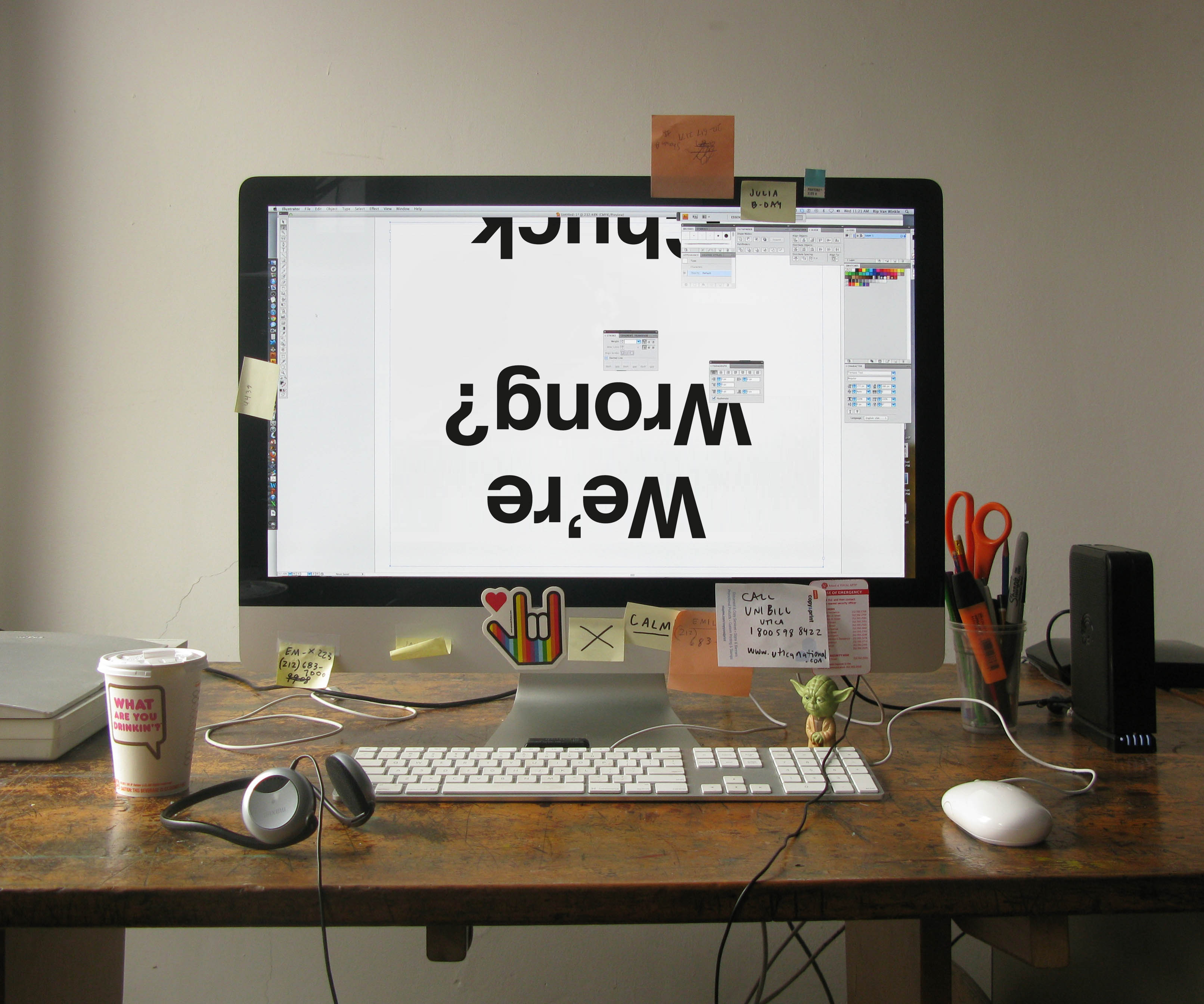
It’s remained remarkably consistent. This comes from the systematic approach I have always taken with his covers. There are a number of rules that have evolved over the years, cover to cover: starting with the typeface, HELVETICA BOLD (all caps). There is usually some structure involving the typography that either interacts with or is set apart from a conceptual image. All of the images we have created for Chucks covers are oblique is a way that I think feels right for the author.

The new cover is a departure in that there is no imagery and we went upper and lower case with the type. But then again, this book is a bit of a departure for Chuck so the cover reflects that. He is dealing with some big ideas here so there is a monumental quality to the cover design that is inverted. Yet it still feels like a Chuck cover.

What were some of your other ideas for this cover? Why did you choose to pursue this particular one?

There was a cosmic thumbs up (or down) depending on how you held the book. There was a typographic design superimposed on a photograph of the cosmos. There was a pretzel in the shape of an infinity symbol and there was a fallen over question mark. I think the best cover won out.

Do you interact with the author when planning your design?

We have never had any direct contact during the design process. His reactions/concerns are communicated through the publisher (editor and the creative director). They sort of act as a buffer, which I’ve come to view as a good thing. When designer and author get together it often ends badly.

What is your favorite part of your job? What’s the hardest?

Covers are interesting because they need to do a number of things at the same time that are sort of at cross purposes. 

On a purely functional level a jacket is there to protect the book, but I also like to think of a book cover as a door. It’s the beginning of the experience of reading. 

A book cover should be appropriate, it should feel right (in an unexpected way) but it should also create an experience of its own.

Then there is the packaging (selling) of a book. Covers help sell books, but as the designer I can’t be concerned about that when I am designing the book. This is the publisher’s job. For me this concern translates more as trying to draw people to the cover in some way. So a good cover should engage. 

Read first post in this series here, and find out more about But What If We’re Wrong here: 

TV Project Based on Bettyville to Star Shirley MacLaine and Matthew Broderick

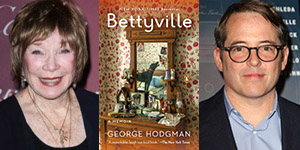
George Hodgman’s bestselling  memoir Bettyville is being developed into a dramedy series by Paramount Television. Oscar winner Shirley MacLaine and Tony winner Matthew Broderick are attached to star, it was reported by Deadline Hollywood. The adaptation is being written by John Hoffman (Looking, Grace and Frankie), who will serve as executive producer and showrunner on the potential series.  Hodgman will also executive produce, alongside Archer Gray’s Anne Carey and Amy Nauiokas (The Diary of a Teenage Girl). The project is currently being shopped to networks.  BettyvilleMovieStarsTnail Bettyville follows George Hodgman (Broderick) after he leaves Manhattan for his hometown of Paris, Missouri to care for his aging mother Betty (MacLaine). He expects to be away for only a few weeks, but life conspires to keep him there, armed with not much more than a (mostly) willing heart, a broken past to sort out, and two irascible personalities: his own, and Betty’s. The funny and heartbreaking memoir chronicles the mother-son journey, capturing truths about family, identity, and our current American landscape. Learn about the book here.  

Writing Tips from Karan Bajaj, author of The Yoga of Max’s Discontent

We know readers tend to be writers too, so we feature writing tips from our authors. Who better to offer advice, insight, and inspiration than the authors you admire? They’ll answer several questions about their work, share their go-to techniques and more. Now, get writing!  How would you recommend creating and getting to know your characters? I construct my writing on two pillars—ENTERTAINMENT and MEANING. The meaning comes from a deep, personal question I’m wrestling with and my novels help me articulate the answer to myself. That’s why I recommend creating characters that are asking your deepest questions. If you start from that foundation, you’ll know the back-story that led to the question and the journey the character has to embark on to answer the question in a very personal, visceral way. My best advice to get to know your characters is to push them from the ordinary world into the extraordinary world quickly! Their reactions to the extraordinary world will help you both unpeel the character and give the story the propulsive entertainment it needs to keep the reader glued. Did you always want to write? How did you start your career as an author? I’m an engineer-MBA and hadn’t written a single non-technical word until the age of 28! Yet my first novel was published in India at age 29. What happened in that year? I took a sabbatical from my job at Procter & Gamble and backpacked and lived in places I’d always fantasized about like Bhutan and Mongolia. Both the adventures that came from the journey and the sudden space and silence in my life compelled me to write. I wrote without a goal but ended up completing a novel that did quite well in India. Since then, I’ve constructed my life around what I call a 4/1/4 principle: -4 years of goal-directed working in a corporate environment while writing with discipline on the side. -1 year of complete slack where I travel, meditate, work in an orphanage, live in an ashram, write a little, basically do whatever I feel like without goals. -4 years of goal-directed living again. …and so on. I think this tight-slack model is allowing enough adventures to inspire new ideas while ensuring the discipline to commit them to paper. What clichĂ©s or bad habits would you tell aspiring writers to avoid? Do you still experience them yourself? I tell aspiring writers to never have a single coincidence in their story. Nothing should happen by chance or destiny to your protagonist. The moment destiny plays a role in a story, the reader senses the presence of an author writing the story and the fictive dream breaks. Indeed, I still experience it myself because I like my novels to be fast-paced and often make things “happen” to my characters in the early drafts so that the story moves along quickly. I have to weed those incidents out in the subsequent drafts to make every incident organic to the story. Let me give you an example from my new novel, The Yoga of Max’s Discontent, which is about a Wall Street banker who becomes a yogi in the Himalayas. I wrote and re-wrote the beginning thirty or forty times to make his decision to leave his job and go to the top of the Himalayas extremely authentic to his past rather than a result of a chance encounter as I’d originally written it. Describe your writing style in 5 words or less. Pacy and unpretentious yet layered. What are three or four books that influenced your writing, or had a profound affect on you? This will probably be a surprising answer but the one book that had a profound impact on me was Forrest Gump (the book not the movie). I grew up in a small town in the Himalayas in India that people rarely left. My aunt who was visiting from the US left a copy of the book by accident in our house. I remember reading the book when I was fifteen and feeling deeply transformed by the idea of a life that has no limits and a world that knows no boundaries. Soon after, I left my town for New Delhi, then moved out of India and lived in Philippines, Singapore, then Europe and the US, and have been traveling since without any permanent notion of home or a fixed sense of my own abilities and limitations. I think Forrest Gump may have something to do with it! Other than that, the books I keep re-visiting again and again and shape my writing are perennial Eastern philosophical text like The Yoga Sutras of Patanjali, Dhammapada and the Upanishads, since they always deepen me as a person and a writer no matter how many times I read them. Learn more about the book below:

The Life of a Book: An interview with Jason Booher, Art Director, Blue Rider Press and Plume

We’re going deep inside the making of a book, with interviews from Penguin Random House employees in editorial, marketing, sales, and more.  If you’ve ever wondered about all the behind-the-scenes work that goes into making your favorite books, this is the series for you.   Today we’re featuring an interview with Art Director, Jason Booher. What does an Art Director do? What would surprise a layman to know about your job?

An art director of any imprint does a number of things. But one of the most important is choosing what designer will work on each cover. In this case, Paul Sahre has always designed Chuck Klosterman’s jackets. And so the question was really, do we hire Paul to design the jacket, or do we do something else since this is Chuck’s first book with Blue Rider Press. It wasn’t a difficult decision, since Paul is one of the best book cover designers and his covers for Chuck are consistently fantastic. 

Getting good work out of someone like Paul Sahre consists of letting him do the good work. And, at some level, having him feel that if he works to make something interesting, we will go with it, even if it is a little risky. So fighting for something that is interesting or risky is part of what I do, and I knew Paul was definitely going to deliver something that is smart and bold and different. In this instance there was certainly a risk in an upside down cover, but everyone here loved and thought it was perfect.

Working with and trusting my publisher, editors, sales and marketing and gaining their trust is another huge part of my job. Like any team working towards an end, there are many pieces that are cumulative, and the jacket can be a focal point of a lot of things. So fostering an environment with my designers and pushing my design to bring things to the table that I believe in, and then working with my editorial team to massage those jackets into something even better. That’s the goal. 

As for a surprising thing someone outside of publishing might not know about my job; perhaps that I’m a reader and lover of books, and not just some art guy. Or that a graphic designer is more like an engineer or general problem solver—the end result just happens to be visual form. A design can be thought of as a set of constraints or parameters. In book design, these consist of things like the conceptual literary content of the book, what makes the book unique in the context of other similar books or all books, how the author is (or is not) known, the expectations of the book from the point of view of the author/editor/sales force/readers, the context of book jacket in the contemporary moment, the context of book jackets in the last 10 (or even 20) years, visual pop culture. Or something that is obvious and not obvious is working with type is very difficult.  And it perhaps the most specialized thing that graphic designers bring to that general problem solving into form.  

When you first start working on a book, what does that mean – what are your first steps?

There’s a combination of reading the manuscript, and listening to the editor talk about the book. As an art director, I have to dip into almost all the of the books to see what they are like before deciding to whom to give each title. As a designer (if I’m working on that title’s jacket) it’s always different with every book. But as a general process I will read the book, and think and sketch, and sketch, and reread, work though a number of ideas, throw most of them out, stay with others, reread, take a walk (much harder when you are also the art director), try to come up with something new. Those are the first steps. 

Please explain why you like the cover of But What if We’re Wrong? What did you most want it to convey? 

As soon as I saw this design, I knew it was the best solution for the jacket. Fantastic. 

The cover is simple and direct, but at the same time so “wrong.” It disrupts the expectation we have that things should be right-side up. And that’s exactly what the book questions; what do we assume to be right or decided about the world (take gravity for instance) and asks the simple question, “But…”  The package brings you immediately to that kind of query and lets you know that Chuck is going to have some serious fun with the idea. It’s quirky but bold; not a gimmicky trick as much as a statement. Perfect for the book. 

After everyone else saw it and also thought it was great, we talked about things like color and so on. But it would complicate the intent, bringing perhaps something else to muddy up the main thing. Keeping it black and white, keeping the type all the same typeface and size, moving the subtitle to the back, allows the one big move to be the clear and immediate thing that is experienced. 

You read the manuscript to figure out your approach, and on this book you collaborated with a freelancer. What is that working relationship like? Do you brainstorm together? Do you suggest concepts? 

When I work with a freelancer (as well as with my in-house designers), I like to see what they come up with without any input from me. Not only are you more likely to get something special and surprising, something you couldn’t have thought of yourself (which is why art directors work with a variety of freelancers in addition to their in-house staff), but you are sending a signal of trust. If a designer knows what “kind” of design they are expected to deliver, they might not push very far or hard. But if they take ownership of being the first arbiters of what the package of the book might be, there is more of a chance for something brilliant. I’m just trying to maximize the talent I have working with me. 

With my in house staff, it is similar but there might also be a concept that is floating that we will work with. Or occasionally I’ll work with one designer or my whole team to come up with  ideas together. That’s an exception though, and cover design is generally a sole enterprise in the initial stages. Then it becomes a collaboration when I see comps, and goes from there. 

Who approves the cover design? Who has a say in the final cover? 

It always depends. What we are really trying to make is a unique and powerful package that connects to the soul of the book. By the time we work through that process in-house, it’s hopefully the jacket that feels just right to the author and anyone else surrounding the book. 

What makes certain piece of jacket art successful in your mind?

A jacket the feels unique, that stands alone and marks the book as an individual thing that is exciting and worth experiencing always wins the day. In the sea of book covers, a clever concept is not as strong as formal innovation. The great trick is to have something that is both visually stunning or startling that has a conceptual grounding or underlying connection to the book. Something that suggests something tangible but not literal about what’s inside. The jacket But What if We’re Wrong jacket is visually dynamic and unique because it’s upside down, which is also the conceptual move that leads you right into the book.  

Check back next time for an interview with Paul Saher, the designer behind Klosterman’s cover art.

Read first post in this series here, and find out more about But What If We’re Wrong here:Â